Separating mixtures worksheet for Year 5
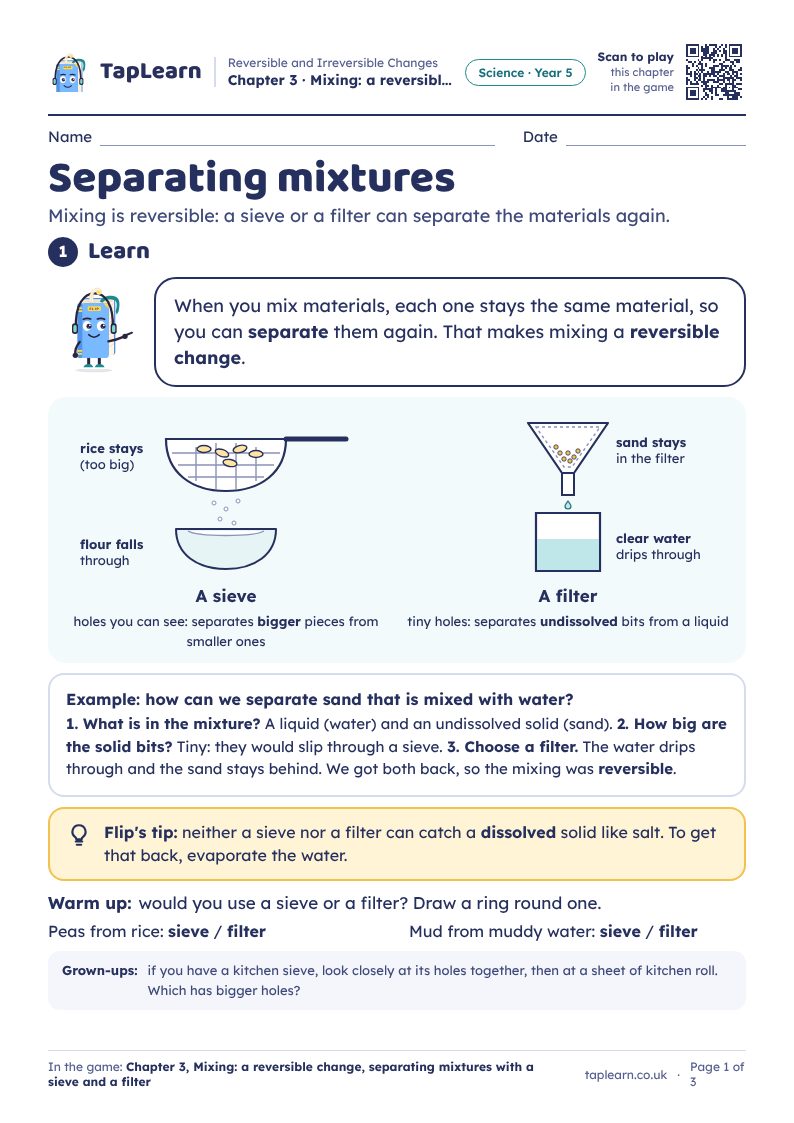
Separating Mixtures is a printable worksheet for Year 5 (ages 9 to 10) that teaches children to separate mixtures with a sieve or a filter and explain why mixing is a reversible change. It follows the Year 5 national curriculum in England for science: demonstrate that dissolving, mixing and changes of state are reversible changes.
This worksheet is for members
Membership opens every chapter of every game and every worksheet, for all your children.
See the plansAlready a member? Log in to print it.
Start with the free one: Changing state (chapter 1).
Print it on A4, in colour or black and white. Do it after the chapter, or before it to see what your child already knows.
What's on the worksheet
Children show that mixing is reversible by separating mixtures, choosing a sieve for solids of different sizes and a filter for undissolved solids in a liquid. Includes a sieve and filter activity and answers.
- Page 1 · Learn
- Side-by-side pictures show a sieve catching rice while flour falls through and a filter catching sand while water drips through, with a worked example.
- Page 2 · Try it together
- Sieve it, filter it: separate pasta from flour with a kitchen sieve, then filter muddy water through kitchen roll and compare what stays behind.
- Page 2–3 · Practise
- Choose a sieve or a filter for five mixtures, fill gaps, draw and label a filter, and explain how to get salt, sand and water back from one mixture.
- Answers sheet
- Every answer by page, notes on thinking mixtures can't be separated or mixing up sieves and filters, and ideas to try in the kitchen.
3 A4 pages and an answers sheet · about 35 minutes
In the classroom
- Set up a carousel of mixtures in trays (rice and flour, sand and water, pebbles and sand) for groups to choose and test a method.
- Use the salt, sand and water question as an extended-writing plenary.
Questions from the worksheet
- Sieve or filter? Tick the best one for each mixture: rice and flour, sand and water, pebbles and sand.
- Draw and label how you would separate sand from water.
- Sam mixes salt, sand and water. Explain the two steps he would need to get back all three materials.
- Leo says, "Once things are mixed, they can never be separated." Is he right? Use an example to explain.
The answers are on the answers sheet, for grown-ups.
National curriculum in England
This worksheet practises this statement from the Year 5 science programme of study:
- Demonstrate that dissolving, mixing and changes of state are reversible changes
Source: National curriculum in England: science programmes of study (DfE)
Using it at home
- Do the pasta and flour part over a tray: it's quick, and your child can see at once that the pasta hasn't changed.
- Pour the muddy water slowly so the kitchen roll doesn't tear, and let your child compare the water before and after.
Watch out for
- Thinking materials can't be separated once they are mixed.
- Sieve the pasta and flour again and ask: "Is the pasta any different from before we mixed it?"
- Mixing up when to use a sieve and when to use a filter.
- A sieve separates solid pieces of different sizes; a filter catches tiny undissolved bits and lets a liquid through.
Questions and answers
What is the difference between a sieve and a filter?
A sieve has holes you can see, so it separates bigger solid pieces from smaller ones. A filter has tiny holes that let a liquid through but catch undissolved solid bits, like sand.
Is mixing a reversible change?
Yes. When materials are mixed, each one stays the same material, so they can be separated again by sieving, filtering or evaporating.
More worksheets from Reversible and Irreversible Changes: Melt, Mix and Fizz
- Chapter 1: Changes of state worksheet: Changing state Free
- Chapter 2: Dissolving and evaporating worksheet: Salt comes back Members
- Chapter 4: Burning as an irreversible change worksheet: Burning makes new things Members
- Chapter 5: Vinegar and bicarbonate of soda worksheet: Fizz! A new gas Members
- Chapter 6: Reversible and irreversible changes worksheet: Reversible or not? Members
 TapLearn