Where, when and whose worksheet for Year 5
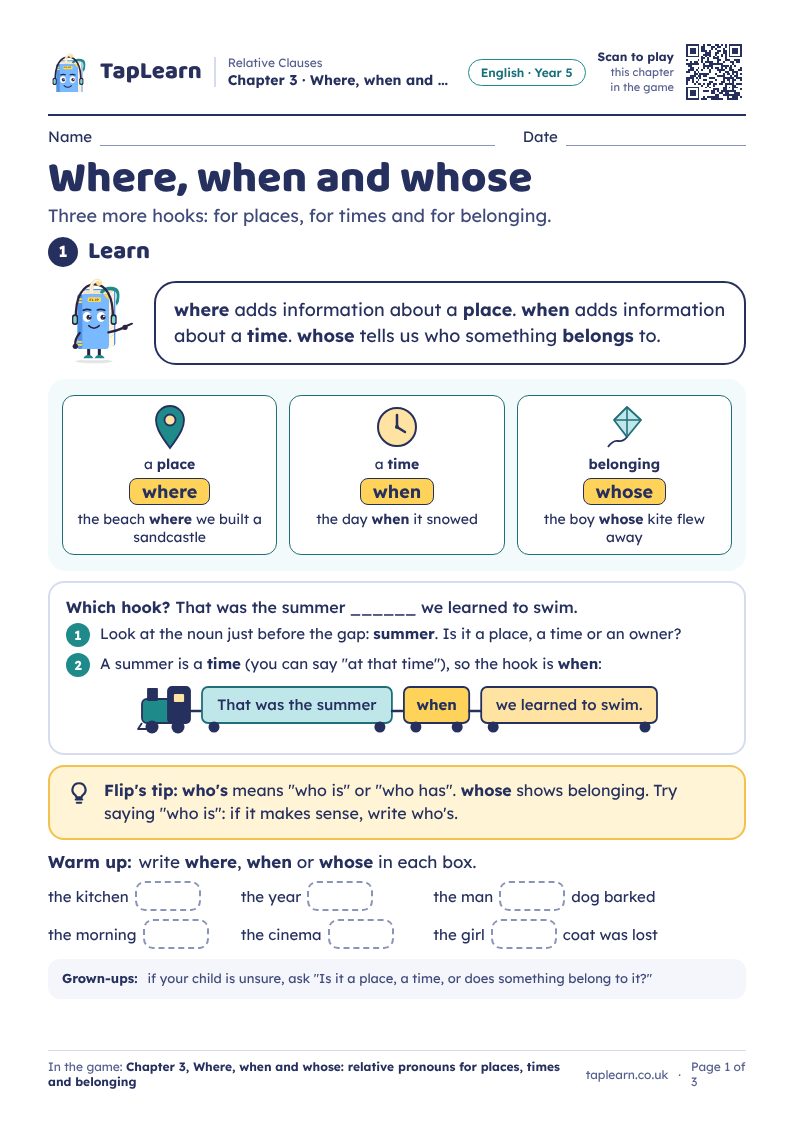
Where, When and Whose is a printable where, when and whose worksheet for Year 5 (ages 9 to 10) that teaches children to choose where for a place, when for a time and whose for belonging, and to tell whose from who's. It covers the Year 5 grammar statement on relative clauses beginning with who, which, where, when, whose, that, or an omitted relative pronoun.
Free to print, no account needed.
Print it on A4, in colour or black and white. Do it after the chapter, or before it to see what your child already knows.
What's on the worksheet
Your child uses where for places, when for times and whose for belonging in relative clauses, and tells whose from who's. Includes a home tour activity and an answers sheet.
- Page 1 · Learn
- Where, when and whose with examples, a worked example choosing when for a summer, Flip's tip on whose and who's, and a fill-the-box warm-up.
- Page 2 · Try it together
- Home tour: walk round your home or look out of a window, and describe two places with where, two special times with when and two things with whose.
- Page 3 · Practise
- Fill gaps with where, when or whose, fix wrong words, choose whose or who's, write three relative clauses about your school, and a challenge about "the moment where".
- Answers sheet
- Every answer, mix-ups like where for a time, and on-a-walk and whose-is-it ideas.
3 A4 pages and an answers sheet · about 30 minutes
Using it at home
- If your child is unsure, ask "Is it a place, a time, or does something belong to it?"
- For whose, check who the owner is: "the man whose dog barked" is about the man, and the dog is his.
- On a walk, take turns describing what you pass: "the shop where we buy bread".
Watch out for
- Using where for a time, like "the night where...".
- A night is a time, so use when.
- Using when for a place, like "the museum when...".
- Try "in that place": if it fits, use where.
- Mixing up whose and who's.
- Say "who is" or "who has" in the gap. If it makes sense, write who's; if not, whose.
Questions from the worksheet
- Fill each gap with where, when or whose: This is the house ___ I was born. I met a man ___ dog could catch a frisbee.
- Spot the mistake. Cross out the wrong word: I remember the night where the storm began.
- whose or who's? ___ coming to the party on Saturday? The singer ___ voice we loved won the prize.
- Ava says: "You can use where for anything, like 'the moment where I scored'." Is she right? Explain, and write the phrase the right way.
The answers are on the answers sheet, for grown-ups.
National curriculum in England
This worksheet practises these statements from the Years 5–6 english programme of study:
- Develop their understanding of the concepts set out in English appendix 2 by: using relative clauses beginning with who, which, where, when, whose, that or with an implied (ie omitted) relative pronoun
- Sentence: relative clauses beginning with who, which, where, when, whose, that, or an omitted relative pronoun (Year 5 english)
In the classroom
- Use the warm-up as a quick sort on mini whiteboards: place, time or belonging?
- Ask pupils to write three relative clauses about the school and share them with a partner.
Questions and answers
When do you use where, when and whose?
Use where for places, when for times and whose for belonging: the beach where we played, the day when it snowed, the boy whose kite flew away.
What is the difference between whose and who's?
Whose shows belonging. Who's means "who is" or "who has". If "who is" makes sense, write who's.
Can you say "the moment where"?
In writing, no. A moment is a time, so use when: the moment when I scored.
More worksheets from Relative Clauses: All Aboard the Relative Railway
- Chapter 1: Relative clauses worksheet: Spotting relative clauses Free
- Chapter 2: Who, which or that worksheet: Who, which or that? Free
- Chapter 4: Omitted relative pronouns worksheet: The hidden hook Free
- Chapter 5: Parenthesis with relative clauses worksheet: Commas, brackets, dashes Free
- Chapter 6: Grammar terms worksheet: Grammar word bank Free
 TapLearn