Relative clauses worksheet for Year 5: Spotting relative clauses
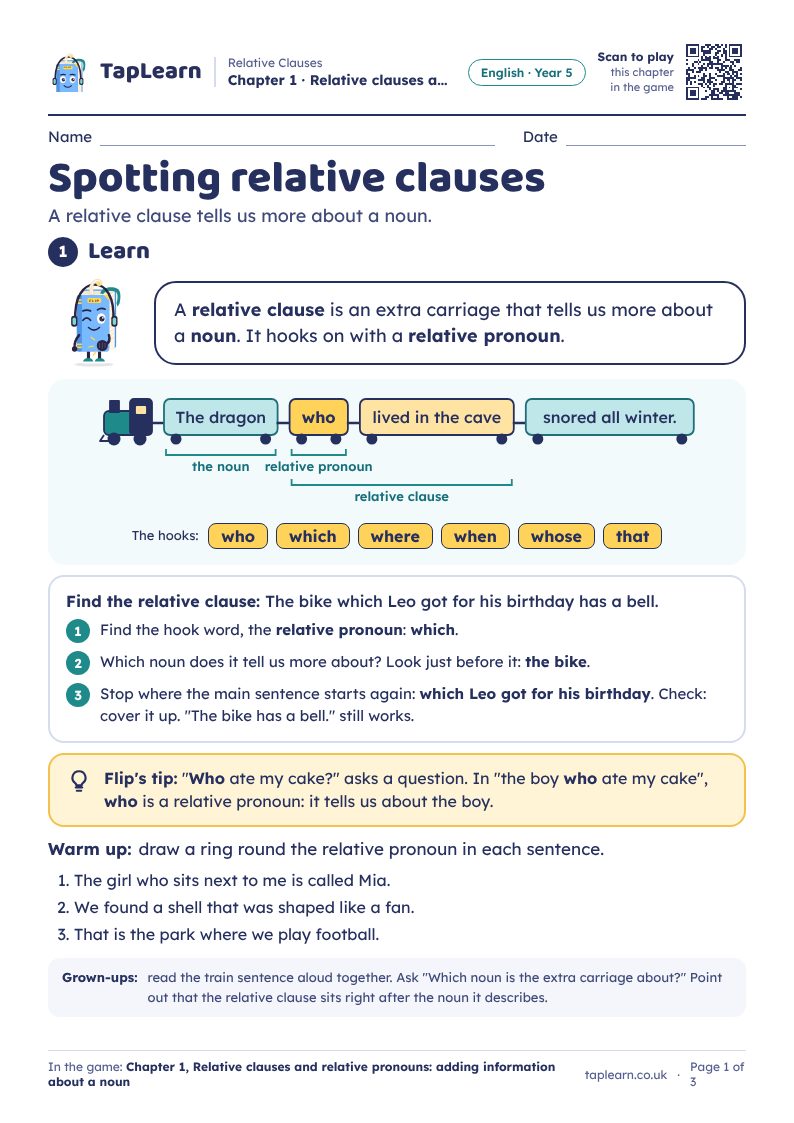
Spotting Relative Clauses is a printable relative clauses worksheet for Year 5 (ages 9 to 10) that teaches children to find the relative pronoun, the noun it describes and where the clause stops, so the sentence still works without it. It covers the Year 5 grammar statement on relative clauses beginning with who, which, where, when, whose, that, or an omitted relative pronoun.
Free to print, no account needed.
Print it on A4, in colour or black and white. Do it after the chapter, or before it to see what your child already knows.
What's on the worksheet
Your child spots relative clauses and their relative pronouns, finds the noun each clause describes, and hooks new clauses onto nouns. Includes a relative clause hunt in a book and an answers sheet.
- Page 1 · Learn
- A sentence train with a relative clause carriage, the six relative pronouns, a worked example finding the clause about Leo's bike, Flip's tip on question words, and a warm-up.
- Page 2 · Try it together
- Relative clause hunt: each choose a page of a book, hunt for who, which, where, when, whose and that, check each tells you more about a noun, then hook on a clause of your own.
- Page 3 · Practise
- Underline relative clauses and arrow them to their nouns, tick whether words are relative pronouns, finish relative clauses, write one about an animal, and a challenge.
- Answers sheet
- Every answer, mix-ups like linking to the wrong noun, and grow-a-sentence and hook-hunt ideas.
3 A4 pages and an answers sheet · about 30 minutes
Using it at home
- Read the train sentence aloud together and ask "Which noun is the extra carriage about?"
- In the hunt, if your child picks out too many words, ask "Where does the main sentence start again?" The relative clause stops before it does.
- Say "The cat sat." and take turns hooking on a relative clause to grow the sentence.
Watch out for
- Mixing up question words with relative pronouns.
- "Who ate my cake?" has no relative clause. Ask: "Is it asking something, or telling us more about a noun?"
- Linking the clause to the wrong noun.
- A relative clause usually describes the noun just before it.
- Taking too many words.
- Cover the chosen words and read what is left. It should still be a sentence.
Questions from the worksheet
- Underline the relative clause. Then draw an arrow from it to the noun it describes: The man who fixed our roof had a very long ladder.
- Is the word who a relative pronoun? Who left the gate open? The boy who left the gate open said sorry.
- Hook on a carriage. Finish the relative clause: We went back to the beach where...
- Leo says the relative clause in "The girl who won the race is my sister." is "who won the race is my sister". Is he right? Explain how you know.
The answers are on the answers sheet, for grown-ups.
National curriculum in England
This worksheet practises these statements from the Years 5–6 english programme of study:
- Develop their understanding of the concepts set out in English appendix 2 by: using relative clauses beginning with who, which, where, when, whose, that or with an implied (ie omitted) relative pronoun
- Sentence: relative clauses beginning with who, which, where, when, whose, that, or an omitted relative pronoun (Year 5 english)
- Terminology: modal verb, relative pronoun, relative clause, parenthesis, bracket, dash, cohesion, ambiguity (Year 5 english)
In the classroom
- Project a page from a class novel and hunt for relative clauses together.
- Use Practise B as a show-me check: relative pronoun, yes or no?
Questions and answers
What is a relative clause?
A relative clause is a group of words that tells us more about a noun. It starts with a relative pronoun, like "the dragon who lived in the cave".
What are the relative pronouns?
The relative pronouns are who, which, where, when, whose and that.
How do you find a relative clause?
Find the relative pronoun, look at the noun just before it, and stop where the main sentence starts again. Cover the clause: the sentence should still work.
More worksheets from Relative Clauses: All Aboard the Relative Railway
- Chapter 2: Who, which or that worksheet: Who, which or that? Free
- Chapter 3: Where, when and whose worksheet Free
- Chapter 4: Omitted relative pronouns worksheet: The hidden hook Free
- Chapter 5: Parenthesis with relative clauses worksheet: Commas, brackets, dashes Free
- Chapter 6: Grammar terms worksheet: Grammar word bank Free
 TapLearn