Omitted relative pronouns worksheet for Year 5: The hidden hook
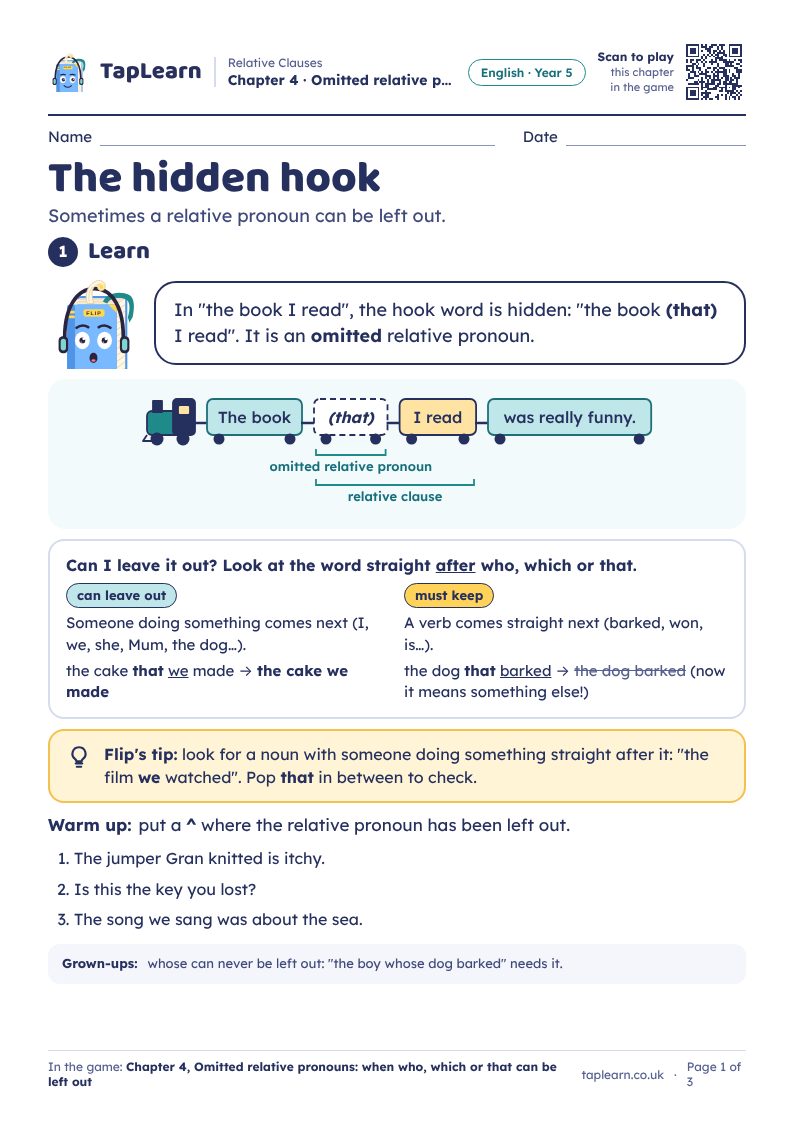
The Hidden Hook is a printable omitted relative pronouns worksheet for Year 5 (ages 9 to 10) that teaches children to spot a hidden that, as in "the book I read", and to keep the pronoun when a verb comes straight after it. It covers the Year 5 grammar statement on relative clauses beginning with who, which, where, when, whose, that, or an omitted relative pronoun.
Free to print, no account needed.
Print it on A4, in colour or black and white. Do it after the chapter, or before it to see what your child already knows.
What's on the worksheet
Your child spots relative clauses where who, which or that has been left out, as in "the book I read", and learns when it can and can't be left out. Includes a fold-it-out-of-sight activity and an answers sheet.
- Page 1 · Learn
- "The book (that) I read" with the hidden hook shown, a table of when you can leave it out and when you must keep it, Flip's tip to pop that in to check, and a warm-up.
- Page 2 · Try it together
- Fold it out of sight: copy phrases like "the cake that we made" and "the dog that barked" onto paper strips, fold that out of sight, and sort them into can-hide and must-keep piles.
- Page 3 · Practise
- Mark where the pronoun has been left out, tick whether it could be left out, fix sentences missing a needed pronoun, rewrite sentences without one, and a challenge.
- Answers sheet
- Every answer, mix-ups like dropping a needed pronoun, and say-it-both-ways and hidden-hook-hunt ideas.
3 A4 pages and an answers sheet · about 30 minutes
Using it at home
- Whose can never be left out: "the boy whose dog barked" needs it.
- In the folding activity, read "the dog barked" aloud and ask: "Is that a phrase about a dog, or a whole sentence now?"
- Spot phrases like "the toy you wanted" in stories or adverts and pop in that to check.
Watch out for
- Dropping a needed pronoun, like "the girl won the race is my sister".
- Read it aloud: it sounds like two sentences squashed together. Put who back in.
- Missing the hidden hook, like in "the key you lost".
- Try popping that in: if it fits, there is a relative clause.
Questions from the worksheet
- Each sentence has an omitted relative pronoun. Put a ^ where it goes and write that, which or who above it: The pizza we ordered was cold.
- Could the relative pronoun be left out? Tick yes or no: The film that we watched was scary. The girl who sang the song is my cousin.
- Fix it. The relative pronoun was left out, but it is needed: The girl won the race is my sister.
- Rewrite the sentence without the relative pronoun: The sandwich that I made was huge.
- Mia says: "You can always leave out who, which or that." Is she right? Use an example to explain.
The answers are on the answers sheet, for grown-ups.
National curriculum in England
This worksheet practises these statements from the Years 5–6 english programme of study:
- Develop their understanding of the concepts set out in English appendix 2 by: using relative clauses beginning with who, which, where, when, whose, that or with an implied (ie omitted) relative pronoun
- Sentence: relative clauses beginning with who, which, where, when, whose, that, or an omitted relative pronoun (Year 5 english)
- Terminology: modal verb, relative pronoun, relative clause, parenthesis, bracket, dash, cohesion, ambiguity (Year 5 english)
In the classroom
- Run fold it out of sight as a group sort with phrase strips.
- Say phrases both ways as a starter: "the cake that we made", "the cake we made", then "the dog that barked".
Questions and answers
What is an omitted relative pronoun?
It is a relative pronoun that has been left out, like the hidden that in "the book I read" (the book that I read).
When can you leave out who, which or that?
You can leave it out when someone doing something comes next, as in "the film we watched". Keep it when a verb comes straight after it, as in "the dog that barked".
Can whose be left out?
No. Whose can never be left out: "the boy whose dog barked" needs it.
More worksheets from Relative Clauses: All Aboard the Relative Railway
- Chapter 1: Relative clauses worksheet: Spotting relative clauses Free
- Chapter 2: Who, which or that worksheet: Who, which or that? Free
- Chapter 3: Where, when and whose worksheet Free
- Chapter 5: Parenthesis with relative clauses worksheet: Commas, brackets, dashes Free
- Chapter 6: Grammar terms worksheet: Grammar word bank Free
 TapLearn