Grammar terms worksheet for Year 5: Grammar word bank
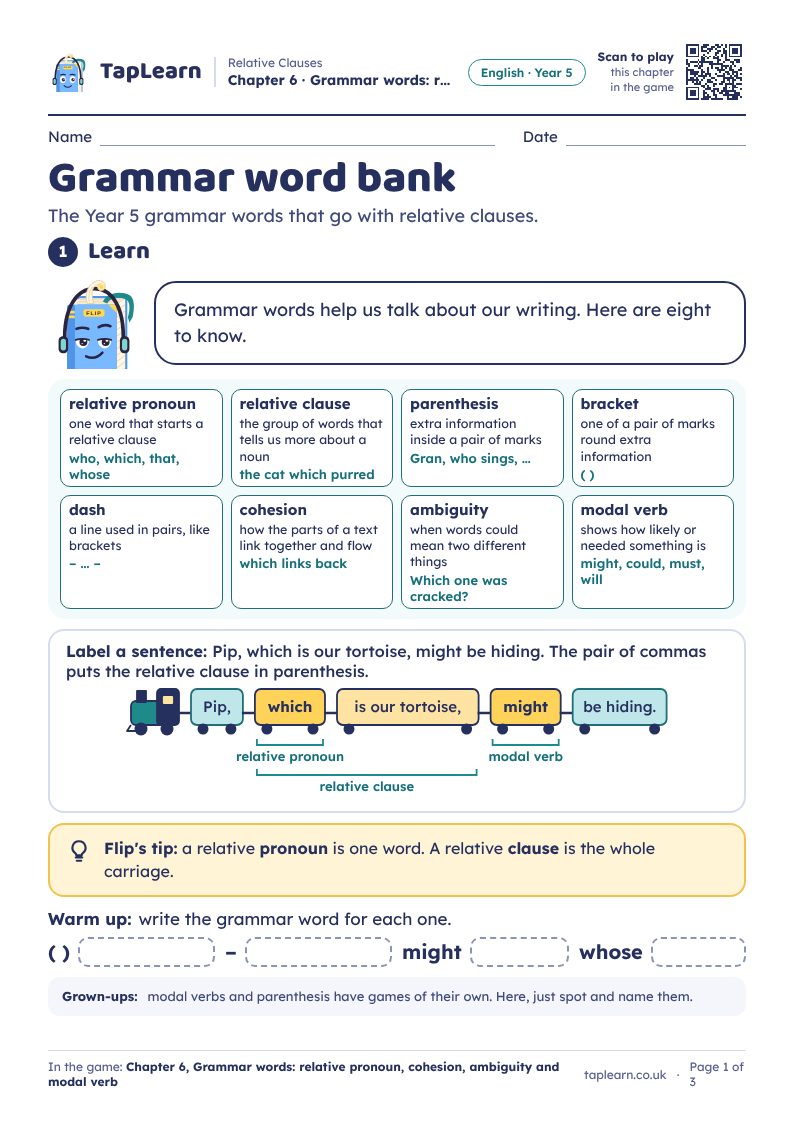
Grammar Word Bank is a printable grammar terms worksheet for Year 5 (ages 9 to 10) that teaches children eight grammar words with examples, from relative pronoun to ambiguity, and how a relative clause placed after its noun avoids confusion. It covers the Year 5 terminology: relative pronoun, relative clause, parenthesis, bracket, dash, cohesion, ambiguity and modal verb.
Free to print, no account needed.
Print it on A4, in colour or black and white. Do it after the chapter, or before it to see what your child already knows.
What's on the worksheet
Your child uses the Year 5 grammar words relative pronoun, relative clause, parenthesis, bracket, dash, cohesion, ambiguity and modal verb. Includes a grammar word card game and an answers sheet.
- Page 1 · Learn
- A word bank of eight grammar words with examples, a labelled sentence about Pip the tortoise, Flip's tip on pronoun and clause, and a name-the-grammar-word warm-up.
- Page 2 · Try it together
- Grammar word cards: write each word from the word bank on a scrap of paper, take turns turning one over and give a real example, or find one in a book.
- Page 3 · Practise
- Label a lighthouse sentence, ring pronoun or clause, rewrite ambiguous sentences, join sentences with relative clauses for cohesion, and a challenge about cohesion and ambiguity.
- Answers sheet
- Every answer, mix-ups like pronoun and clause, and silly-sentences and modal-hunt ideas.
3 A4 pages and an answers sheet · about 30 minutes
Using it at home
- Modal verbs and parenthesis have games of their own. On this sheet, your child just needs to spot and name them.
- Ambiguity is the trickiest word. Try "I saw a dog in my pyjamas." Who was wearing the pyjamas?
- Invent silly ambiguous sentences together, like "I fed the cat in my slippers", and fix them.
Watch out for
- Mixing up a relative pronoun and a relative clause.
- The pronoun is one word (which); the clause is the whole group of words it starts.
- Mixing up cohesion and ambiguity.
- Cohesion: "Does it all link up?" Ambiguity: "Could it mean two things?"
- Putting a relative clause far from its noun.
- Keep it right after its noun, or the meaning can become unclear.
Questions from the worksheet
- Read the sentence: The lighthouse, which stands on the cliff, could be seen for miles. Label the relative pronoun, the relative clause, the marks for parenthesis and the modal verb.
- Ambiguity: rewrite so it has only one meaning: Leo put the cup on the table which was cracked. (Show that the cup was cracked.)
- Cohesion: join the two sentences into one with a relative clause: We visited a castle. The castle had a moat.
- Sam says: "Cohesion and ambiguity mean the same thing." Is he right? Explain the difference in your own words.
The answers are on the answers sheet, for grown-ups.
National curriculum in England
This worksheet practises these statements from the Years 5–6 english programme of study:
- Develop their understanding of the concepts set out in English appendix 2 by: using relative clauses beginning with who, which, where, when, whose, that or with an implied (ie omitted) relative pronoun
- Terminology: modal verb, relative pronoun, relative clause, parenthesis, bracket, dash, cohesion, ambiguity (Year 5 english)
In the classroom
- Play grammar word cards in small groups as a revision starter.
- Listen for modal verbs like might, could, must and will in a class discussion and collect them.
Questions and answers
What is the difference between a relative pronoun and a relative clause?
A relative pronoun is one word, like which. A relative clause is the whole group of words it starts, like "which purred".
What is cohesion in writing?
Cohesion is how the parts of a text link together so it flows, such as joining sentences with a relative clause.
What is ambiguity in writing?
Ambiguity is when words could mean two different things, so the reader isn't sure which is meant.
More worksheets from Relative Clauses: All Aboard the Relative Railway
- Chapter 1: Relative clauses worksheet: Spotting relative clauses Free
- Chapter 2: Who, which or that worksheet: Who, which or that? Free
- Chapter 3: Where, when and whose worksheet Free
- Chapter 4: Omitted relative pronouns worksheet: The hidden hook Free
- Chapter 5: Parenthesis with relative clauses worksheet: Commas, brackets, dashes Free
 TapLearn