Parenthesis with relative clauses worksheet for Year 5: Commas, brackets, dashes
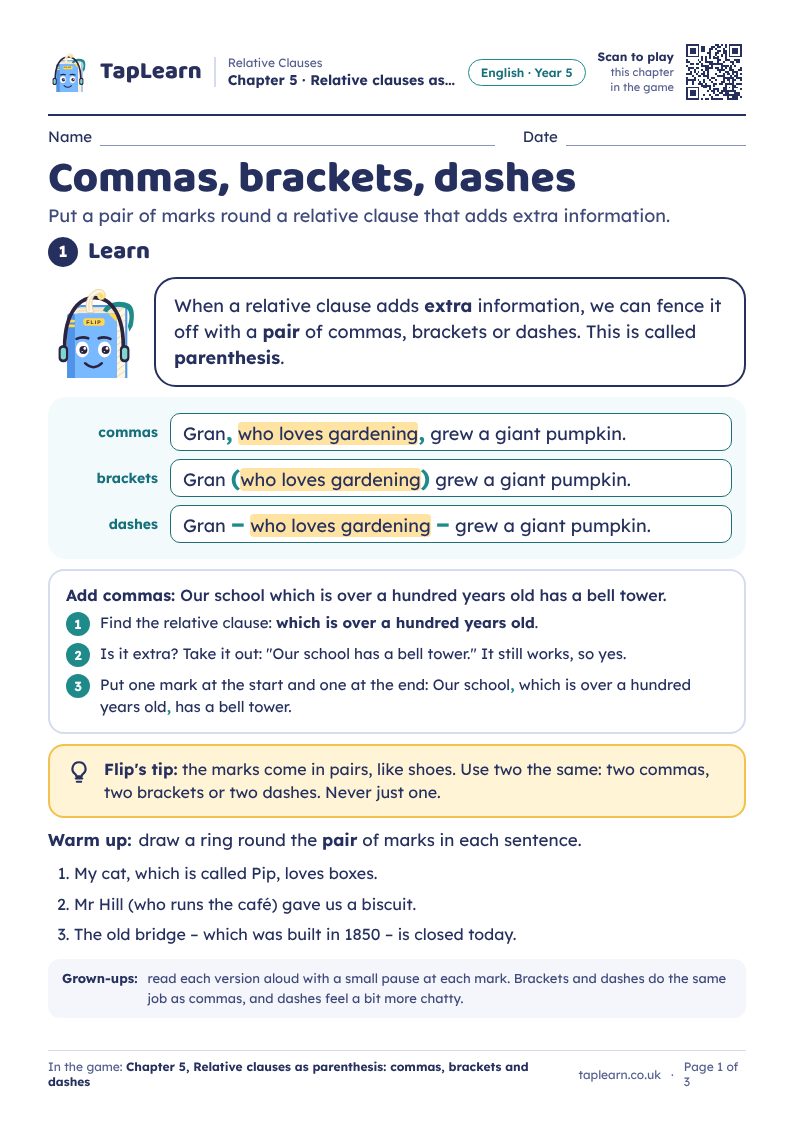
Commas, Brackets, Dashes is a printable parenthesis with relative clauses worksheet for Year 5 (ages 9 to 10) that teaches children to fence off extra information with a pair of commas, brackets or dashes, as in "Gran, who loves gardening, grew a giant pumpkin". It covers the Year 5 terminology: relative pronoun, relative clause, parenthesis, bracket, dash, cohesion, ambiguity and modal verb.
Free to print, no account needed.
Print it on A4, in colour or black and white. Do it after the chapter, or before it to see what your child already knows.
What's on the worksheet
Your child punctuates relative clauses as parenthesis with a pair of commas, brackets or dashes, and fixes single or misplaced marks. Includes a family facts activity and an answers sheet.
- Page 1 · Learn
- One sentence written with commas, brackets and dashes, a worked example adding commas round a relative clause, Flip's tip that the marks come in pairs, and a ring-the-pair warm-up.
- Page 2 · Try it together
- Family facts, three ways: the grown-up says a sentence about someone you know, the child adds an extra fact with who, and you write it with commas, brackets and dashes.
- Page 3 · Practise
- Add missing pairs of commas, tick or fix the marks, write a sentence with brackets and dashes, add your own parenthesis about a giraffe, and a challenge about one comma.
- Answers sheet
- Every answer, mix-ups like using only one mark, and air-marks and whisper-the-brackets ideas.
3 A4 pages and an answers sheet · about 30 minutes
Using it at home
- Read each version aloud with a small pause at each mark. Brackets and dashes do the same job as commas, and dashes feel a bit more chatty.
- Check the marks go right round the extra fact, with the first one just after the person's name.
- Say a sentence with extra information and your child draws the pair of marks in the air in the right places.
Watch out for
- Using only one mark.
- Ask: "Where does the extra part start, and where does it stop?" Each end needs a mark.
- Putting the marks in the wrong place, like "Leo who, plays...".
- The first mark goes just before who or which.
Questions from the worksheet
- Add the missing pair of commas round each relative clause: Leo who is six can swim a whole length. The Moon which travels round the Earth has no air.
- Tick the box if the sentence is right. If it is wrong, fix the marks: Leo who, plays the drums, is very loud.
- Write this sentence two more ways, once with brackets and once with dashes: Sam, who was very hungry, ate three sandwiches.
- Add your own relative clause as parenthesis: The giraffe ___ ate the leaves at the top of the tree.
- Ava wrote: "Mum, who loves running ran a marathon." She says one comma is fine because the sentence is short. Is she right?
The answers are on the answers sheet, for grown-ups.
National curriculum in England
This worksheet practises these statements from the Years 5–6 english programme of study:
- Develop their understanding of the concepts set out in English appendix 2 by: using relative clauses beginning with who, which, where, when, whose, that or with an implied (ie omitted) relative pronoun
- Terminology: modal verb, relative pronoun, relative clause, parenthesis, bracket, dash, cohesion, ambiguity (Year 5 english)
In the classroom
- Display one sentence with commas, brackets and dashes and discuss how each feels when read aloud.
- Use Practise B as a pairs editing task, fixing the marks on each sentence.
Questions and answers
What is parenthesis?
Parenthesis is extra information added to a sentence inside a pair of commas, brackets or dashes. The sentence still makes sense without it.
Can a relative clause be in parenthesis?
Yes. A relative clause that adds extra information can be fenced off: "Gran, who loves gardening, grew a giant pumpkin."
Do you need two commas for parenthesis?
Yes. The marks come in pairs, one at the start and one at the end of the extra information.
More worksheets from Relative Clauses: All Aboard the Relative Railway
- Chapter 1: Relative clauses worksheet: Spotting relative clauses Free
- Chapter 2: Who, which or that worksheet: Who, which or that? Free
- Chapter 3: Where, when and whose worksheet Free
- Chapter 4: Omitted relative pronouns worksheet: The hidden hook Free
- Chapter 6: Grammar terms worksheet: Grammar word bank Free
 TapLearn