More and fewer worksheet for Reception: Match and compare
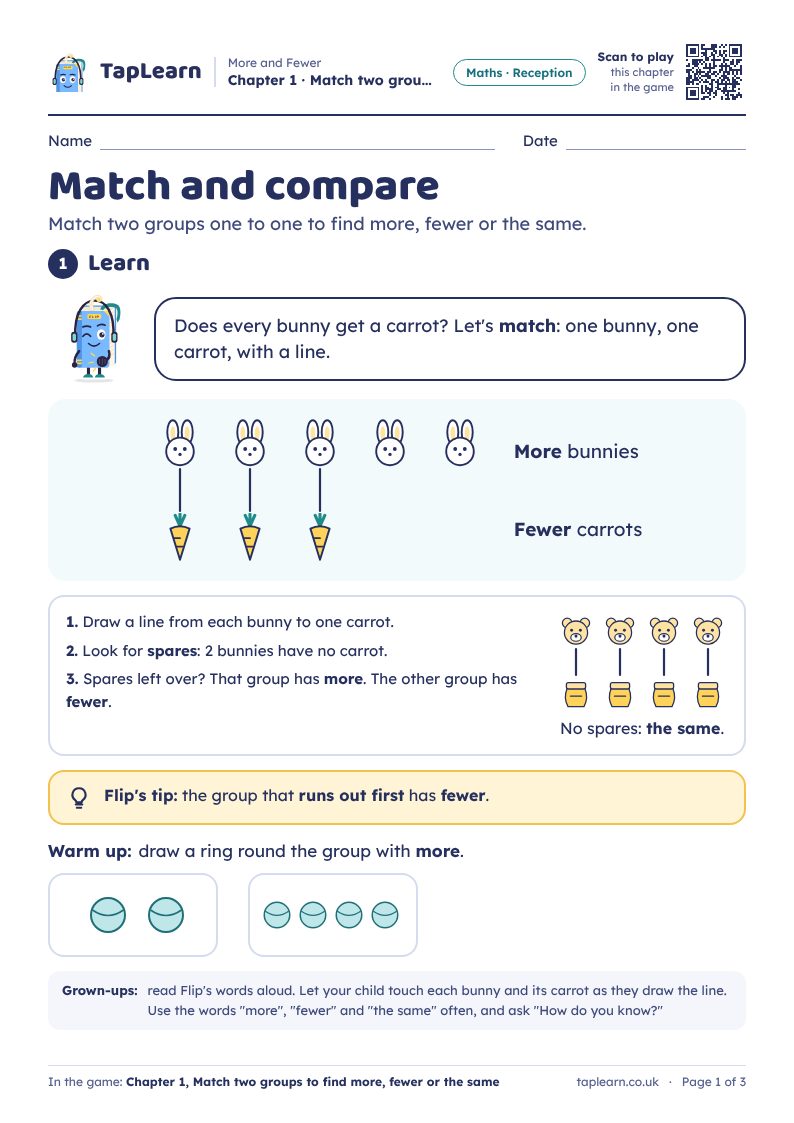
Match and Compare is a printable more and fewer worksheet for Reception (ages 4 to 5) that teaches children to draw a line from each thing to one partner and look for spares: the group with spares has more. It covers the Reception (EYFS) maths goal to compare quantities up to 10 in different contexts, recognising when one is greater than, less than or the same as the other.
Free to print, no account needed.
Print it on A4, in colour or black and white. Do it after the chapter, or before it to see what your child already knows.
What's on the worksheet
Your child matches two groups one to one and uses the spares to say which has more, fewer or the same. Includes a teddy tea party activity and an answers sheet.
- Page 1 · Learn
- Bunnies matched to carrots with lines, showing more bunnies and fewer carrots, the steps for finding spares, Flip's tip that the group that runs out first has fewer, and a warm-up.
- Page 2 · Try it together
- Teddy tea party: sit some soft toys in a row, give each one cup, look for spare cups or toys with no cup, then ring which group has more or "same" and play again.
- Page 3 · Practise
- Match groups with lines and ring the one with more, tick same or not the same, ring the group with fewer, draw one carrot for each bunny, and a challenge about apples and cups.
- Answers sheet
- Every answer, mix-ups like saying "the same" when there are spares, and snack-time and shoes-and-socks ideas.
3 A4 pages and an answers sheet · about 20 minutes
In the classroom
- Run the teddy tea party in small groups with toys and cups.
- Line up two groups of children and pair them up to see which group has spares.
Questions from the worksheet
- Draw lines to match one to one. Draw a ring round the group with more.
- Match. Is there one for each? Tick same or not the same.
- Leo has 5 apples and 4 cups. He says, "They are the same!" Is he right? How can you check?
The answers are on the answers sheet, for grown-ups.
National curriculum in England
This worksheet practises this statement from the Reception maths programme of study:
- Compare quantities up to 10 in different contexts, recognising when one quantity is greater than, less than or the same as the other quantity
Using it at home
- Let your child touch each bunny and its carrot as they draw the line, and ask "How do you know?"
- In the teddy tea party, try one go with the same number of each, so your child hears "no spares, the same".
- Match each shoe to a sock: more shoes, more socks, or the same?
Watch out for
- Mixing up "more" and "fewer".
- Point to the spares: "These have no partner, so this group has more. That group ran out first, so it has fewer."
- Saying "the same" when there are spares.
- Ask your child to touch each line, then look for anything without a line. Same means no spares at all.
Questions and answers
How do you teach more and fewer in Reception?
Match two groups one to one. If one group has spares left over, it has more, and the other group has fewer.
What does fewer mean?
Fewer means not as many. The group that runs out first when you match has fewer.
How do children know two groups are the same?
When every thing has exactly one partner and there are no spares, the groups are the same.
 TapLearn