Comparing groups worksheet for Reception: Spread out or close?
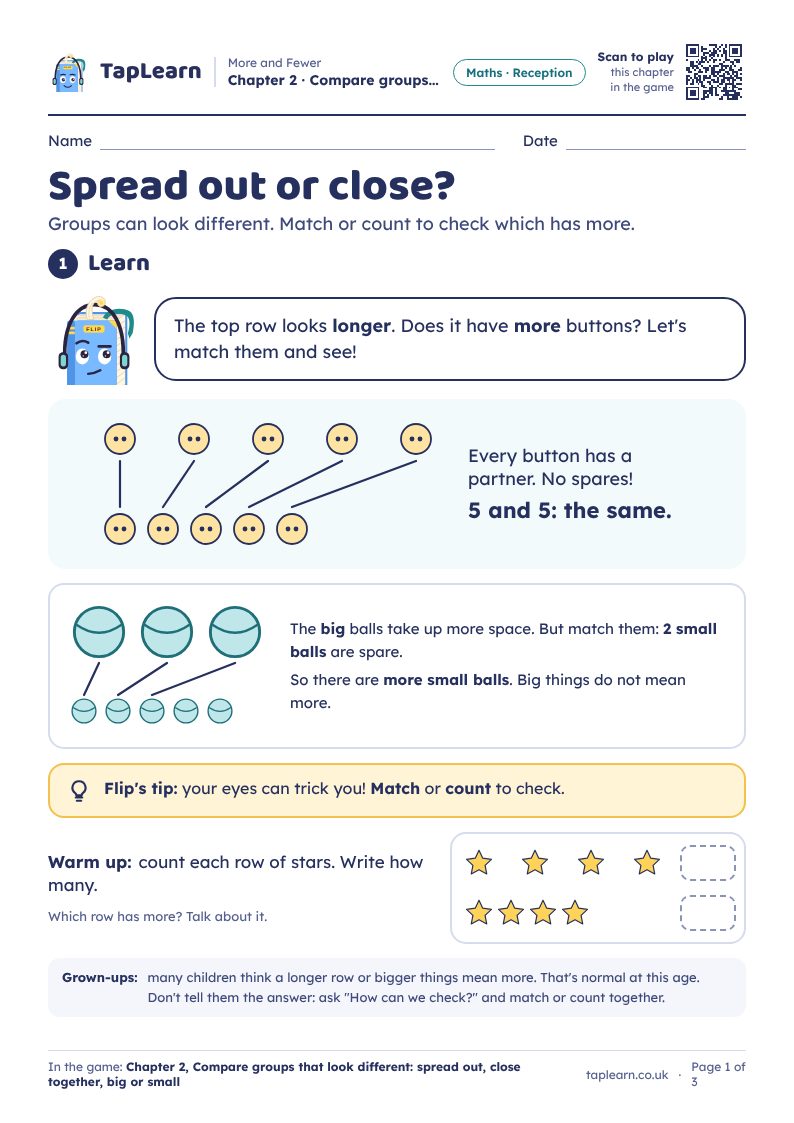
Spread Out or Close? is a printable comparing groups worksheet for Reception (ages 4 to 5) that teaches children that a longer row or bigger things don't always mean more, and to match or count to check. It covers the Reception (EYFS) maths goal to compare quantities up to 10 in different contexts, recognising when one is greater than, less than or the same as the other.
This worksheet is for members
Membership opens every chapter of every game and every worksheet, for all your children.
See the plansAlready a member? Log in to print it.
Start with the free one: Match and compare (chapter 1).
Print it on A4, in colour or black and white. Do it after the chapter, or before it to see what your child already knows.
What's on the worksheet
Your child compares groups that look different (spread out or close together, big or small) and checks by matching or counting. Includes a spread-it-out activity and an answers sheet.
- Page 1 · Learn
- A spread-out row of 5 buttons matched to a close row of 5, big balls compared with more small balls, Flip's tip that your eyes can trick you, and a count-the-stars warm-up.
- Page 2 · Try it together
- Spread it out!: make two matching rows of 5 pasta shapes, spread one out and say which has more, push them back to check, then compare 3 big things with 5 small things.
- Page 3 · Practise
- Match or count rows and ring the one with more, compare big and small groups, ring the group with fewer, draw 3 big and 3 tiny balls, and a challenge about a longer row of fish.
- Answers sheet
- Every answer, mix-ups like picking the longer row, and button-trick and big-and-small ideas.
3 A4 pages and an answers sheet · about 20 minutes
In the classroom
- Demonstrate the button trick on the carpet: spread one row and ask the class to vote, then check.
- Compare big and small objects in a tray and ask children to prove which group has more.
Questions from the worksheet
- Match or count. Draw a ring round the row with more. If they are the same, tick same.
- Big or small? Draw a ring round the group with more. If they are the same, tick same.
- Mia says, "The top row has more fish, because it is longer." Is she right? How do you know?
The answers are on the answers sheet, for grown-ups.
National curriculum in England
This worksheet practises this statement from the Reception maths programme of study:
- Compare quantities up to 10 in different contexts, recognising when one quantity is greater than, less than or the same as the other quantity
Using it at home
- Many children think a longer row or bigger things mean more. Don't give the answer: ask "How can we check?"
- After spreading a row out, ask "Did we add any? Did we take any away?" Moving things doesn't change how many.
- Put 3 big teddies next to 5 small toy cars and ask which group has more.
Watch out for
- Picking the longer row.
- Push the spread-out row back together, or match the rows with lines. Ask "Did we add any?"
- Picking the bigger things.
- Say "Big things take up more space, but how many are there?" Then count both groups.
Questions and answers
Does a longer row mean more?
No. A row can look longer because it is spread out. Match or count both rows to check.
Do bigger things mean more?
No. Big things take up more space, but there may be fewer of them. Count or match to find out.
Does moving things change how many there are?
No. Spreading things out or pushing them together doesn't add or take any away.
 TapLearn