More, fewer or the same worksheet for Reception: Make a group
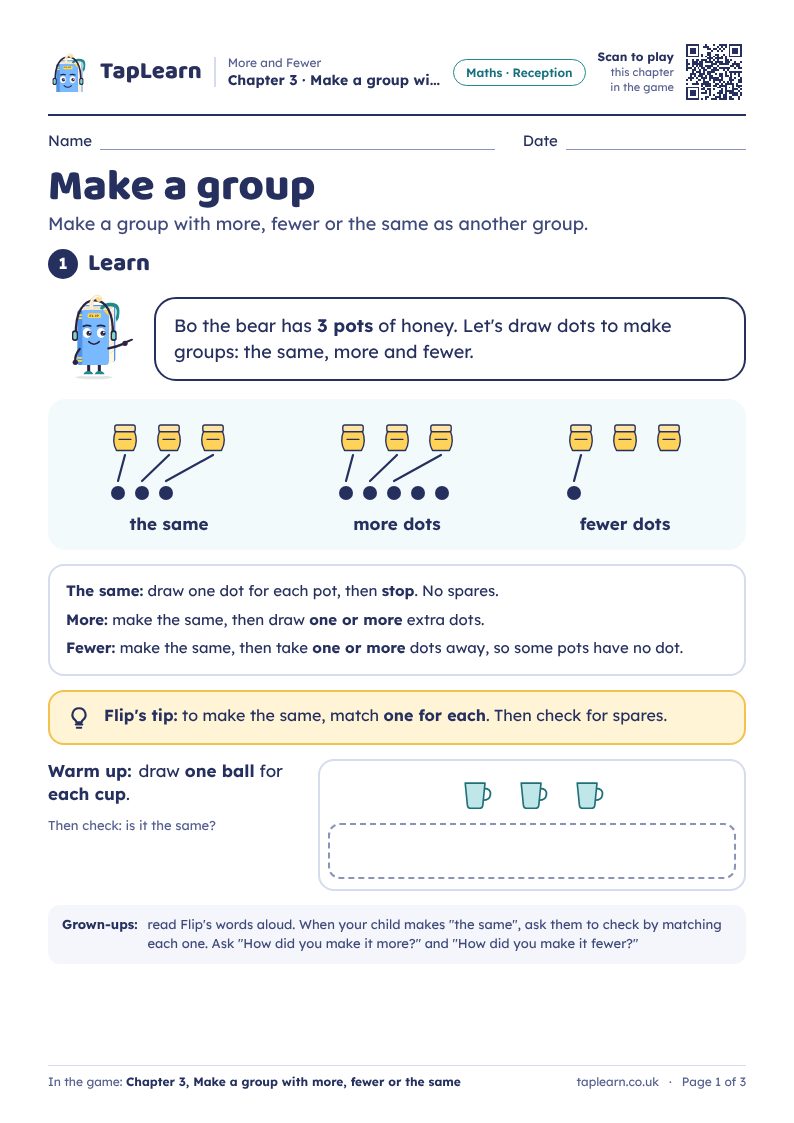
Make a Group is a printable more, fewer or the same worksheet for Reception (ages 4 to 5) that teaches children to make the same by matching one for each, then add extras for more or take some away for fewer. It covers the Reception (EYFS) maths goal to compare quantities up to 10 in different contexts, recognising when one is greater than, less than or the same as the other.
This worksheet is for members
Membership opens every chapter of every game and every worksheet, for all your children.
See the plansAlready a member? Log in to print it.
Start with the free one: Match and compare (chapter 1).
Print it on A4, in colour or black and white. Do it after the chapter, or before it to see what your child already knows.
What's on the worksheet
Your child makes a group with the same as, more than or fewer than another group by drawing and matching. Includes a lay-the-table activity and an answers sheet.
- Page 1 · Learn
- Bo the bear's 3 pots of honey with dots drawn to make the same, more and fewer, Flip's tip to match one for each and check for spares, and a one-ball-for-each-cup warm-up.
- Page 2 · Try it together
- Lay the table: put out some plates, put one spoon on each to make the same, then change the spoons so there are more spoons, then fewer, and draw or write how many.
- Page 3 · Practise
- Draw the same number of dots, draw more balls than cups and fewer stars than fish, make groups the same by crossing out or drawing, and a challenge about carrots and bunnies.
- Answers sheet
- Every answer, mix-ups like one too many for the same, and spoons-and-forks and bath-toys ideas.
3 A4 pages and an answers sheet · about 20 minutes
In the classroom
- Play lay the table in the role-play area with plates and cutlery.
- Give pairs a set of cubes: one builds a group, the other makes the same, then more, then fewer.
Questions from the worksheet
- Draw more balls than cups.
- Draw fewer stars than fish.
- Make them the same. Cross out the spares, or draw the ones that are missing.
- Sam needs the same number of carrots as bunnies. Is it the same? What should Sam do?
The answers are on the answers sheet, for grown-ups.
National curriculum in England
This worksheet practises this statement from the Reception maths programme of study:
- Compare quantities up to 10 in different contexts, recognising when one quantity is greater than, less than or the same as the other quantity
Using it at home
- When your child makes "the same", ask them to check by matching each one, then ask how they made it more or fewer.
- In lay the table, watch for one spoon too many or too few, and check every plate has exactly one spoon.
- Line up some bath toys: "Make a group with more ducks than boats."
Watch out for
- Mixing up "more" and "fewer".
- Before drawing, ask "Will you need extra, or not enough to go round?" More has spares; fewer runs out.
- Making one too many or one too few for "the same".
- Draw each dot right under its partner, then check every one has exactly one partner.
Questions and answers
How do you make a group that is the same?
Match one for each, then stop. If every thing has one partner and there are no spares, it's the same.
How do you make a group with more?
Make the same first, then add one or more extra, so there are spares.
How do you make a group with fewer?
Make the same first, then take one or more away, so some don't have a partner.
 TapLearn