Comparing numbers to 10 worksheet for Reception: Which number is more?
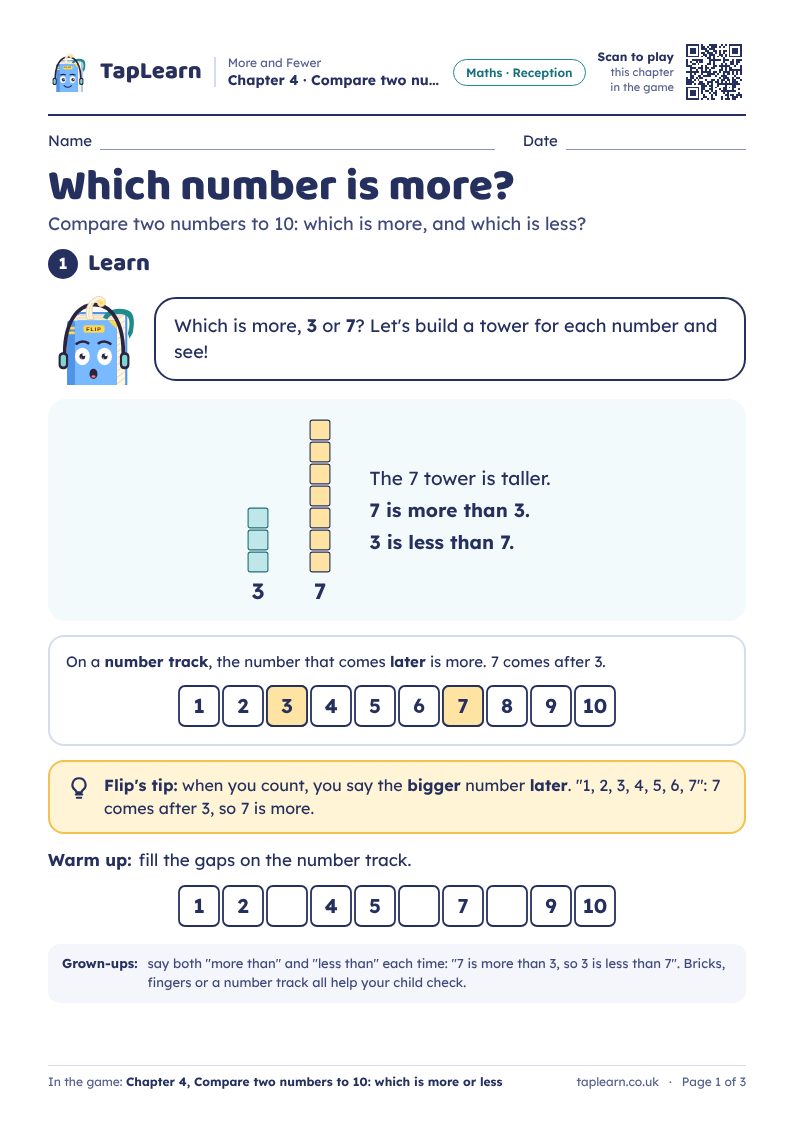
Which Number Is More? is a printable comparing numbers to 10 worksheet for Reception (ages 4 to 5) that teaches children to build towers or use a number track to see that the number that comes later is more. It covers the Reception (EYFS) maths goals to compare quantities up to 10 and to compare numbers.
This worksheet is for members
Membership opens every chapter of every game and every worksheet, for all your children.
See the plansAlready a member? Log in to print it.
Start with the free one: Match and compare (chapter 1).
Print it on A4, in colour or black and white. Do it after the chapter, or before it to see what your child already knows.
What's on the worksheet
Your child compares two numbers to 10 with towers and a number track, and says which is more or less. Includes a number towers activity and an answers sheet.
- Page 1 · Learn
- Towers of 3 and 7 showing 7 is more than 3, a number track from 1 to 10, Flip's tip that the bigger number is said later when counting, and a fill-the-track warm-up.
- Page 2 · Try it together
- Number towers: each pick a number from 1 to 10, say which is more, build a tower of bricks for each to check, then write both numbers and ring the one that is more.
- Page 3 · Practise
- Count cubes and ring the bigger number, ring the number that is more or less using the track, ring the bigger number even when it's written small, write numbers, and a challenge.
- Answers sheet
- Every answer, mix-ups like thinking big writing means more, and card-towers and finger-compare ideas.
3 A4 pages and an answers sheet · about 20 minutes
Using it at home
- Say both "more than" and "less than" each time: "7 is more than 3, so 3 is less than 7".
- In number towers, if you both pick the same number, build the towers: they are the same height.
- Each hold up some fingers and ask who is showing more and who is showing less.
Watch out for
- Picking the smaller number for "more".
- Build towers for both numbers and ask "Which tower is taller?"
- Thinking big writing means more.
- Say "The size of the writing doesn't matter. What number is it?" Then find both on the track.
- Mixing up "more" and "less".
- Say both: "7 is more than 4, and 4 is less than 7."
Questions from the worksheet
- Count the cubes. Write each number. Draw a ring round the number that is more.
- Careful! Big writing does not mean more. Ring the number that is more.
- Write a number: more than 6, less than 3, the same as 5.
- Sam says, "4 is more than 7." Is he right? Use towers, your fingers or the number track to check.
The answers are on the answers sheet, for grown-ups.
National curriculum in England
This worksheet practises these statements from the Reception maths programme of study:
- Compare quantities up to 10 in different contexts, recognising when one quantity is greater than, less than or the same as the other quantity
- Compare numbers
In the classroom
- Play number towers in pairs with number cards and cubes.
- Use a large number track on the floor and have children stand on two numbers to compare.
Questions and answers
How do you compare two numbers to 10?
Build a tower for each number, or find them on a number track. The taller tower, or the number that comes later, is more.
What does less than mean?
Less than means a smaller amount. 3 is less than 7, because a tower of 3 is shorter than a tower of 7.
Does a number written bigger mean more?
No. The size of the writing doesn't matter, only the number itself.
 TapLearn