What are micro-organisms worksheet for Year 6: Tiny but alive
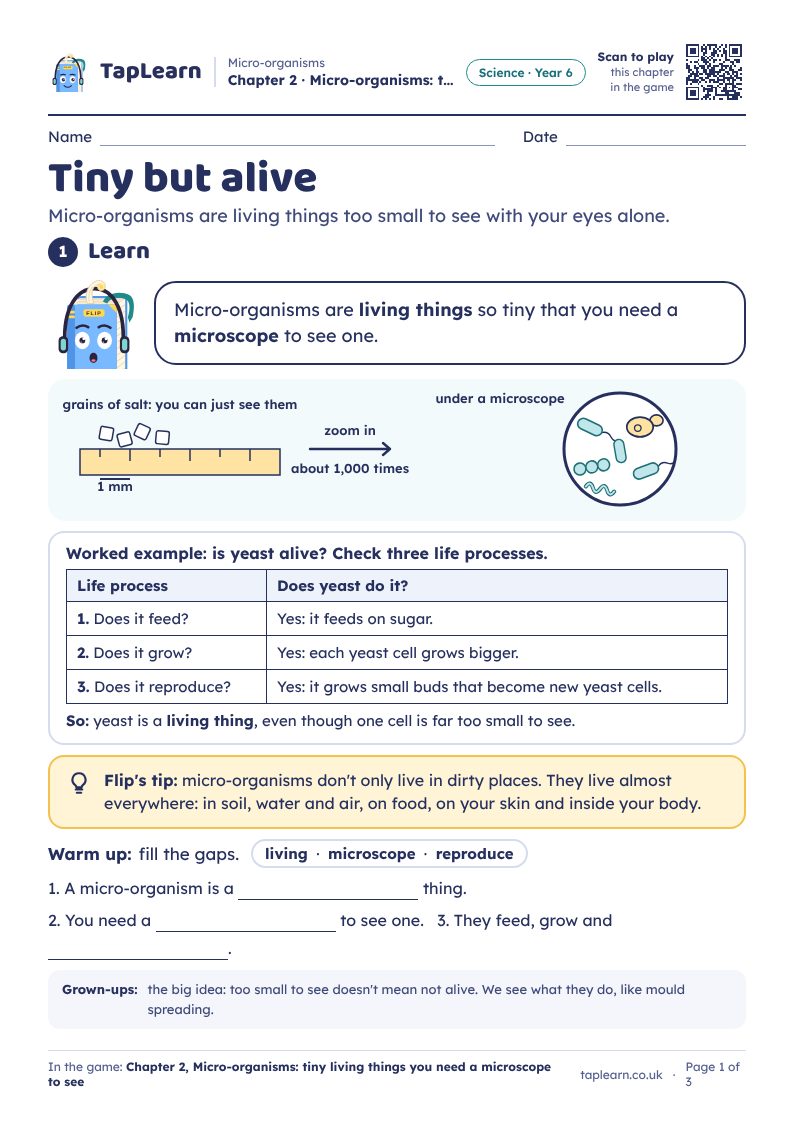
Tiny but Alive is a printable worksheet on what micro-organisms are for Year 6 (ages 10 to 11) that teaches children they are living things, too small to see without a microscope, that feed, grow and reproduce. It supports the Year 6 national curriculum in England: describe how living things are classified into broad groups according to common observable characteristics, including micro-organisms, plants and animals.
This worksheet is for members
Membership opens every chapter of every game and every worksheet, for all your children.
See the plansAlready a member? Log in to print it.
Start with the free one: Three big groups (chapter 1).
Print it on A4, in colour or black and white. Do it after the chapter, or before it to see what your child already knows.
What's on the worksheet
Children learn that micro-organisms are tiny living things you need a microscope to see, that they feed, grow and reproduce, and that they live almost everywhere. With a salt-grain measuring activity and an answers sheet.
- Page 1 · Learn
- A picture zooms from grains of salt to a microscope view, a worked example checks whether yeast is alive, and a warm-up fills the gaps.
- Page 2 · Try it together
- How small is small? Line up grains of salt or sugar along a ruler, count how many fit in 1 mm and work out the size of one grain.
- Pages 2–3 · Practise
- Ring where micro-organisms live, match clues to life processes, explain a mouldy-bread diary, and ring the living things in a list.
- Answers sheet
- Every answer by page, what to watch out for (not alive because too small, only in dirty places) and ideas to go further.
3 A4 pages and an answers sheet · about 30 minutes
Using it at home
- The salt activity takes about 10 minutes and needs a ruler with millimetres. Let your child do the counting and the dividing.
- Ask "How could we tell it's alive if we can't see it?" and talk about what micro-organisms do, like mould spreading.
Watch out for
- Thinking micro-organisms aren't alive because they are too small to see.
- Use the yeast table on page 1: it feeds, grows and reproduces, just like other living things.
- Thinking micro-organisms only live in dirty places.
- Explain that they live almost everywhere: in soil, water and air, on clean surfaces and inside our bodies.
- Thinking you can see a single micro-organism without a microscope.
- A patch of mould is millions of tiny cells. One alone is far too small to see.
Questions from the worksheet
- Ring every place where micro-organisms can live: soil, pond water, the air, your skin, inside your gut, a clean plate, a mouldy orange.
- Sam sealed bread in a clear bag. On day 1 there was no mould; by day 7 there were large, fuzzy patches. What does this show about micro-organisms?
- Why can't you see the bacteria on your hands, even though they are there?
- Leo says, "Micro-organisms can't be alive, because they're too small to see." Is he right? Explain.
The answers are on the answers sheet, for grown-ups.
National curriculum in England
This worksheet practises this statement from the Year 6 science programme of study:
- Describe how living things are classified into broad groups according to common observable characteristics and based on similarities and differences, including micro-organisms, plants and animals
Source: National curriculum in England: science programmes of study (DfE)
In the classroom
- Use the mouldy-bread diary as a discussion starter, then the Challenge about Leo as an exit question.
Questions and answers
What is a micro-organism?
A micro-organism is a living thing so small you need a microscope to see one. Bacteria, yeasts and moulds are micro-organisms.
Are micro-organisms living things?
Yes. Micro-organisms feed, grow and reproduce, like other living things, even though one alone is far too small to see.
Where do micro-organisms live?
Micro-organisms live almost everywhere: in soil, water and air, on food and surfaces, on our skin and inside our bodies.
More worksheets from Micro-organisms: A Microscope Adventure in the Tiny Life Lab
- Chapter 1: Classifying living things worksheet: Three big groups Free
- Chapter 3: Bacteria and fungi worksheet: Bacteria, yeasts and moulds Members
- Chapter 4: Classification keys worksheet: Using a key Members
- Chapter 5: Helpful micro-organisms worksheet Members
- Chapter 6: Harmful micro-organisms worksheet Members
 TapLearn