Harmful micro-organisms worksheet for Year 6
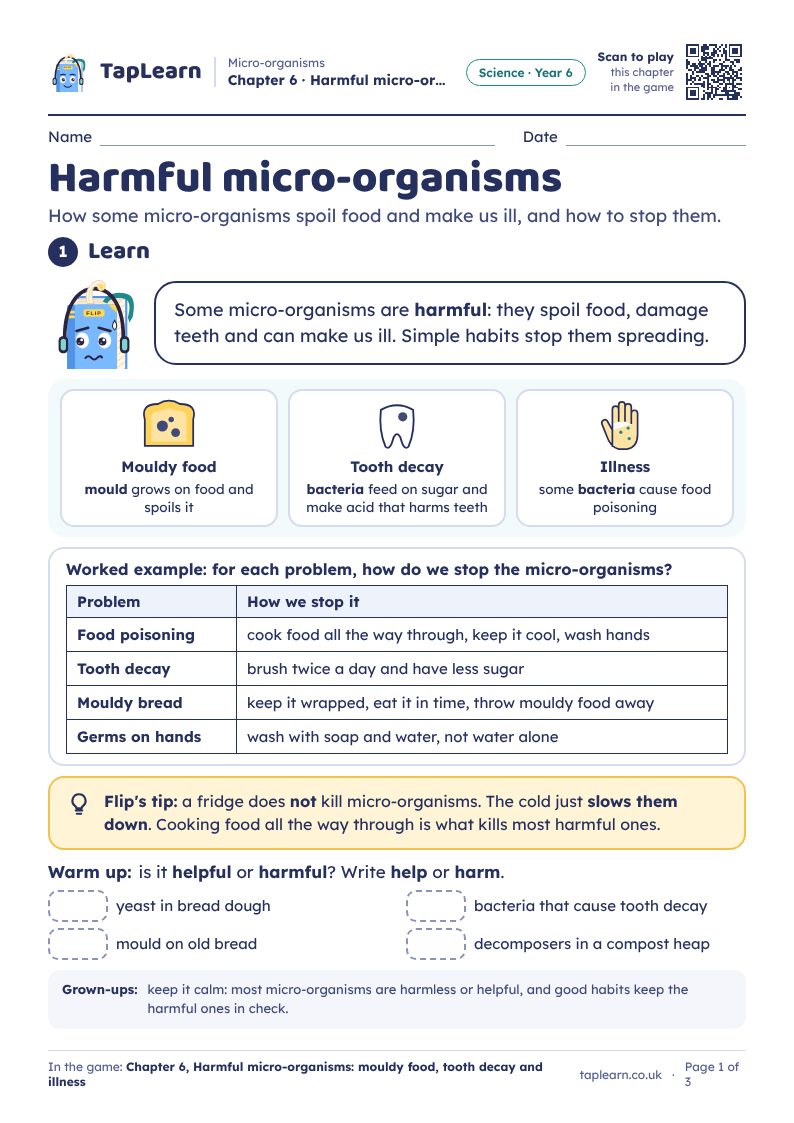
Harmful Micro-organisms is a printable worksheet for Year 6 (ages 10 to 11) that teaches children how some micro-organisms spoil food, cause tooth decay and make us ill, and how to stop them spreading. It supports the Year 6 national curriculum in England: describe how living things are classified into broad groups according to common observable characteristics, including micro-organisms, plants and animals.
This worksheet is for members
Membership opens every chapter of every game and every worksheet, for all your children.
See the plansAlready a member? Log in to print it.
Start with the free one: Three big groups (chapter 1).
Print it on A4, in colour or black and white. Do it after the chapter, or before it to see what your child already knows.
What's on the worksheet
Children learn how some micro-organisms spoil food, cause tooth decay and food poisoning, and how to stop them spreading, and sort helpful from harmful ones. With a glitter-germs handwashing test and an answers sheet.
- Page 1 · Learn
- Cards show mouldy food, tooth decay and illness, a worked example matches each problem to how we stop it, and a warm-up sorts helpful from harmful.
- Page 2 · Try it together
- Glitter germs: put cream and glitter on hands as pretend germs, see where they spread, then compare rinsing with water only and washing with soap.
- Pages 2–3 · Practise
- Tick helpful or harmful for six micro-organisms, match problems to ways of stopping them, tick true or false, and explain when to wash your hands.
- Answers sheet
- Every answer by page, what to watch out for (water alone is enough, the fridge kills germs) and ideas to go further.
3 A4 pages and an answers sheet · about 30 minutes
Using it at home
- The glitter test takes about 10 minutes at the sink. Let your child rinse with water first, then wash with soap, and compare.
- Keep the message calm: most micro-organisms are harmless or helpful, and good habits keep the harmful ones in check.
Watch out for
- Thinking rinsing hands with water alone removes germs as well as soap and water.
- The glitter test shows soap and water work much better. Rub backs of hands, between fingers and thumbs.
- Thinking a fridge kills micro-organisms.
- Cold only slows them down. Cooking food all the way through kills most harmful ones.
- Thinking all micro-organisms are harmful germs.
- Remind your child of helpful ones: yeast in bread, bacteria in yoghurt, decomposers in compost and penicillin.
Questions from the worksheet
- Helpful or harmful? Yeast making bread rise; bacteria causing tooth decay; mould growing on strawberries; bacteria turning milk into yoghurt.
- Match each problem to the best way to stop it: tooth decay, germs on hands, bacteria in raw chicken, mould on bread.
- True or false: rinsing with water alone removes germs as well as soap and water.
- Give two times when you should wash your hands, and say why.
- Leo says keeping raw chicken in the fridge will kill all the germs on it. Is he right? Explain how to make the chicken safe to eat.
The answers are on the answers sheet, for grown-ups.
National curriculum in England
This worksheet practises this statement from the Year 6 science programme of study:
- Describe how living things are classified into broad groups according to common observable characteristics and based on similarities and differences, including micro-organisms, plants and animals
Source: National curriculum in England: science programmes of study (DfE)
In the classroom
- Run the glitter germs test as a class demonstration before lunch, then complete the helpful or harmful table.
- Use Leo's fridge Challenge as an exit question on food safety.
Questions and answers
What are some harmful micro-organisms?
Some bacteria cause tooth decay and food poisoning, and moulds spoil food. Many other micro-organisms are harmless or helpful.
Does a fridge kill germs?
No. A fridge slows micro-organisms down but doesn't kill them. Cooking food all the way through kills most harmful bacteria.
Why should you wash your hands with soap?
Soap and water remove germs from your hands much better than water alone, so they don't spread to food, mouths or other people.
More worksheets from Micro-organisms: A Microscope Adventure in the Tiny Life Lab
- Chapter 1: Classifying living things worksheet: Three big groups Free
- Chapter 2: What are micro-organisms worksheet: Tiny but alive Members
- Chapter 3: Bacteria and fungi worksheet: Bacteria, yeasts and moulds Members
- Chapter 4: Classification keys worksheet: Using a key Members
- Chapter 5: Helpful micro-organisms worksheet Members
 TapLearn