Classifying living things worksheet for Year 6: Three big groups
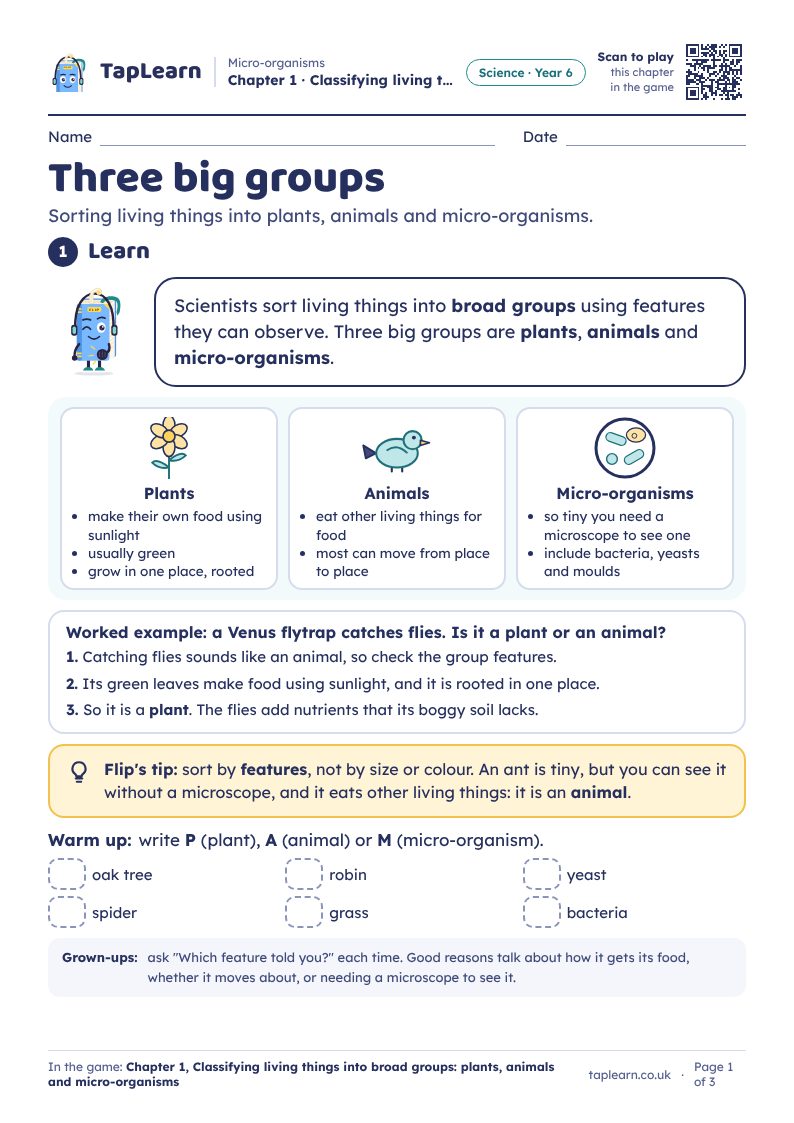
Three Big Groups is a printable classifying living things worksheet for Year 6 (ages 10 to 11) that teaches children to sort living things into plants, animals and micro-organisms by features they can observe. It supports the Year 6 national curriculum in England: describe how living things are classified into broad groups according to common observable characteristics, including micro-organisms, plants and animals.
Free to print, no account needed.
Print it on A4, in colour or black and white. Do it after the chapter, or before it to see what your child already knows.
What's on the worksheet
Children sort living things into plants, animals and micro-organisms using features they can observe, such as how they get food, and explain why a Venus flytrap is a plant. With a living things hunt and an answers sheet.
- Page 1 · Learn
- Cards show the features of plants, animals and micro-organisms, a worked example decides whether a Venus flytrap is a plant or an animal, and a warm-up sorts six living things.
- Page 2 · Try it together
- Living things hunt: find five living things, or signs of them like mould or 'live cultures' on a label, write each one's group and the feature that told you.
- Pages 2–3 · Practise
- Sort nine living things into three columns, ring the odd one out in three rows, tick true or false, and name a feature plants have but animals don't.
- Answers sheet
- Every answer by page, what to watch out for (small means micro-organism, grouping by size or colour) and ideas to go further.
3 A4 pages and an answers sheet · about 30 minutes
Using it at home
- Do the living things hunt first: it takes about 10 minutes around the house or garden and gives your child real examples to sort.
- Each time your child names a group, ask "Which feature told you?" so they explain with features, not size or colour.
Watch out for
- Thinking any small living thing, like an ant, is a micro-organism.
- Ask "Can you see it without a microscope?" Ants, mites and fleas are small animals.
- Calling a Venus flytrap an animal because it catches flies.
- Ask whether it makes its own food from sunlight. It does, and it is rooted, so it is a plant.
- Grouping living things by size or colour instead of features.
- Steer back to features: how it gets food, whether it moves about, whether you need a microscope to see it.
Questions from the worksheet
- Sort these living things into plants, animals and micro-organisms: sunflower, fox, bacteria, moss, earthworm, yeast, ant, mould, oak tree.
- Ring the odd one out: yeast, bacteria, ladybird, mould. Say which group it belongs to.
- True or false: a Venus flytrap is an animal because it catches flies.
- Give one feature that plants have but animals don't, and one that animals have but plants don't.
- Mia sorts living things by colour. She puts a green frog, a green leaf and green mould in one group. Is this a good way to sort them? Explain.
The answers are on the answers sheet, for grown-ups.
National curriculum in England
This worksheet practises this statement from the Year 6 science programme of study:
- Describe how living things are classified into broad groups according to common observable characteristics and based on similarities and differences, including micro-organisms, plants and animals
Source: National curriculum in England: science programmes of study (DfE)
In the classroom
- Use the odd-one-out rows as a starter, with pupils explaining their choice to a partner.
- Mia's colour-sorting Challenge works as a class discussion about choosing useful features.
Questions and answers
What are the broad groups of living things in Year 6?
Year 6 children learn to sort living things into broad groups such as plants, animals and micro-organisms, using features they can observe.
Is a Venus flytrap a plant or an animal?
A Venus flytrap is a plant. It makes its own food using sunlight and is rooted in one place; the insects it catches add nutrients missing from its boggy soil.
Is an ant a micro-organism?
No. An ant is a small animal. You can see it without a microscope, and it eats other living things.
More worksheets from Micro-organisms: A Microscope Adventure in the Tiny Life Lab
- Chapter 2: What are micro-organisms worksheet: Tiny but alive Members
- Chapter 3: Bacteria and fungi worksheet: Bacteria, yeasts and moulds Members
- Chapter 4: Classification keys worksheet: Using a key Members
- Chapter 5: Helpful micro-organisms worksheet Members
- Chapter 6: Harmful micro-organisms worksheet Members
 TapLearn