Bacteria and fungi worksheet for Year 6: Bacteria, yeasts and moulds
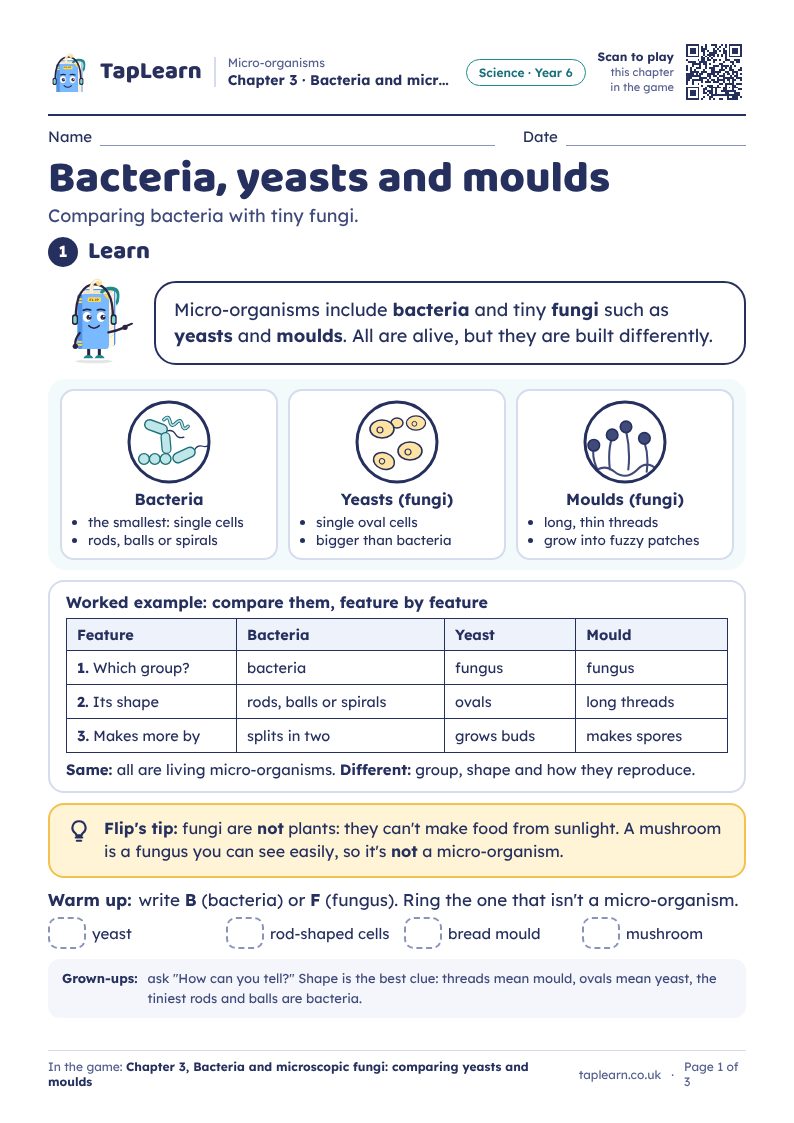
Bacteria, Yeasts and Moulds is a printable bacteria and fungi worksheet for Year 6 (ages 10 to 11) that teaches children how bacteria and microscopic fungi such as yeasts and moulds are similar and different. It supports the Year 6 national curriculum in England: describe how living things are classified into broad groups according to common observable characteristics, including micro-organisms, plants and animals.
This worksheet is for members
Membership opens every chapter of every game and every worksheet, for all your children.
See the plansAlready a member? Log in to print it.
Start with the free one: Three big groups (chapter 1).
Print it on A4, in colour or black and white. Do it after the chapter, or before it to see what your child already knows.
What's on the worksheet
Children compare bacteria with microscopic fungi such as yeasts and moulds, by group, shape and how they reproduce, and learn why fungi are not plants. With a fungi-spotting activity and an answers sheet.
- Page 1 · Learn
- Three microscope views show bacteria, yeasts and moulds, a worked example compares their group, shape and how they reproduce, and a warm-up labels bacteria or fungus.
- Page 2 · Try it together
- Fungi spotters: look closely at a mushroom, dried yeast, bread and mould sealed in a bag, and decide whether each is a fungus and a micro-organism.
- Pages 2–3 · Practise
- Name three microscope views, write B, Y or M for six descriptions, tick true or false, and compare yeast and mould.
- Answers sheet
- Every answer by page, what to watch out for (fungi as plants, a mushroom as a micro-organism) and ideas to go further.
3 A4 pages and an answers sheet · about 30 minutes
Using it at home
- Do the fungi spotters activity with whatever you have; keep any mouldy food sealed in its bag and throw it away unopened. It takes about 10 minutes.
- Ask "How can you tell?" for each microscope view: threads mean mould, ovals mean yeast, the tiniest rods and balls are bacteria.
Watch out for
- Thinking fungi such as mushrooms and moulds are plants.
- Ask "Can it make its own food from sunlight?" Fungi can't, so they are a separate group.
- Mixing up bacteria and fungi such as yeast and mould.
- Use shape as the clue: threads mean mould, ovals with buds mean yeast, the tiniest rods and balls are bacteria.
- Thinking a mushroom is a micro-organism.
- A mushroom is a fungus, but you can see it without a microscope, so it isn't a micro-organism.
Questions from the worksheet
- Write B (bacteria), Y (yeast) or M (mould): grows long, thin threads; splits in two to make more; makes bread dough rise; is a kind of fungus.
- True or false: a mushroom is a micro-organism.
- Write one way yeast and mould are the same, and one way they are different.
- Ava says, "Mould is a plant, because it grows on things." Is she right? Explain.
The answers are on the answers sheet, for grown-ups.
National curriculum in England
This worksheet practises this statement from the Year 6 science programme of study:
- Describe how living things are classified into broad groups according to common observable characteristics and based on similarities and differences, including micro-organisms, plants and animals
Source: National curriculum in England: science programmes of study (DfE)
In the classroom
- Project the three microscope views and ask pupils to identify each one on mini-whiteboards before revealing the comparison table.
Questions and answers
What is the difference between bacteria and fungi?
Bacteria are tiny single cells shaped like rods, balls or spirals that split in two. Fungi such as yeasts and moulds are a separate group; yeasts are oval cells that bud and moulds grow threads and make spores.
Is mould a plant?
No. Mould is a fungus. Unlike plants, fungi can't make their own food from sunlight, so mould feeds on what it grows on.
Is yeast a micro-organism?
Yes. Yeast is a microscopic fungus made of single oval cells. A grain of dried yeast holds a huge number of them.
More worksheets from Micro-organisms: A Microscope Adventure in the Tiny Life Lab
- Chapter 1: Classifying living things worksheet: Three big groups Free
- Chapter 2: What are micro-organisms worksheet: Tiny but alive Members
- Chapter 4: Classification keys worksheet: Using a key Members
- Chapter 5: Helpful micro-organisms worksheet Members
- Chapter 6: Harmful micro-organisms worksheet Members
 TapLearn