Helpful micro-organisms worksheet for Year 6
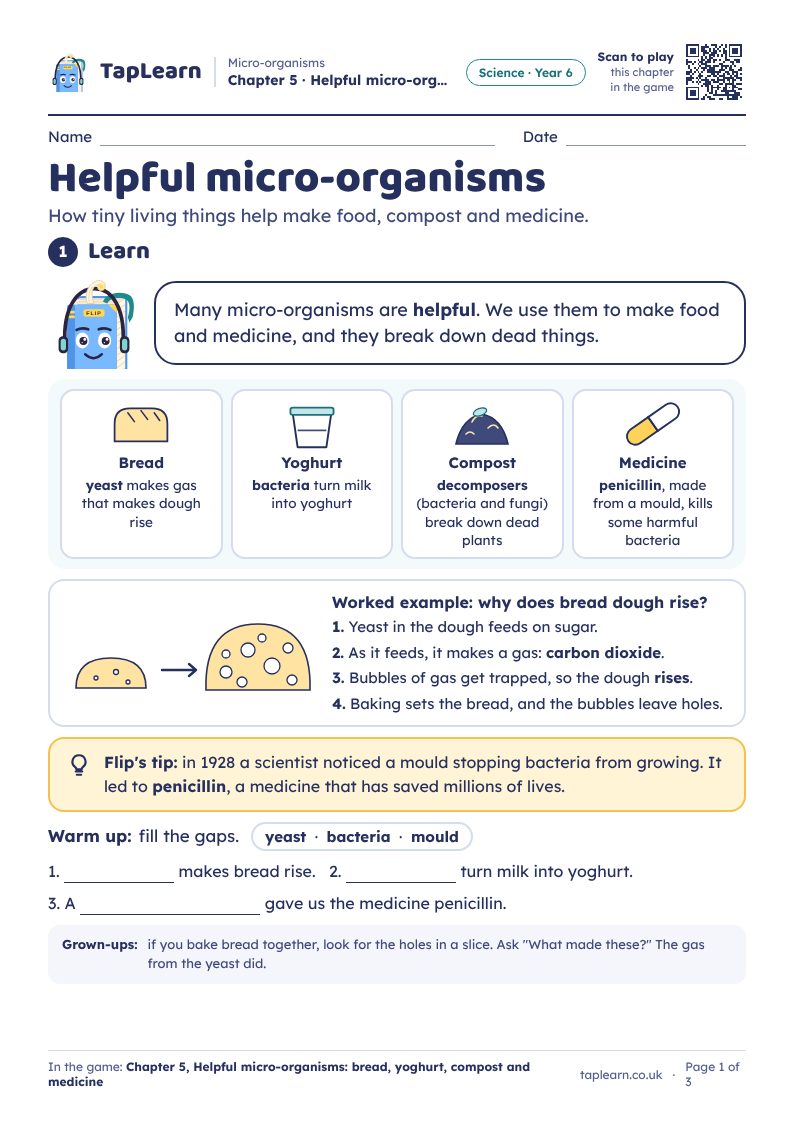
Helpful Micro-organisms is a printable worksheet for Year 6 (ages 10 to 11) that teaches children how yeast, bacteria and moulds help us make bread, yoghurt, compost and medicine. It supports the Year 6 national curriculum in England: describe how living things are classified into broad groups according to common observable characteristics, including micro-organisms, plants and animals.
This worksheet is for members
Membership opens every chapter of every game and every worksheet, for all your children.
See the plansAlready a member? Log in to print it.
Start with the free one: Three big groups (chapter 1).
Print it on A4, in colour or black and white. Do it after the chapter, or before it to see what your child already knows.
What's on the worksheet
Children learn how micro-organisms help us: yeast makes bread rise, bacteria turn milk into yoghurt, decomposers make compost and a mould gave us penicillin. With a food-label hunt and an answers sheet.
- Page 1 · Learn
- Cards show micro-organisms in bread, yoghurt, compost and medicine, a worked example explains why bread dough rises, and a warm-up fills the gaps.
- Page 2 · Try it together
- Label detectives: read the ingredients on food packets for clue words like yeast or live cultures, and record which micro-organism helped and its job.
- Pages 2–3 · Practise
- Match micro-organisms to their jobs, order five bread-making steps, explain how a compost heap works, and explain what really makes dough rise.
- Answers sheet
- Every answer by page, what to watch out for (all micro-organisms are harmful, the oven makes bread rise) and ideas to go further.
3 A4 pages and an answers sheet · about 30 minutes
Using it at home
- The label hunt takes about 10 minutes with whatever packets are in the cupboard or fridge. Let your child read the ingredients aloud.
- If you bake bread together, look for the holes in a slice and ask "What made these?"
Watch out for
- Thinking all micro-organisms are harmful germs.
- Ask your child to name one that helps with food and one that helps in the garden.
- Mixing up which micro-organism does which job, such as thinking yeast makes yoghurt.
- Yeast makes bread rise, bacteria turn milk into yoghurt and a mould gave us penicillin.
- Thinking bread rises because of the oven's heat.
- Dough rises in a warm place before baking. The carbon dioxide gas made by the yeast does it.
Questions from the worksheet
- Match each micro-organism to its helpful job: yeast, bacteria in milk, a mould, decomposers.
- Number these bread-making steps 1 to 5 in the right order.
- Dead leaves in a compost heap slowly turn into crumbly compost. Explain what is happening. Use the words micro-organisms and decomposers.
- Leo thinks bread rises because of the heat of the oven. What really makes the dough rise?
- Mia says all micro-organisms are germs, so we should get rid of all of them. Is she right? Give two examples to explain.
The answers are on the answers sheet, for grown-ups.
National curriculum in England
This worksheet practises this statement from the Year 6 science programme of study:
- Describe how living things are classified into broad groups according to common observable characteristics and based on similarities and differences, including micro-organisms, plants and animals
Source: National curriculum in England: science programmes of study (DfE)
In the classroom
- Pupils bring in empty food packets for a class label hunt and sort them by micro-organism.
- Use the bread-steps ordering as a pairs task, then discuss the oven misconception.
Questions and answers
How do micro-organisms help us?
Many micro-organisms are helpful: yeast makes bread rise, bacteria turn milk into yoghurt, decomposers break down dead plants into compost, and a mould gave us the medicine penicillin.
Why does bread dough rise?
Yeast in the dough feeds on sugar and makes carbon dioxide gas. Bubbles of gas get trapped, so the dough rises.
Where does penicillin come from?
Penicillin is a medicine first made from a mould. In 1928 a scientist noticed a mould stopping bacteria from growing, and it led to a medicine that kills some harmful bacteria.
More worksheets from Micro-organisms: A Microscope Adventure in the Tiny Life Lab
- Chapter 1: Classifying living things worksheet: Three big groups Free
- Chapter 2: What are micro-organisms worksheet: Tiny but alive Members
- Chapter 3: Bacteria and fungi worksheet: Bacteria, yeasts and moulds Members
- Chapter 4: Classification keys worksheet: Using a key Members
- Chapter 6: Harmful micro-organisms worksheet Members
 TapLearn