Classification keys worksheet for Year 6: Using a key
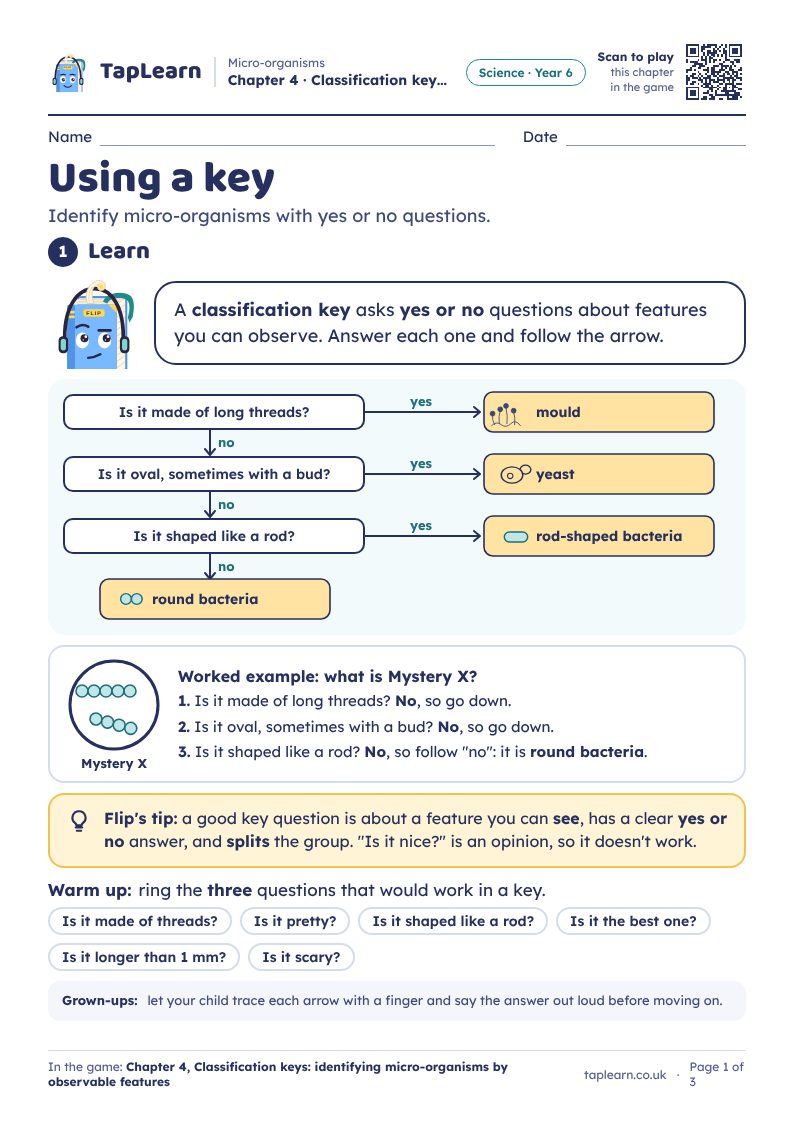
Using a Key is a printable classification keys worksheet for Year 6 (ages 10 to 11) that teaches children to use and finish a yes or no key to identify micro-organisms by features they can observe. It supports the Year 6 national curriculum in England: describe how living things are classified into broad groups according to common observable characteristics, including micro-organisms, plants and animals.
This worksheet is for members
Membership opens every chapter of every game and every worksheet, for all your children.
See the plansAlready a member? Log in to print it.
Start with the free one: Three big groups (chapter 1).
Print it on A4, in colour or black and white. Do it after the chapter, or before it to see what your child already knows.
What's on the worksheet
Children use a yes or no classification key to identify moulds, yeasts and bacteria, finish a numbered key and learn what makes a good key question. With a make-your-own kitchen key activity and an answers sheet.
- Page 1 · Learn
- A yes or no key sorts mould, yeast, rod-shaped and round bacteria, a worked example identifies Mystery X step by step, and a warm-up rings good key questions.
- Page 2 · Try it together
- Make a kitchen key: choose four objects, write yes or no questions on a blank branching key, and test it by having a grown-up pick one in secret.
- Pages 2–3 · Practise
- Name three mystery micro-organisms with the key, finish a numbered key, choose the better key question, and explain why 'Is it a fungus?' won't work.
- Answers sheet
- Every answer by page, what to watch out for (following the wrong branch, opinion questions) and ideas to go further.
3 A4 pages and an answers sheet · about 30 minutes
Using it at home
- Making a kitchen key takes about 10 minutes. Let your child choose the objects and write the questions; you answer them when testing.
- When using the key on page 1, ask your child to say each answer out loud and trace the matching arrow with a finger.
Watch out for
- Following the wrong branch of a key after answering a yes or no question.
- Say the answer out loud, then trace the arrow that matches it with a finger before reading the next question.
- Choosing key questions that are opinions, like 'Is it nice?', or that don't split the group.
- Use features you can see or measure, and check each question puts some things on 'yes' and some on 'no'.
Questions from the worksheet
- Use the key on page 1 to name each mystery micro-organism.
- Finish this numbered key for an oak tree, a butterfly, yeast and bacteria.
- Leo suggests the question "Is it big?". Mia suggests "Is it longer than 1 mm?". Which question is better for a key? Why?
- Ava writes the key question "Is it a fungus?" to split yeast and mould. Why won't this question work?
- Sam answers "yes" to "Is it made of long threads?" but then follows the "no" arrow. What will go wrong? What should he do?
The answers are on the answers sheet, for grown-ups.
National curriculum in England
This worksheet practises this statement from the Year 6 science programme of study:
- Describe how living things are classified into broad groups according to common observable characteristics and based on similarities and differences, including micro-organisms, plants and animals
Source: National curriculum in England: science programmes of study (DfE)
In the classroom
- Pairs swap their kitchen keys and test each other's, then improve any question that didn't work.
- Use the Mystery X worked example as a modelled read-through before pupils try the three mysteries.
Questions and answers
What is a classification key?
A classification key is a set of yes or no questions about features you can observe. Answering each question and following the arrows identifies a living thing.
What makes a good question for a key?
A good key question is about a feature you can see or measure, has a clear yes or no answer and splits the group into two.
Can you use a key to identify micro-organisms?
Yes. Under a microscope you can observe features such as threads, oval cells with buds, or rod and ball shapes, and use a key to name moulds, yeasts and bacteria.
More worksheets from Micro-organisms: A Microscope Adventure in the Tiny Life Lab
- Chapter 1: Classifying living things worksheet: Three big groups Free
- Chapter 2: What are micro-organisms worksheet: Tiny but alive Members
- Chapter 3: Bacteria and fungi worksheet: Bacteria, yeasts and moulds Members
- Chapter 5: Helpful micro-organisms worksheet Members
- Chapter 6: Harmful micro-organisms worksheet Members
 TapLearn