Making inferences worksheet for Years 1–2: Clue detectives
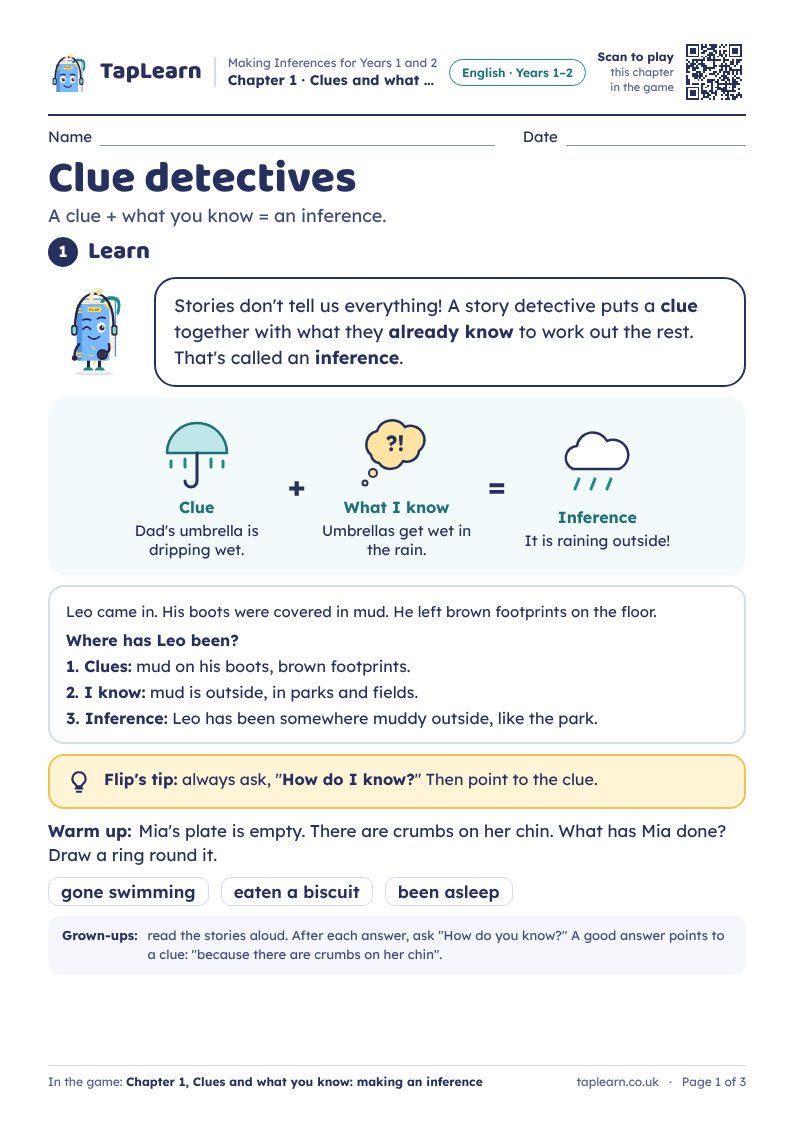
Clue Detectives is a printable making inferences worksheet for Years 1 and 2 (ages 5 to 7) that teaches children that a clue plus what you already know makes an inference, like a dripping umbrella meaning it is raining. It covers the Years 1 and 2 statements on understanding books by drawing on what they already know and by making inferences on the basis of what is being said and done.
What it practises: Learn that an inference is a clue plus what you already know, by spotting clues on a rain-soaked character, opening mystery boxes and sorting what a story tells us from what we work out.
Free to print, no account needed.
Print it on A4, in colour or black and white. Do it after the chapter, or before it to see what your child already knows.
What's on the worksheet
Your child puts a clue from a story together with what they already know to work out something the story doesn't say. Includes a clue trail to set up around the room and an answers sheet.
- Page 1 · Learn
- What an inference is, with clue + what I know = inference, a worked example about Leo's muddy boots, Flip's tip to ask "How do I know?", and a crumbs-on-her-chin warm-up.
- Page 2 · Try it together
- Clue trail: the grown-up sets out three everyday clues, like a coat by the door or a teddy tucked up in bed, and the child finds each one, says what it shows and how they know.
- Page 3 · Practise
- Match clues to what they show, read short stories and ring an answer, sort what the story told us from what we worked out, draw a bedtime clue, and a challenge about Grandpa.
- Answers sheet
- Every answer, mix-ups like a wild guess with no clue, and a window-detective idea.
3 A4 pages and an answers sheet · about 20 minutes
Using it at home
- Read the stories aloud. After each answer, ask "How do you know?" A good answer points to a clue: "because there are crumbs on her chin".
- After the clue trail, swap so your child sets the clues for you to work out.
- Look out of the window together and work out the weather or time of day from clues like wet ground or lights on.
Watch out for
- Making a wild guess with no clue behind it, like the cat.
- Ask, "Which words in the story made you think that?"
- Choosing an answer that fits one clue but not all.
- Check every clue fits: in the dog story, the keys show someone is coming home.
- Repeating the story instead of working something out, like "Her cheeks were red."
- Ask, "So what does that tell us?"
Questions from the worksheet
- Sam put on his coat, hat, scarf and gloves. His breath made little clouds in the air. What is the weather like? hot, cold or rainy.
- The dog wagged its tail and ran to the front door. Then keys jingled in the lock. What is happening?
- Mia's cheeks were red and she was puffing. She dropped her football on the grass. Did the story tell us (T), or did we work it out (W)?
- Grandpa's glasses were on his head. He looked under every cushion. Ava says, "Grandpa is looking for the cat." Is she right? What do you think he is looking for?
The answers are on the answers sheet, for grown-ups.
National curriculum in England
This worksheet practises these statements from the Year 1 english programme of study:
- Understand both the books they can already read accurately and fluently and those they listen to by: drawing on what they already know or on background information and vocabulary provided by the teacher
- Understand both the books that they can already read accurately and fluently and those that they listen to by: drawing on what they already know or on background information and vocabulary provided by the teacher (Year 2 english)
- Understand both the books they can already read accurately and fluently and those they listen to by: making inferences on the basis of what is being said and done
- Understand both the books that they can already read accurately and fluently and those that they listen to by: making inferences on the basis of what is being said and done (Year 2 english)
In the classroom
- Set up a clue trail in the classroom for groups to solve.
- Use Practise C as a told-or-worked-out sort on the board.
Questions and answers
What is an inference in Year 1 and Year 2?
An inference is when you work out something a story doesn't say by putting a clue together with what you already know.
How do you teach inference to young children?
Start with real clues, like a wet umbrella or crumbs on a plate, and ask "What can you work out? How do you know?"
What is the difference between a guess and an inference?
An inference is backed up by a clue in the story; a guess isn't. Ask your child to point to the clue.
 TapLearn