Character feelings worksheet for Years 1–2: Feelings in actions
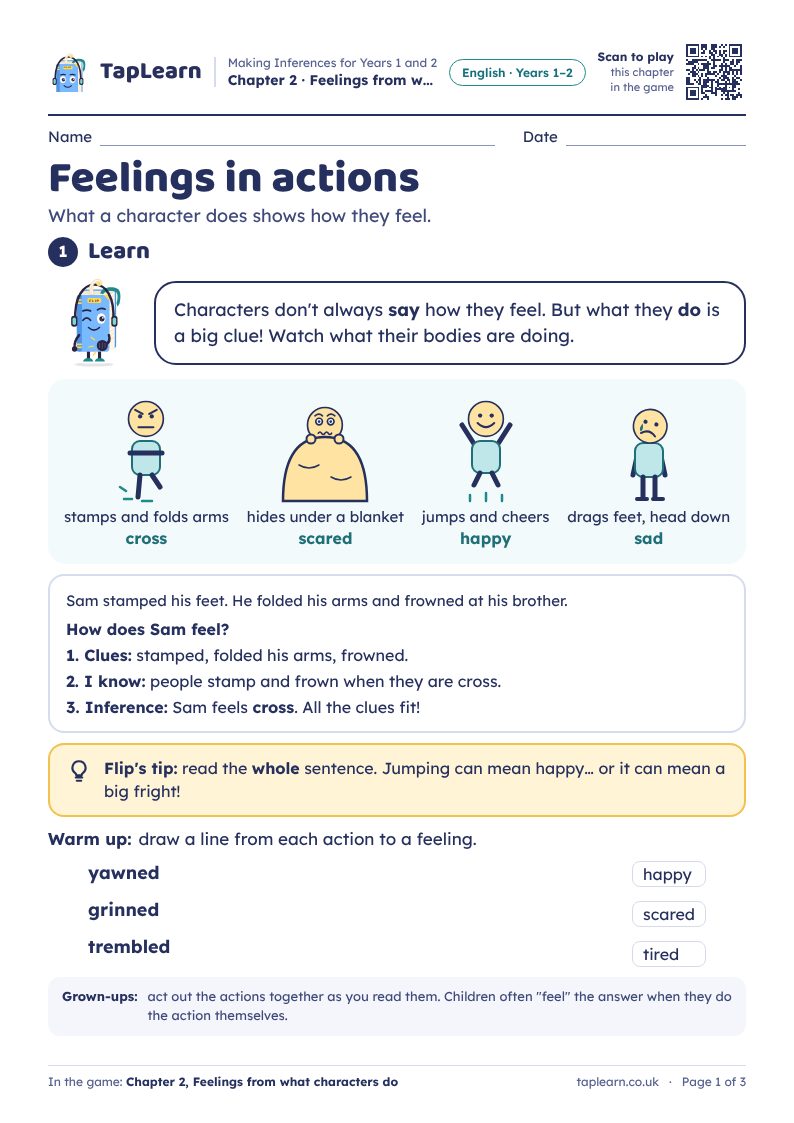
Feelings in Actions is a printable character feelings worksheet for Years 1 and 2 (ages 5 to 7) that teaches children to work out how a character feels from what their body is doing, such as stamping when cross or hiding when scared. It covers the Years 1 and 2 statement on understanding books by making inferences on the basis of what is being said and done.
What it practises: Infer how characters feel from what they do, such as stamping, hiding, yawning or grinning, by watching characters act and tapping the action words that are clues.
This worksheet is for members
Membership opens every chapter of every game and every worksheet, for all your children.
See the plansAlready a member? Log in to print it.
Start with the free one: Clue detectives (chapter 1).
Print it on A4, in colour or black and white. Do it after the chapter, or before it to see what your child already knows.
What's on the worksheet
Your child works out how a character feels from what they do, like stamping, hiding or grinning, and reads the whole sentence before deciding. Includes a feelings charades game and an answers sheet.
- Page 1 · Learn
- Four actions matched to feelings, a worked example about Sam stamping and frowning, Flip's tip to read the whole sentence, and a match-the-action warm-up.
- Page 2 · Try it together
- Feelings charades: secretly choose a feeling like cross or tired, act it out without words, and the other person guesses and names the actions that gave it away.
- Page 3 · Practise
- Ring the feeling for each sentence, ring the feeling in short stories, explain why Leo isn't happy, draw a proud character, and a challenge about Sam jumping.
- Answers sheet
- Every answer, mix-ups like judging from one action, and picture-book-pause and feelings-freeze ideas.
3 A4 pages and an answers sheet · about 20 minutes
Using it at home
- Act out the actions together as you read them. Children often "feel" the answer when they do the action themselves.
- In charades, name the clues out loud: "You stamped and crossed your arms, so I think you're cross."
- Stop on a picture in a book and ask, "How is this character feeling? What are they doing that tells you?"
Watch out for
- Picking the opposite feeling, like happy for a stamping character.
- Act the action out together and ask, "How does that feel?"
- Picking a feeling nothing shows, like bored for Ava's gasp.
- Ask, "Which words tell you that?"
- Judging from one action, like jumping means happy.
- Read the whole sentence again: what else is happening?
Questions from the worksheet
- Read each sentence. Ring the feeling (happy, sad, cross, scared): Leo hid under his duvet when the thunder crashed. Mia slammed the door and kicked her school bag.
- Read each story. Ring the feeling: Ava's mouth fell open. She gasped and her eyes went wide. (bored, surprised, sleepy)
- Leo jumped. A huge spider had dropped onto the table! How did Leo feel? Why is it not happy?
- Sam jumped up and down and shouted, "It's not fair!" Mia says, "Sam is happy, because he is jumping." Is she right? How does Sam really feel?
The answers are on the answers sheet, for grown-ups.
National curriculum in England
This worksheet practises these statements from the Year 1 english programme of study:
- Understand both the books they can already read accurately and fluently and those they listen to by: making inferences on the basis of what is being said and done
- Understand both the books that they can already read accurately and fluently and those that they listen to by: making inferences on the basis of what is being said and done (Year 2 english)
In the classroom
- Play feelings freeze: call out a feeling and pupils freeze in a pose that shows it.
- Use Practise A as a whole-class vote with feelings face cards.
Questions and answers
How can children tell how a character feels?
Look at what the character does. Stamping and frowning show cross, hiding shows scared, and dragging feet shows sad.
Why should children read the whole sentence?
One action can mean different things. Jumping can be happy, but "jumped… a huge spider" shows a fright.
Is working out feelings from actions an inference?
Yes. The story doesn't say the feeling, so children use the action clue and what they know to work it out.
 TapLearn