Inference worksheet for Years 1–2: Speaking clues
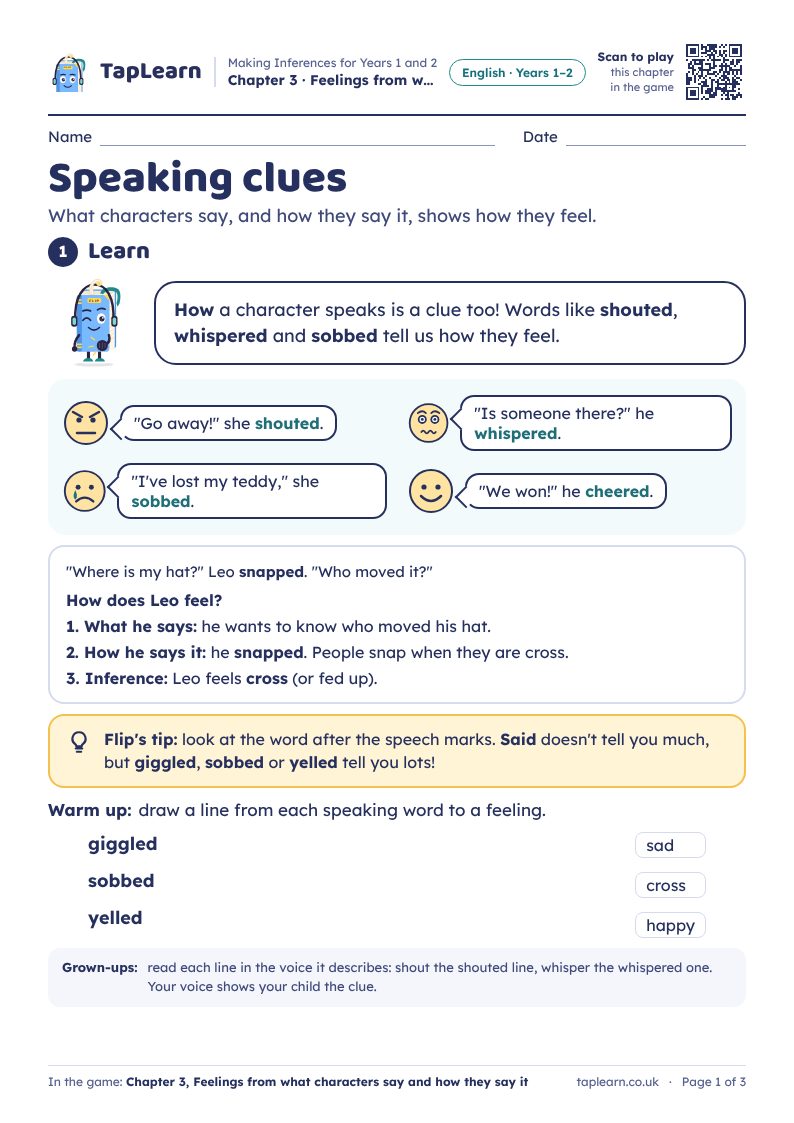
Speaking Clues is a printable inference worksheet for Years 1 and 2 (ages 5 to 7) that teaches children to work out how a character feels from what they say and how they say it, using words like snapped, giggled and whispered. It covers the Years 1 and 2 statement on understanding books by making inferences on the basis of what is being said and done.
What it practises: Infer how characters feel from what they say and how they say it, such as shouted, sobbed or whispered, including what to do when their words and actions don't match.
This worksheet is for members
Membership opens every chapter of every game and every worksheet, for all your children.
See the plansAlready a member? Log in to print it.
Start with the free one: Clue detectives (chapter 1).
Print it on A4, in colour or black and white. Do it after the chapter, or before it to see what your child already knows.
What's on the worksheet
Your child uses what characters say, and words like shouted, whispered and sobbed, to work out how they feel, even when their words and actions don't match. Includes a one-sentence, four-voices game and an answers sheet.
- Page 1 · Learn
- Four speech lines with speaking words like shouted and sobbed, a worked example about Leo who snapped, Flip's tip to look at the word after the speech marks, and a warm-up.
- Page 2 · Try it together
- One sentence, four voices: the grown-up says a short sentence in a secret feeling voice, the child guesses the feeling and notes whether it was loud or quiet, fast or slow.
- Page 3 · Practise
- Ring the feeling for each speech line, choose a speaking word for each feeling, decide if Leo is scared, write a surprised line, and a challenge about Ava saying "I'm fine".
- Answers sheet
- Every answer, mix-ups like believing the words only, and voice-detective and swap-the-word ideas.
3 A4 pages and an answers sheet · about 20 minutes
Using it at home
- Read each line in the voice it describes: shout the shouted line, whisper the whispered one. Your voice shows your child the clue.
- After each go in the voices game, find a speaking word for it: a cross voice "snapped", a scared voice "whispered".
- When reading together, change "said" in a story to shouted, whispered or giggled, and talk about how the feeling changes.
Watch out for
- Missing the speaking word.
- Ask your child to put a finger on the word after the speech: shouted, sobbed, whispered.
- Believing the words only, when actions show a different feeling.
- Ask, "What is the character doing? Does it match what they say?"
- Picking the opposite feeling, like happy for "sobbed".
- Act it out: "Show me sobbing. How does that feel?"
Questions from the worksheet
- Read what each character says. Ring the feeling: "My ice cream fell on the floor," Mia sobbed. "What was that noise?" Leo whispered, shaking.
- Write a speaking word from the box (giggled, snapped, sobbed, gasped) to show the feeling: "Leave me alone," ___ Leo. (cross)
- "I'm not scared," said Leo. But his knees were knocking and he held Mum's hand tight. Is Leo scared? How do you know?
- "I'm fine," said Ava, as a tear rolled down her cheek. Sam says, "Ava is happy, because she said she's fine." Is he right? How does Ava really feel?
The answers are on the answers sheet, for grown-ups.
National curriculum in England
This worksheet practises these statements from the Year 1 english programme of study:
- Understand both the books they can already read accurately and fluently and those they listen to by: making inferences on the basis of what is being said and done
- Understand both the books that they can already read accurately and fluently and those that they listen to by: making inferences on the basis of what is being said and done (Year 2 english)
In the classroom
- Read a line in four voices as a starter and pupils hold up feeling cards.
- Use Practise B in pairs, then read the finished lines aloud in role.
Questions and answers
What are speaking words in a story?
Speaking words like shouted, whispered, giggled and sobbed tell us how a character speaks, which is a clue to how they feel.
What if a character's words and actions don't match?
Look at the actions. If Ava says "I'm fine" but a tear rolls down her cheek, she is really sad.
Why is said not a helpful clue?
Said doesn't show any feeling. Words like snapped or sobbed tell the reader much more.
 TapLearn