Story questions worksheet for Years 1–2
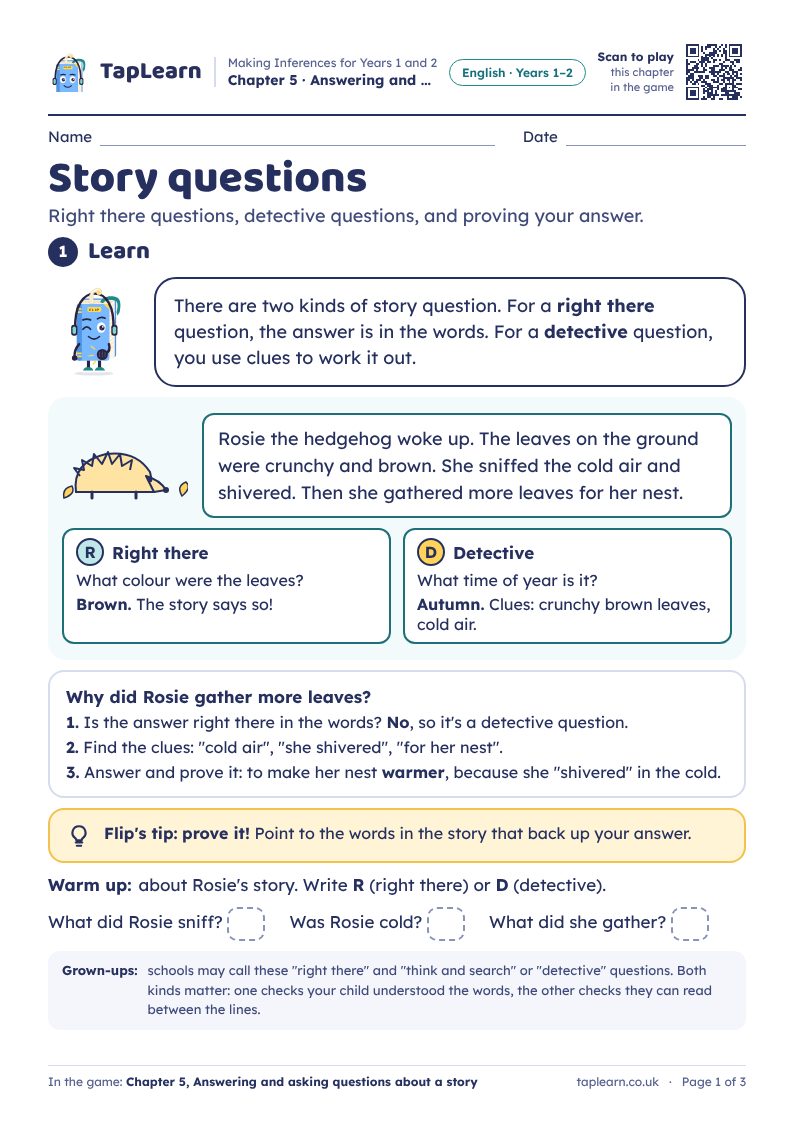
Story Questions is a printable story questions worksheet for Years 1 and 2 (ages 5 to 7) that teaches children that the answer to a right there question is in the words, while a detective question is worked out from clues. It covers the Year 2 statements on understanding books by making inferences and by answering and asking questions.
What it practises: Answer questions about a short story, sort ones answered in the text from ones that need inference, prove answers with a sentence, and build good questions of your own (right there questions).
This worksheet is for members
Membership opens every chapter of every game and every worksheet, for all your children.
See the plansAlready a member? Log in to print it.
Start with the free one: Clue detectives (chapter 1).
Print it on A4, in colour or black and white. Do it after the chapter, or before it to see what your child already knows.
What's on the worksheet
Your child tells right there questions from detective questions, proves answers with a clue from the story, and asks questions of their own. Includes a question swap with a storybook and an answers sheet.
- Page 1 · Learn
- A short story about Rosie the hedgehog with a right there and a detective question, a worked example proving an answer, Flip's prove-it tip, and an R-or-D warm-up.
- Page 2 · Try it together
- Question swap: read a short storybook together, take turns asking a right there question and a detective question, then answer each other and prove it with a clue.
- Page 3 · Practise
- Write R or D and answer questions on two short stories, tick questions about the story, tick the sentence that proves Leo was happy, ask your own question, and a challenge.
- Answers sheet
- Every answer, mix-ups like proof that doesn't prove it, and a one-of-each idea.
3 A4 pages and an answers sheet · about 25 minutes
Using it at home
- Schools may call these right there and think and search or detective questions. One checks the words were understood; the other checks reading between the lines.
- In the question swap, detective questions often start with why, how does… feel or what do you think. Keep questions about the story.
- After any story, ask one right there and one detective question, then let your child ask you.
Watch out for
- Mixing up the two kinds of question.
- Ask, "Can you put your finger on the answer?" If yes, it's right there. If not, it's a detective question.
- Giving proof that doesn't prove it, like "On the table was a cake" for how Leo felt.
- Ask, "Does that sentence show his feelings?"
- Asking questions that aren't about the story, like "Do you like pizza?"
- Ask, "Is the answer in the story or its clues?"
Questions from the worksheet
- Read Ava's story. Write R or D for each question, then answer it: What did Ava grab? Where is Ava going?
- Tick the questions that are about Ava's story: Will Ava jump in the pool? Do you like pizza? Who is driving the car?
- Prove it! Which sentence proves Leo was happy? Tick it.
- Ask your own detective question about Leo's story.
- Mia is asked, "How old is Leo now?" She says, "I don't know. The story doesn't say." Is she right? What clue could help her?
The answers are on the answers sheet, for grown-ups.
National curriculum in England
This worksheet practises these statements from the Year 2 english programme of study:
- Understand both the books that they can already read accurately and fluently and those that they listen to by: making inferences on the basis of what is being said and done
- Understand both the books that they can already read accurately and fluently and those that they listen to by: answering and asking questions
In the classroom
- Sort question cards for a class story into right there and detective piles.
- Use Practise E for pupils to swap detective questions with a partner.
Questions and answers
What is a right there question?
A right there question has its answer in the words of the story, so you can put your finger on it.
What is a detective question?
A detective question asks you to work out the answer from clues, like knowing Leo is seven from a cake with seven candles.
Why should children prove their answers?
Pointing to the words that back up an answer shows it comes from the story, not a guess.
 TapLearn