Character traits and motives worksheet for Years 1–2: Why they did it
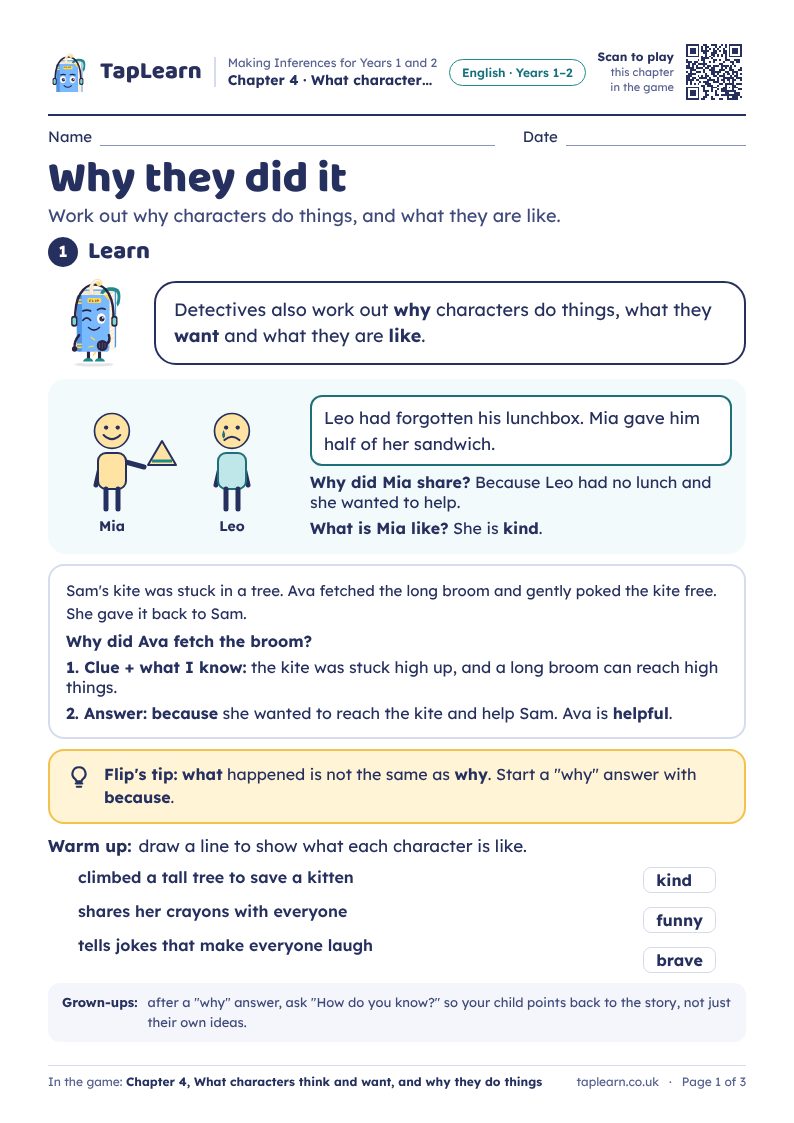
Why They Did It is a printable character traits and motives worksheet for Years 1 and 2 (ages 5 to 7) that teaches children to work out why a character does something and what they are like, starting a why answer with because. It covers the Years 1 and 2 statements on understanding books by drawing on what they already know and by making inferences on the basis of what is being said and done.
What it practises: Work out what characters think and want, why they act and what they are like, using clues from the story plus background facts given in the game, such as hedgehogs hibernating.
This worksheet is for members
Membership opens every chapter of every game and every worksheet, for all your children.
See the plansAlready a member? Log in to print it.
Start with the free one: Clue detectives (chapter 1).
Print it on A4, in colour or black and white. Do it after the chapter, or before it to see what your child already knows.
What's on the worksheet
Your child works out why characters do things and what they are like, answering with because and a clue from the story. Includes a why-did-they-do-that storybook activity and an answers sheet.
- Page 1 · Learn
- Mia sharing her sandwich and what it shows about her, a worked example about Ava fetching a broom to free a kite, Flip's tip that what is not the same as why, and a warm-up.
- Page 2 · Try it together
- Why did they do that?: read a favourite storybook, stop when a character does something important, answer why with because, say what they are like, and find the clue.
- Page 3 · Practise
- Ring the reason for each story, ring what each character is like, tick the answer that says why, finish a because sentence, and a challenge about the broom.
- Answers sheet
- Every answer, mix-ups like saying what instead of why, and pause-and-ask and character-cards ideas.
3 A4 pages and an answers sheet · about 20 minutes
Using it at home
- After a why answer, ask "How do you know?" so your child points back to the story, not just their own ideas.
- With the storybook, there can be more than one good answer, as long as a clue backs it up.
- At bedtime stories, stop once and ask, "Why do you think she did that?"
Watch out for
- Giving a reason no clue supports, like sweeping the garden.
- Ask, "Which words in the story tell you that?"
- Saying what happened, not why, like "Mia cried".
- Prompt with "because…" and let your child finish the sentence.
- Picking the opposite of what a character is like, like mean for kind.
- Ask, "Would a mean person invite someone to play?"
Questions from the worksheet
- Leo put on his wellies and grabbed his umbrella. Why? because it was raining, because it was sunny, because he was hungry.
- What is each character like? Ava saw a girl sitting alone at playtime. She asked her to come and play. (kind, mean, lazy)
- The puppy hid under the bed when the fireworks went BANG! Finish the sentence: The puppy hid because…
- Leo says, "Ava fetched the broom because she wanted to sweep the garden." Is he right? Why did Ava really fetch it?
The answers are on the answers sheet, for grown-ups.
National curriculum in England
This worksheet practises these statements from the Year 1 english programme of study:
- Understand both the books they can already read accurately and fluently and those they listen to by: drawing on what they already know or on background information and vocabulary provided by the teacher
- Understand both the books that they can already read accurately and fluently and those that they listen to by: drawing on what they already know or on background information and vocabulary provided by the teacher (Year 2 english)
- Understand both the books they can already read accurately and fluently and those they listen to by: making inferences on the basis of what is being said and done
- Understand both the books that they can already read accurately and fluently and those that they listen to by: making inferences on the basis of what is being said and done (Year 2 english)
In the classroom
- Make character cards for a class book: one word for what each character is like, with a reason.
- Use Practise A as a talk-partner task: agree a reason and the clue that shows it.
Questions and answers
How do children work out why a character did something?
Find a clue in the story, add what you know, and answer with because: "Ava fetched the broom because she wanted to reach the kite."
What is a character trait?
A character trait is what a character is like, such as kind, brave, funny or greedy, shown by what they do.
What is the difference between what and why?
What tells you what happened ("Mia cried"). Why tells you the reason ("because her balloon floated away").
 TapLearn