Pulley systems worksheet for Year 5: More ropes, smaller pull
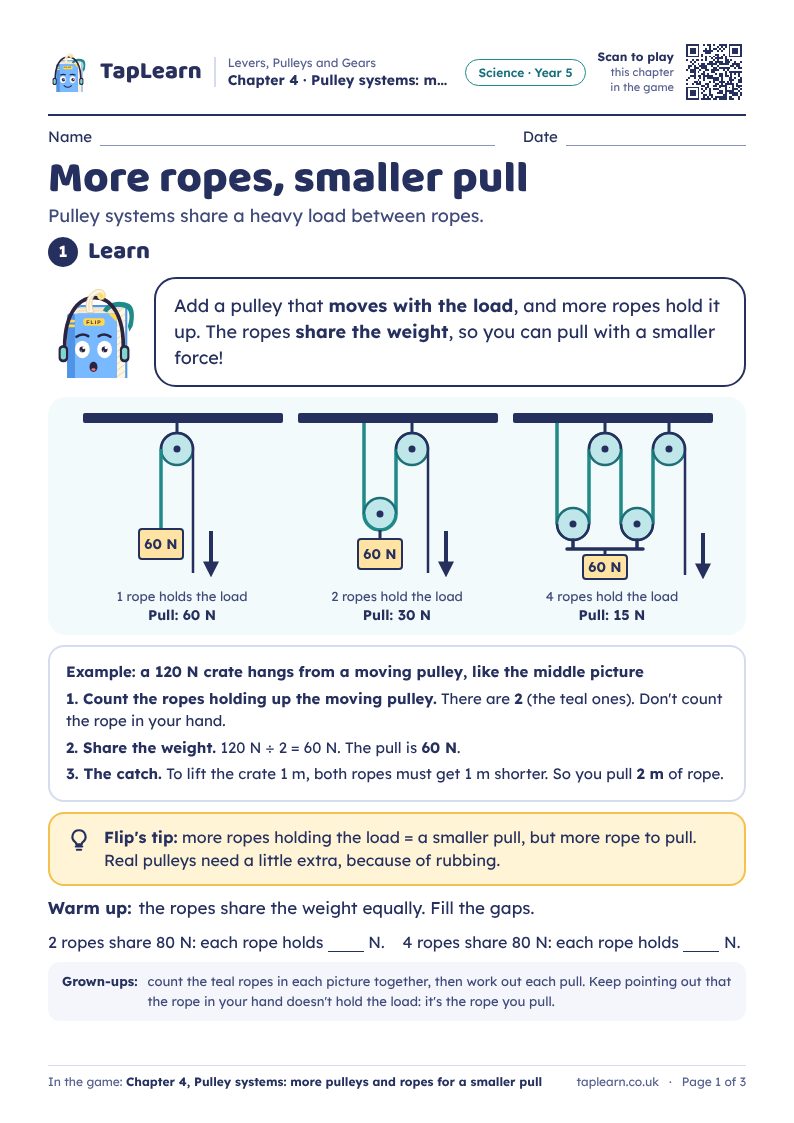
More Ropes, Smaller Pull is a printable pulley systems worksheet for Year 5 (ages 9 to 10) that teaches children to count the ropes holding a load, share its weight between them and see why more rope must be pulled. It covers the Year 5 science national curriculum statement: recognise that some mechanisms, including levers, pulleys and gears, allow a smaller force to have a greater effect.
This worksheet is for members
Membership opens every chapter of every game and every worksheet, for all your children.
See the plansAlready a member? Log in to print it.
Start with the free one: Pivot, load and effort (chapter 1).
Print it on A4, in colour or black and white. Do it after the chapter, or before it to see what your child already knows.
What's on the worksheet
Count the ropes holding a load to see why pulley systems need a smaller pull, and why more rope must be pulled. With a share-the-load string and broom activity at home, and answers.
- Page 1 · Learn
- Pictures of 1, 2 and 4 ropes holding a 60 N load, and a worked 120 N crate example showing the smaller pull and the extra rope. Warm-up: share 80 N between ropes.
- Page 2 · Try it together
- Share the load: lift a bag of books on one string, then two strands, then over a broom, and measure how far the string moves to lift the bag 10 cm.
- Page 3 · Practise
- Count ropes and work out pulls for 50 N to 200 N loads, a rope-pulled table, a true or false quiz, why cranes use many ropes, and a counting challenge.
- Answers sheet
- All answers with the pulls worked out, three common mix-ups, and quick ideas using shopping bags and cranes.
3 A4 pages and an answers sheet · about 25 minutes
In the classroom
- Mini-whiteboard check: show pulley diagrams one at a time and have pupils write the number of supporting ropes, then the pull.
- Use the page 1 challenge (Sam says 3 ropes, Mia says 2) as a talk partners debate.
Questions from the worksheet
- How much rope must be pulled to lift a load 1 m with 2 ropes holding it?
- To lift a load 2 m with 4 ropes holding it, I pull how many metres of rope?
- True or false? The rope you pull down counts as a rope holding the load.
- Cranes on building sites lift loads with pulley systems that have lots of ropes. Why?
The answers are on the answers sheet, for grown-ups.
National curriculum in England
This worksheet practises this statement from the Year 5 science programme of study:
- Recognise that some mechanisms including levers, pulleys and gears allow a smaller force to have a greater effect
Source: National curriculum in England: science programmes of study (DfE)
Using it at home
- Stick tape on the string by your child's hand so you can both see how much further it moves than the bag rises.
- Rubbing means the bag won't feel exactly half as heavy: talk about why real pulleys need a little extra pull.
Watch out for
- Thinking more pulleys make the pull harder.
- More ropes holding the load share its weight, so each pull gets smaller.
- Thinking you pull the same amount of rope.
- With 2 ropes holding the load you pull twice as much rope; with 4 ropes, four times as much.
- Counting the pulled rope.
- Only count the ropes that hold up the moving pulley and the load, not the one in your hand.
Questions and answers
Why do pulley systems make lifting easier?
In a pulley system several ropes hold the load and share its weight, so the pull you need is smaller. The catch is that you must pull more rope.
How do you work out the pull in a pulley system?
Count the ropes holding up the moving pulley and divide the load's weight by that number. A 120 N load held by 2 ropes needs a 60 N pull, ignoring rubbing.
More worksheets from Levers, Pulleys and Gears: Build Machines with Bolt
- Chapter 1: Pivot, load and effort worksheet Free
- Chapter 2: How levers make lifting easier worksheet: Lifting with less force Members
- Chapter 3: Fixed pulleys worksheet: The fixed pulley Members
- Chapter 5: Gears worksheet: How gears work Members
- Chapter 6: Levers, pulleys and gears worksheet: Mechanism detectives Members
 TapLearn