Levers, pulleys and gears worksheet for Year 5: Mechanism detectives
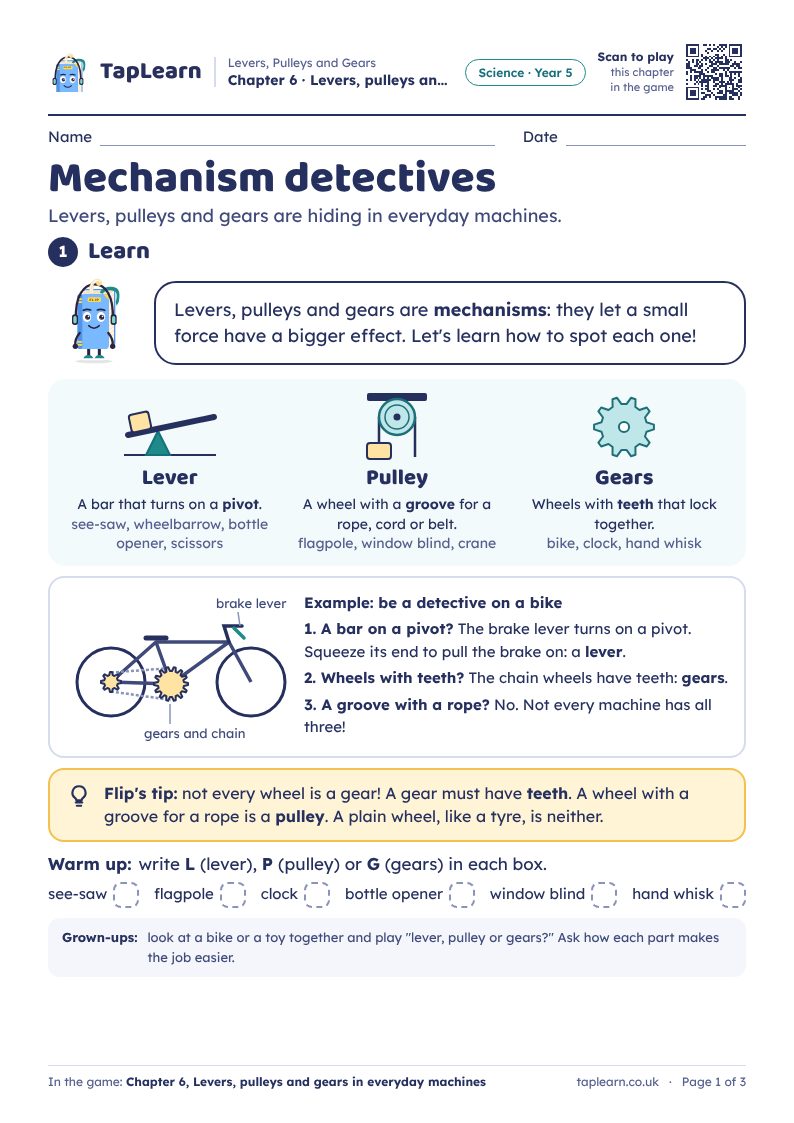
Mechanism Detectives is a printable mechanisms worksheet for Year 5 (ages 9 to 10) that teaches children to spot levers, pulleys and gears in everyday machines and choose the right one to make a heavy job easier. It covers the Year 5 science national curriculum statement: recognise that some mechanisms, including levers, pulleys and gears, allow a smaller force to have a greater effect.
This worksheet is for members
Membership opens every chapter of every game and every worksheet, for all your children.
See the plansAlready a member? Log in to print it.
Start with the free one: Pivot, load and effort (chapter 1).
Print it on A4, in colour or black and white. Do it after the chapter, or before it to see what your child already knows.
What's on the worksheet
Spot levers, pulleys and gears in everyday machines, tell a gear from a plain wheel, and choose the right mechanism for a heavy job. With a mechanism hunt around the home or park, and answers.
- Page 1 · Learn
- How to tell a lever, a pulley and gears apart, with everyday examples and a bike detective example. Warm-up: write L, P or G for six objects.
- Page 2 · Try it together
- Mechanism hunt: find one lever, one pulley and one set of gears at home, in the garden or at the park, and say how each makes a job easier.
- Page 3 · Practise
- Ring and count gears, choose lever, pulley or gears for four jobs, label the pivot, load and effort on scissors, and Sam's pulley challenge.
- Answers sheet
- All answers, three mix-ups to watch for, and an invent-a-machine idea and mechanism I spy game.
3 A4 pages and an answers sheet · about 25 minutes
Using it at home
- Pulleys are the hardest to find at home: try window blinds, a clothes airer that lifts on a cord, or the flagpole at school.
- Remind your child to work each mechanism gently and never touch moving parts of a machine that is switched on.
Watch out for
- Mixing up levers and pulleys.
- A lever is a bar on a pivot; a pulley is a wheel with a rope round it.
- Thinking any wheel is a gear.
- Only wheels with teeth are gears. Ask "Can you see teeth?"
- Thinking mechanisms give free force.
- A smaller force always has to move further: a longer push, more rope or more turns.
Questions from the worksheet
- Which mechanism would you choose to lift a big rock a little way off the ground?
- Which mechanism would you choose to make a toy car's wheels turn faster than its motor?
- A pair of scissors is two levers joined together. Where is the pivot? What is the load? Where is the effort?
- Choose one mechanism from this sheet. How does it let a small force have a bigger effect?
The answers are on the answers sheet, for grown-ups.
National curriculum in England
This worksheet practises this statement from the Year 5 science programme of study:
- Recognise that some mechanisms including levers, pulleys and gears allow a smaller force to have a greater effect
Source: National curriculum in England: science programmes of study (DfE)
In the classroom
- Use the mechanism hunt around the school grounds, with groups photographing one lever, one pulley and one set of gears.
- Plenary: pupils describe an invented machine using all three mechanisms to get a toy onto a high shelf.
Questions and answers
What are mechanisms in Year 5 science?
Mechanisms are devices such as levers, pulleys and gears that let a smaller force have a greater effect. Year 5 pupils learn to spot them in everyday machines like bikes, cranes and scissors.
How can you tell a gear from a pulley?
A gear is a wheel with teeth that lock into another gear, while a pulley is a wheel with a groove for a rope, cord or belt. A plain wheel like a tyre is neither.
More worksheets from Levers, Pulleys and Gears: Build Machines with Bolt
- Chapter 1: Pivot, load and effort worksheet Free
- Chapter 2: How levers make lifting easier worksheet: Lifting with less force Members
- Chapter 3: Fixed pulleys worksheet: The fixed pulley Members
- Chapter 4: Pulley systems worksheet: More ropes, smaller pull Members
- Chapter 5: Gears worksheet: How gears work Members
 TapLearn