Gears worksheet for Year 5: How gears work
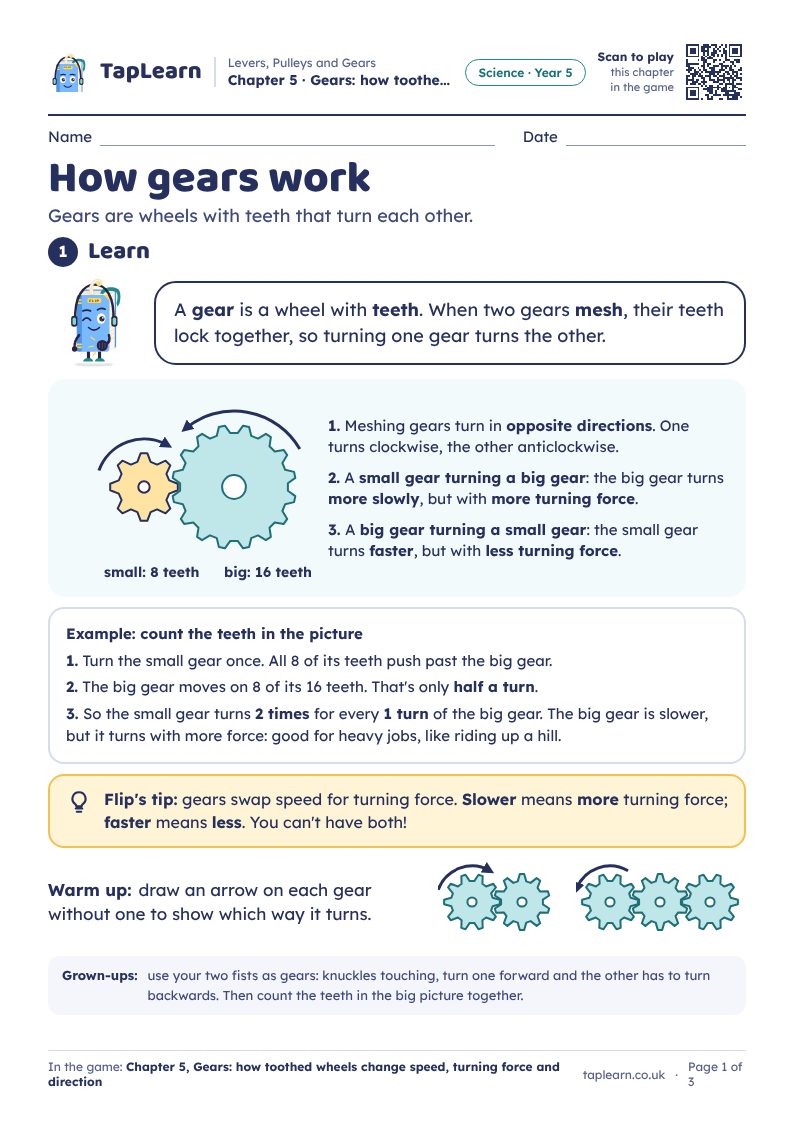
How Gears Work is a printable gears worksheet for Year 5 (ages 9 to 10) that teaches children which way meshing gears turn and how a small gear turning a big gear swaps speed for more turning force. It covers the Year 5 science national curriculum statement: recognise that some mechanisms, including levers, pulleys and gears, allow a smaller force to have a greater effect.
This worksheet is for members
Membership opens every chapter of every game and every worksheet, for all your children.
See the plansAlready a member? Log in to print it.
Start with the free one: Pivot, load and effort (chapter 1).
Print it on A4, in colour or black and white. Do it after the chapter, or before it to see what your child already knows.
What's on the worksheet
Learn that meshing gears turn in opposite directions, and that a small gear turning a big gear makes it turn more slowly with more turning force. With a bike or hand whisk gear count at home, and answers.
- Page 1 · Learn
- Three rules for meshing gears and a worked example with an 8-tooth and a 16-tooth gear. Warm-up: draw arrows to show which way each gear turns.
- Page 2 · Try it together
- Gear detectives: count back-wheel turns on an upside-down bike in its easiest and hardest gears, or count the blades' turns on a hand whisk.
- Page 3 · Practise
- Draw direction arrows for two gears, three in a row and a chain, fill a driver and driven turns table, ring faster or slower, and Leo's big-gear challenge.
- Answers sheet
- All answers, three mix-ups to watch for, and fist-gear and clock-hand ideas to try with no paper.
3 A4 pages and an answers sheet · about 25 minutes
Using it at home
- A grown-up turns the pedals on the upside-down bike while your child counts, and keeps small fingers away from the chain, gears and spokes.
- Make fist gears together, knuckles touching, to feel why meshing gears turn opposite ways before doing the arrows.
Watch out for
- Thinking meshing gears turn the same way.
- Teeth that touch push each other in opposite directions. Gears joined by a chain do turn the same way.
- Thinking the big gear is faster.
- Count the teeth: more of them must be pushed past to make one turn of the big gear.
- Thinking faster means stronger.
- It's the other way round: the slower gear turns with more force.
Questions from the worksheet
- A small gear turns a big gear. Does the big gear turn faster or slower, with more or less turning force?
- A big gear turns a small gear. Does the small gear turn faster or slower?
- Why does a bike have an easy gear for riding up hills?
- Leo says, "The big gear turns faster, because it's bigger." Is he right? Use the teeth to explain.
The answers are on the answers sheet, for grown-ups.
National curriculum in England
This worksheet practises this statement from the Year 5 science programme of study:
- Recognise that some mechanisms including levers, pulleys and gears allow a smaller force to have a greater effect
Source: National curriculum in England: science programmes of study (DfE)
In the classroom
- Starter: three pupils make a row of fist gears and the class predicts which way the third one turns.
- Pairs use construction-kit gears to check the driver and driven turns table.
Questions and answers
Which way do two meshing gears turn?
Two meshing gears turn in opposite directions: if one turns clockwise, the other turns anticlockwise. Gears joined by a chain turn the same way.
Why does a small gear turning a big gear give more force?
The big gear turns more slowly, and gears swap speed for turning force. That's why a bike's easiest gear for hills turns the back wheel slowly with lots of force.
More worksheets from Levers, Pulleys and Gears: Build Machines with Bolt
- Chapter 1: Pivot, load and effort worksheet Free
- Chapter 2: How levers make lifting easier worksheet: Lifting with less force Members
- Chapter 3: Fixed pulleys worksheet: The fixed pulley Members
- Chapter 4: Pulley systems worksheet: More ropes, smaller pull Members
- Chapter 6: Levers, pulleys and gears worksheet: Mechanism detectives Members
 TapLearn