Fixed pulleys worksheet for Year 5: The fixed pulley
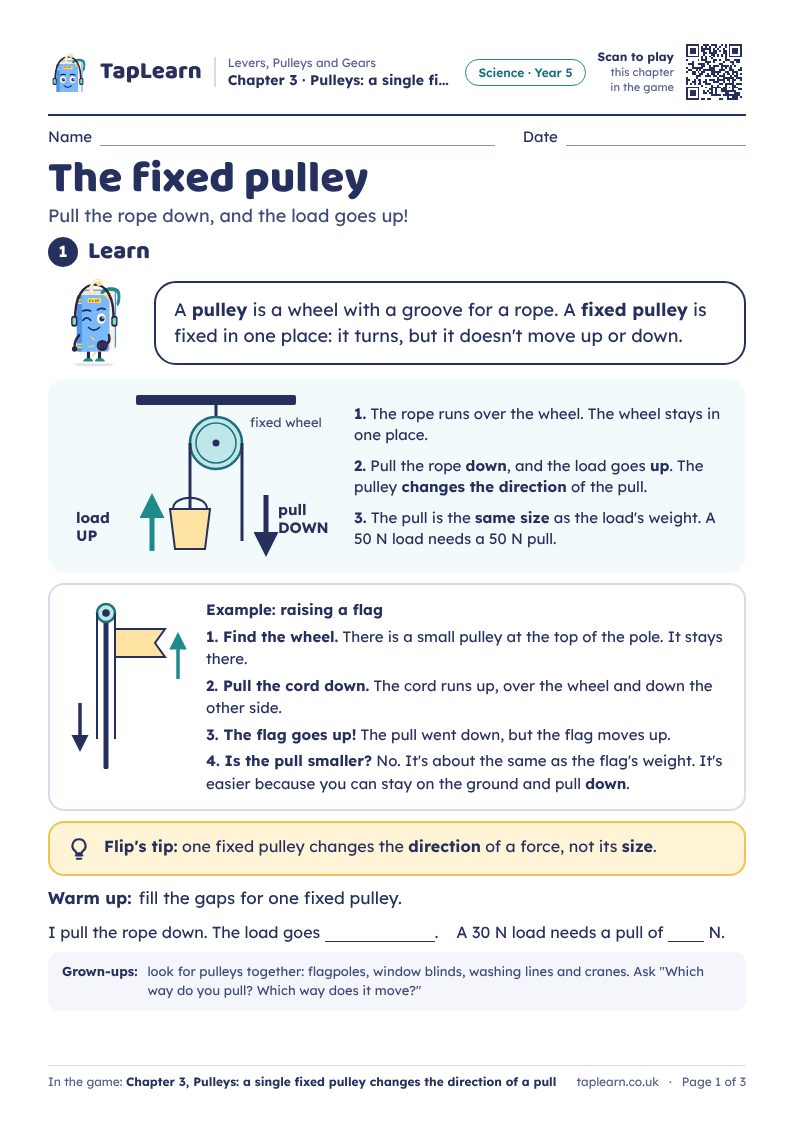
The Fixed Pulley is a printable pulleys worksheet for Year 5 (ages 9 to 10) that teaches children that one fixed pulley changes the direction of a pull but not its size, using flagpoles and wells as examples. It covers the Year 5 science national curriculum statement: recognise that some mechanisms, including levers, pulleys and gears, allow a smaller force to have a greater effect.
This worksheet is for members
Membership opens every chapter of every game and every worksheet, for all your children.
See the plansAlready a member? Log in to print it.
Start with the free one: Pivot, load and effort (chapter 1).
Print it on A4, in colour or black and white. Do it after the chapter, or before it to see what your child already knows.
What's on the worksheet
Learn that a single fixed pulley changes the direction of a pull, so pulling down lifts a load up, with the same size of force. With a broom-handle pulley and elastic-band force test at home, and answers.
- Page 1 · Learn
- What a pulley is, how pulling down lifts a load up, and a step-by-step flagpole example. Warm-up gap fill on direction and the size of the pull.
- Page 2 · Try it together
- Broom-handle pulley: lift a bag of books by an elastic band, then over a broom across two chairs, and compare the band's stretch and the directions.
- Page 3 · Practise
- Draw the direction arrows for a well bucket and a sideways pull, a true or false quiz, work out pulls for 40 N to 120 N loads, and Mia's challenge.
- Answers sheet
- All answers, the three mix-ups to watch for, and quick blind-cord and well-bucket talk ideas.
3 A4 pages and an answers sheet · about 25 minutes
Using it at home
- Keep the bag of books light and feet clear of it, and let your child do the pulling while you measure the elastic band.
- Ask "Which way do you pull? Which way does it move?" every time you spot a flagpole, blind or washing line this week.
Watch out for
- Thinking one pulley makes the load lighter.
- Pulling down feels easier because you can use your weight, but the force is the same size as the load.
- Thinking the load moves the same way as the pull.
- Draw both arrows on a picture: the pull goes down, the load goes up.
- Thinking any wheel is a pulley.
- A pulley has a groove for a rope, cord or belt.
Questions from the worksheet
- True or false? A single fixed pulley makes the pull smaller.
- True or false? The load always moves the same way as you pull the rope.
- Each load is lifted with one fixed pulley. How big is the pull for a 75 N load?
- Why is it easier to raise a flag with a pulley at the top of the pole than to carry it up a ladder?
- Mia says a fixed pulley halves the force, so she can lift a 100 N sack with a 50 N pull. Is she right?
The answers are on the answers sheet, for grown-ups.
National curriculum in England
This worksheet practises this statement from the Year 5 science programme of study:
- Recognise that some mechanisms including levers, pulleys and gears allow a smaller force to have a greater effect
Source: National curriculum in England: science programmes of study (DfE)
In the classroom
- Set up the broom-handle pulley as a demonstration with a force meter instead of an elastic band, so pupils can read the force in newtons.
- In pairs, pupils draw a flagpole and a well and add pull and load arrows, then swap and check.
Questions and answers
What does a fixed pulley do?
A fixed pulley changes the direction of a force, so pulling a rope down lifts the load up. It does not make the pull smaller.
Does a single pulley make lifting easier?
It makes lifting easier to do, not lighter: you can pull down and use your body weight. The pull is still about the same as the load's weight.
More worksheets from Levers, Pulleys and Gears: Build Machines with Bolt
- Chapter 1: Pivot, load and effort worksheet Free
- Chapter 2: How levers make lifting easier worksheet: Lifting with less force Members
- Chapter 4: Pulley systems worksheet: More ropes, smaller pull Members
- Chapter 5: Gears worksheet: How gears work Members
- Chapter 6: Levers, pulleys and gears worksheet: Mechanism detectives Members
 TapLearn