Pivot, load and effort worksheet for Year 5
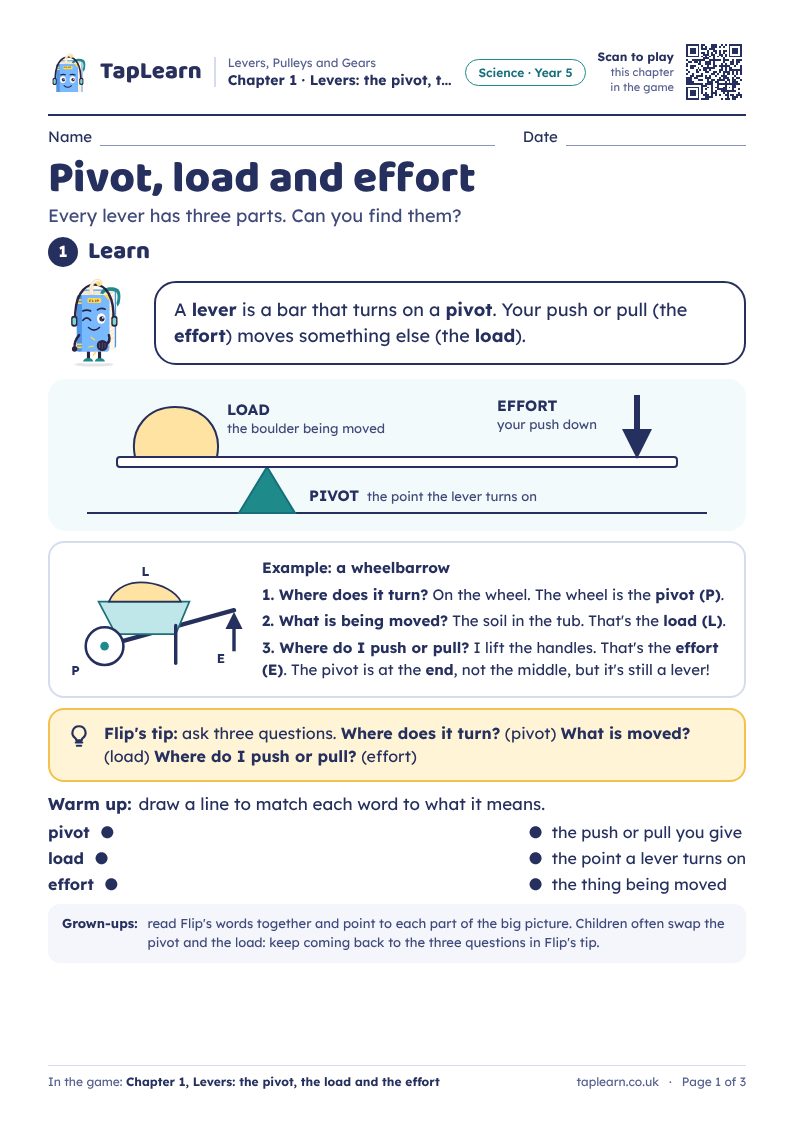
Pivot, Load and Effort is a printable levers worksheet for Year 5 (ages 9 to 10) that teaches children to name the pivot, load and effort on any lever, including levers whose pivot is at one end. It covers the Year 5 science national curriculum statement: recognise that some mechanisms, including levers, pulleys and gears, allow a smaller force to have a greater effect.
Free to print, no account needed.
Print it on A4, in colour or black and white. Do it after the chapter, or before it to see what your child already knows.
What's on the worksheet
Name the pivot, load and effort on levers such as a see-saw, crowbar, wheelbarrow and tongs, and see that a pivot isn't always in the middle. With a ruler-and-pencil lever and a lever hunt at home, plus answers.
- Page 1 · Learn
- A wheelbarrow example and Flip's three questions (Where does it turn? What is moved? Where do I push?), then a warm-up matching pivot, load and effort to their meanings.
- Page 2 · Try it together
- Lever hunt: make a lever from a ruler, a round pencil and a small toy, then find the pivot, load and effort on a peg, tongs, a stapler and a door handle.
- Page 3 · Practise
- Label a see-saw, crowbar and tongs with P, L and E, a true or false quiz, draw a lever to lift a box, and a wheelbarrow challenge.
- Answers sheet
- Every answer, the three mix-ups to watch for, and two five-minute games with no paper, such as finding the pivot in your own arm.
3 A4 pages and an answers sheet · about 25 minutes
Using it at home
- Read Flip's three questions aloud together and ask them about every lever you meet: on the sheet, in the hunt and around the kitchen.
- For the lever hunt, let your child press, squeeze and open each tool themselves before filling in the table: feeling where it turns makes the pivot easy to find.
Watch out for
- Swapping the pivot and the load.
- Ask "Where does it turn?" first: that point is always the pivot. The load is the thing that gets moved.
- Swapping the effort and the load.
- The effort is what you do, your push or pull. The load is what the lever moves.
- Thinking the pivot must be in the middle.
- See-saws and pegs have it in the middle, but wheelbarrows, tongs and staplers have it at one end.
Questions from the worksheet
- True or false? The load is the push or pull that you give.
- True or false? A lever's pivot is always in the middle.
- Draw a lever that could lift a heavy box. Label the pivot, load and effort.
- Mia says, "The load is the place where a lever turns." What would you tell her?
- Ava says a wheelbarrow can't be a lever because its pivot isn't in the middle. Is she right? Where is the pivot?
The answers are on the answers sheet, for grown-ups.
National curriculum in England
This worksheet practises this statement from the Year 5 science programme of study:
- Recognise that some mechanisms including levers, pulleys and gears allow a smaller force to have a greater effect
Source: National curriculum in England: science programmes of study (DfE)
In the classroom
- Starter: hold up classroom objects (scissors, a stapler, a ruler on a pencil) and have pupils point to the pivot, load and effort.
- Run the lever hunt as a carousel, with a tray of tools on each table and one table for each group to fill in.
Questions and answers
What are the pivot, load and effort on a lever?
The pivot is the point a lever turns on, the load is the thing being moved, and the effort is the push or pull you give. Every lever has all three.
Is the pivot of a lever always in the middle?
No, the pivot can be anywhere along a lever. A see-saw has it in the middle, but a wheelbarrow has it at the wheel and tongs have it at the joined end.
More worksheets from Levers, Pulleys and Gears: Build Machines with Bolt
- Chapter 2: How levers make lifting easier worksheet: Lifting with less force Members
- Chapter 3: Fixed pulleys worksheet: The fixed pulley Members
- Chapter 4: Pulley systems worksheet: More ropes, smaller pull Members
- Chapter 5: Gears worksheet: How gears work Members
- Chapter 6: Levers, pulleys and gears worksheet: Mechanism detectives Members
 TapLearn