How levers make lifting easier worksheet for Year 5: Lifting with less force
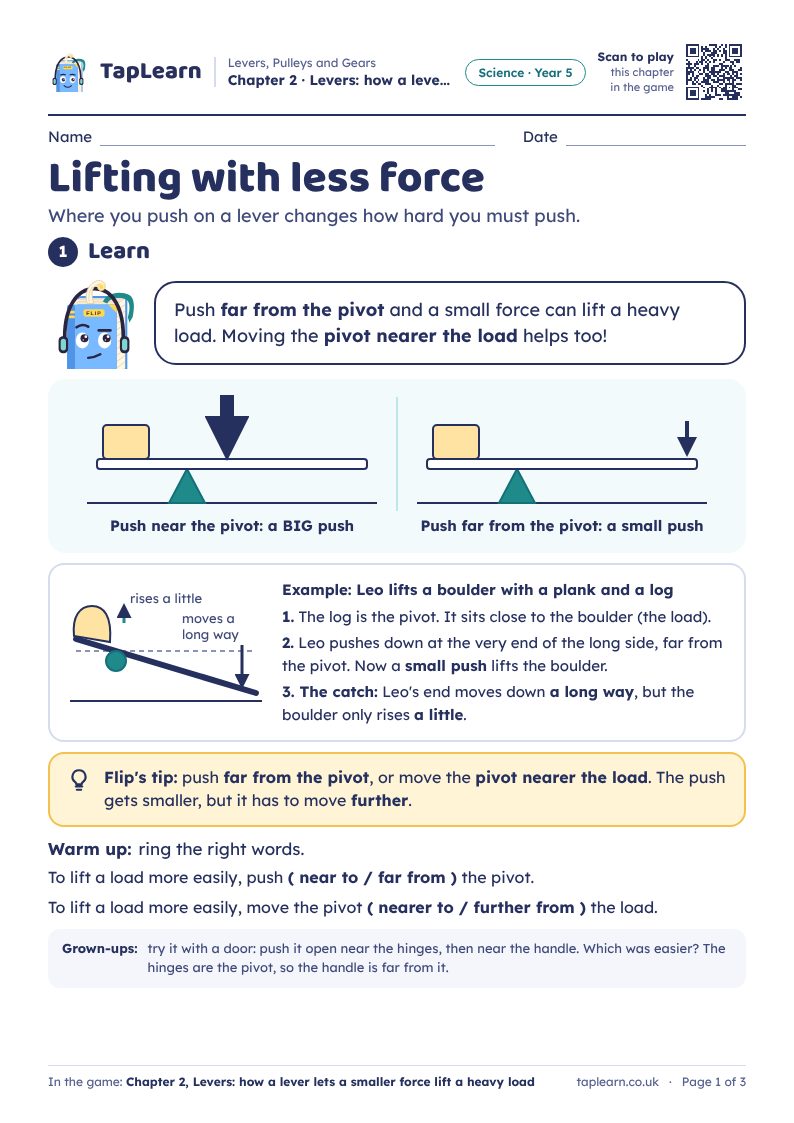
Lifting with Less Force is a printable levers worksheet for Year 5 (ages 9 to 10) that shows children how pushing far from the pivot, or moving the pivot nearer the load, lets a small force lift a heavy load. It covers the Year 5 science national curriculum statement: recognise that some mechanisms, including levers, pulleys and gears, allow a smaller force to have a greater effect.
This worksheet is for members
Membership opens every chapter of every game and every worksheet, for all your children.
See the plansAlready a member? Log in to print it.
Start with the free one: Pivot, load and effort (chapter 1).
Print it on A4, in colour or black and white. Do it after the chapter, or before it to see what your child already knows.
What's on the worksheet
See how pushing further from the pivot, or moving the pivot nearer the load, lets a smaller push lift a heavy load, and why that push must move further. With a ruler-and-coins lever test to record, and answers.
- Page 1 · Learn
- Leo lifts a boulder with a plank and a log, showing that a push far from the pivot is smaller but moves further. Warm-up: ring the right words.
- Page 2 · Try it together
- Coin lever test: balance a 30 cm ruler on a pencil, stack coins at 20, 25 and 29 cm to lift a toy, then move the pivot nearer the toy and compare.
- Page 3 · Practise
- Ring the lever needing the smaller push, read and predict pushes in newtons from Sam's table, a word-bank gap fill, door handles and Leo's pivot challenge.
- Answers sheet
- All answers, including the predicted push, three common mix-ups and two quick playground and garden-tool ideas.
3 A4 pages and an answers sheet · about 25 minutes
In the classroom
- Pairs run the coin lever test and pool results on the board to show the pattern across the class.
- Mini-whiteboard check: draw a plank lever and ask pupils to mark where they'd push, then where they'd move the pivot.
Questions from the worksheet
- Sam lifts the same load with a plank lever. Where did Sam need the biggest push?
- Predict the push at 60 cm. Write it in the table.
- Why are door handles put far away from the hinges?
- Leo says, "I'll slide the pivot closer to me, where I push." Is he right? What should he do instead?
The answers are on the answers sheet, for grown-ups.
National curriculum in England
This worksheet practises this statement from the Year 5 science programme of study:
- Recognise that some mechanisms including levers, pulleys and gears allow a smaller force to have a greater effect
Source: National curriculum in England: science programmes of study (DfE)
Using it at home
- Before the coin test, open a heavy door by pushing near the hinges and then near the handle, and ask which was easier and why.
- Coins slip and rulers bend, so the numbers won't be exact: praise spotting the pattern (fewer coins further out) rather than getting one right number.
Watch out for
- Thinking pushing close to the pivot is easier.
- It feels like it should be, but it's harder. Repeat the door test: push near the hinges, then near the handle.
- Moving the pivot towards the push.
- To make lifting easier, the pivot goes towards the load, not towards your push.
- Missing the trade-off.
- A smaller push always has to move further. Watch how far each end of the ruler moves.
Questions and answers
How does a lever make lifting easier?
A lever makes lifting easier when you push far from the pivot or move the pivot nearer the load. The push you need is smaller, but your end has to move further.
Why are door handles far from the hinges?
The hinges are the door's pivot, so a handle far from them lets a small push open a heavy door. Pushing near the hinges takes a much bigger force.
More worksheets from Levers, Pulleys and Gears: Build Machines with Bolt
- Chapter 1: Pivot, load and effort worksheet Free
- Chapter 3: Fixed pulleys worksheet: The fixed pulley Members
- Chapter 4: Pulley systems worksheet: More ropes, smaller pull Members
- Chapter 5: Gears worksheet: How gears work Members
- Chapter 6: Levers, pulleys and gears worksheet: Mechanism detectives Members
 TapLearn