Story writing worksheet for Years 3–4: My own story
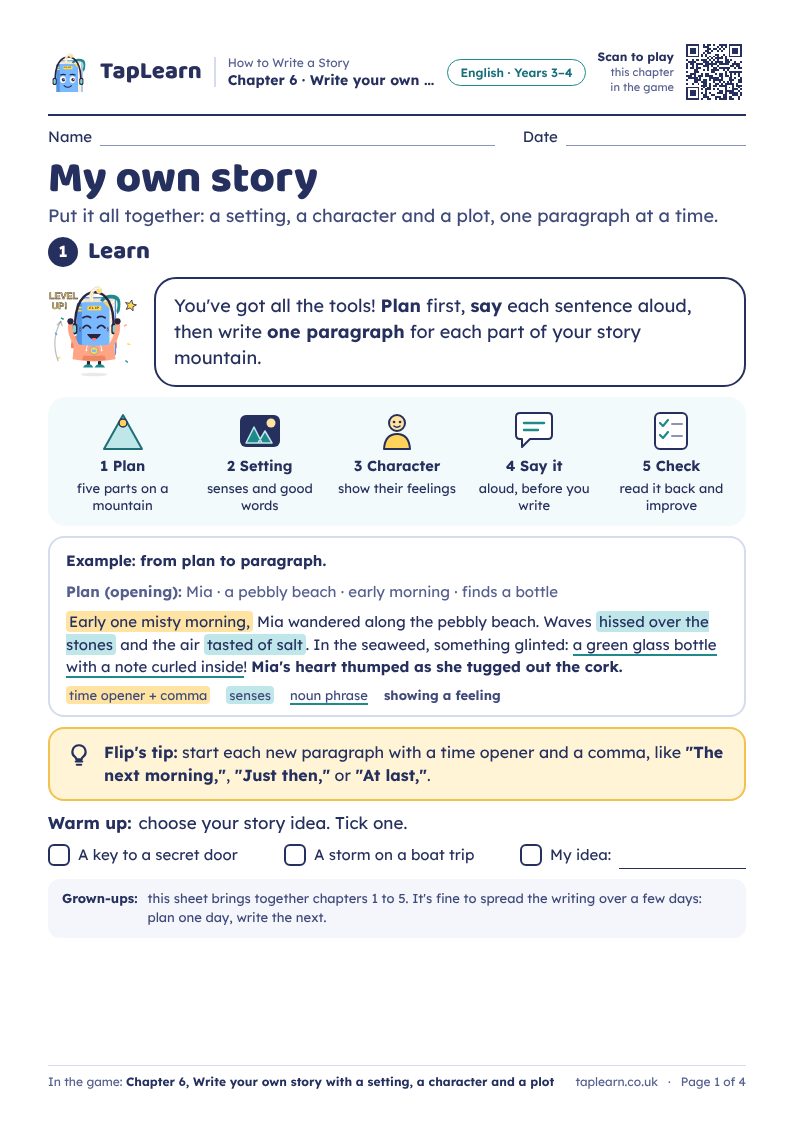
My Own Story is a printable story writing worksheet for Years 3 and 4 (ages 7 to 9) that brings together planning, settings, characters and joined sentences to write a whole story, one paragraph per part. It covers the Years 3–4 English statements on creating settings, characters and plot, rehearsing sentences aloud, and reading their own writing aloud.
This worksheet is for members
Membership opens every chapter of every game and every worksheet, for all your children.
See the plansAlready a member? Log in to print it.
Start with the free one: Read like a writer (chapter 1).
Print it on A4, in colour or black and white. Do it after the chapter, or before it to see what your child already knows.
What's on the worksheet
Your child plans and writes a whole story with a setting, a character and a plot, one paragraph for each part, then checks it like an editor. Includes a story chat planner and an answers sheet.
- Page 1 · Learn
- Five steps from plan to check, an example opening paragraph about Mia finding a bottle on a beach with each skill labelled, Flip's tip on time openers, and a choose-your-idea warm-up.
- Page 2 · Try it together
- Story chat: hold an object from home like a key or a shell, talk about who might find it and what could go wrong, fill in the planner together, and say the first sentence aloud.
- Page 3 · Practise
- Edit Sam's draft, write your own story with one paragraph for each part of the mountain, check it against a list and improve one thing, and a challenge about a missing resolution.
- Answers sheet
- Every answer, mix-ups like getting stuck or tired, and story-time and what-next ideas.
4 A4 pages and an answers sheet · about 40 minutes
Using it at home
- It's fine to spread the writing over a few days: plan one day, write the next.
- In story chat, ask questions rather than giving ideas: "How would she feel? What would she do?"
- Ask your child to read their finished story aloud to someone, with voices for the speech.
Watch out for
- Telling feelings, plain setting words and unsolved problems.
- Point back to chapters 2 to 4 for showing feelings, settings and resolutions.
- Getting stuck or tired.
- Let your child say a sentence aloud, then write just that one. Spread the writing over a few days.
Questions from the worksheet
- Be the editor! Improve Sam's draft: swap "It was nice." for a setting sentence, rewrite "He was scared." and fix the "and then" chain.
- Now write your story. Say each sentence aloud first. Write a paragraph for each part: opening, build-up, problem, resolution, ending.
- Read your story aloud. Tick each one you can find, then improve one thing.
- Leo ends: "The dragon was still in the village. The end." What part is missing?
The answers are on the answers sheet, for grown-ups.
National curriculum in England
This worksheet practises these statements from the Years 3–4 english programme of study:
- Draft and write by: in narratives, creating settings, characters and plot
- Draft and write by: composing and rehearsing sentences orally (including dialogue), progressively building a varied and rich vocabulary and an increasing range of sentence structures (English appendix 2)
- Read their own writing aloud to a group or the whole class, using appropriate intonation and controlling the tone and volume so that the meaning is clear
In the classroom
- Use story chat with objects in a mystery bag to spark ideas before planning.
- Use Sam's draft as a whole-class editing task before children write their own stories.
Questions and answers
How do you write a story in Year 3 and 4?
Plan five parts on a story mountain, write one paragraph for each, say each sentence aloud first, then read it back and improve it.
How should each paragraph in a story start?
Start each new paragraph with a time opener and a comma, like "The next morning," or "At last,".
What should children check when editing a story?
Check for five parts, a sense in the setting, a feeling shown not told, a problem that gets solved, commas after openers and speech in inverted commas.
More worksheets from How to Write a Story: A Story Workshop with Inky
- Chapter 1: Story mountain worksheet: Read like a writer Free
- Chapter 2: Setting description worksheet: Super settings Members
- Chapter 3: Show not tell worksheet: Show, don't tell Members
- Chapter 4: Story planning worksheet: Plan a plot Members
- Chapter 5: Conjunctions and speech marks worksheet: Say it, join it Members
 TapLearn