Setting description worksheet for Years 3–4: Super settings
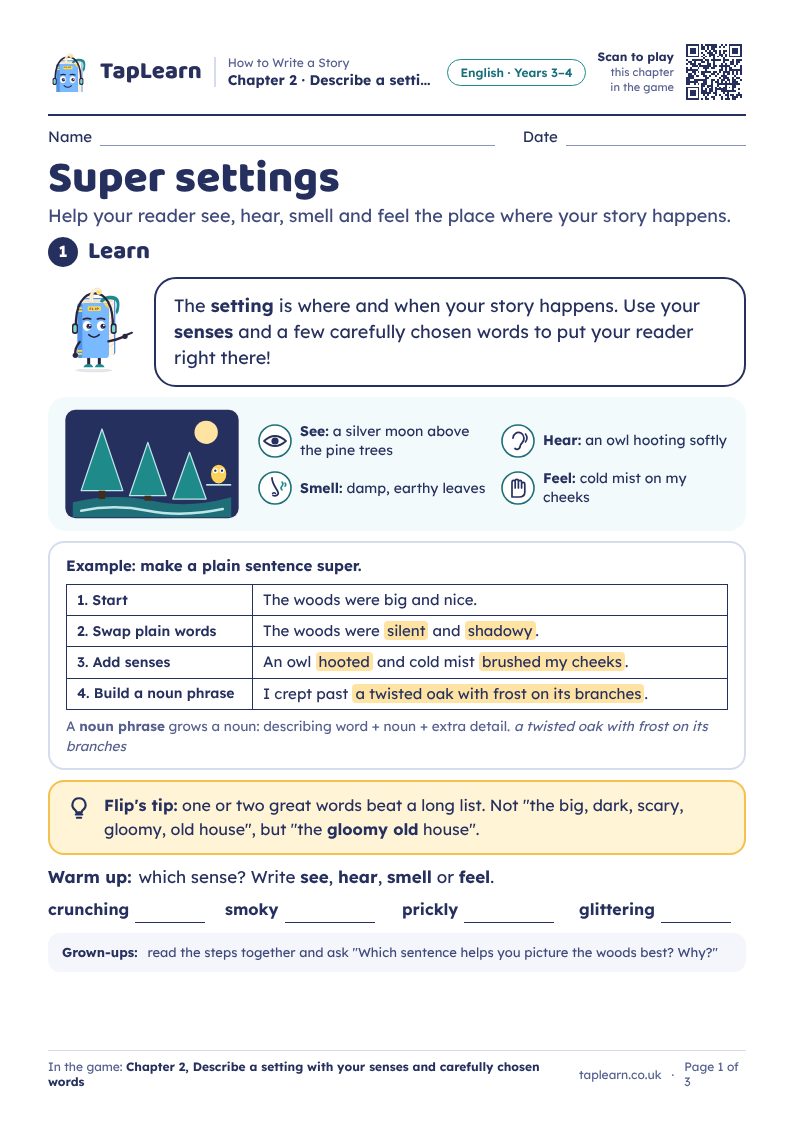
Super Settings is a printable setting description worksheet for Years 3 and 4 (ages 7 to 9) that teaches children to help readers see, hear, smell and feel a place, using one or two well-chosen words and noun phrases. It covers the Years 3–4 English statements on creating settings, characters and plot in narratives and composing and rehearsing sentences orally, including dialogue, with a varied and rich vocabulary.
This worksheet is for members
Membership opens every chapter of every game and every worksheet, for all your children.
See the plansAlready a member? Log in to print it.
Start with the free one: Read like a writer (chapter 1).
Print it on A4, in colour or black and white. Do it after the chapter, or before it to see what your child already knows.
What's on the worksheet
Your child describes a story setting with the senses, swaps plain words for better ones and builds expanded noun phrases. Includes a sense safari around the home and an answers sheet.
- Page 1 · Learn
- Sense words for a woodland setting, a worked example turning "The woods were big and nice" into a rich description, what a noun phrase is, Flip's tip, and a which-sense warm-up.
- Page 2 · Try it together
- Sense safari: sit still in a quiet spot, listen with your eyes closed, note one thing for each sense, swap any plain words, then say and write a setting sentence using two senses.
- Page 3 · Practise
- Ring the better word in setting sentences, cut long lists of describing words, build noun phrases, name the sense used in a market description, and a challenge about "nice".
- Answers sheet
- Every answer, mix-ups like only describing what can be seen, and walk-and-talk and word-swap ideas.
3 A4 pages and an answers sheet · about 25 minutes
Using it at home
- Read the steps together and ask "Which sentence helps you picture the woods most clearly? Why?"
- On the sense safari, stay away from the hob. If your child gets stuck, ask "Is it loud or soft? Fast or slow?"
- When someone says "nice" or "big", race to suggest a better word.
Watch out for
- Using plain words like big, nice, good and bad.
- Ask "What kind of big? Tall? Wide? Towering?"
- Piling up long lists of describing words.
- Too many slow the reader down. Ask "Which one or two help us picture it most clearly?"
- Only describing what can be seen.
- Ask "What could you hear? What could you smell? What would it feel like?"
Questions from the worksheet
- Draw a ring round the better word: The big / towering castle stood on top of the hill.
- Too many describing words! Rewrite with just the best one or two: The big, dark, scary, gloomy, old, spooky house stood in the lane.
- Build noun phrases: add describing words and a detail for boat and lighthouse.
- Leo says, "The beach was nice tells you all about the beach!" Is he right? Make it better using two senses.
The answers are on the answers sheet, for grown-ups.
National curriculum in England
This worksheet practises these statements from the Years 3–4 english programme of study:
- Draft and write by: in narratives, creating settings, characters and plot
- Draft and write by: composing and rehearsing sentences orally (including dialogue), progressively building a varied and rich vocabulary and an increasing range of sentence structures (English appendix 2)
In the classroom
- Take the class on a sense walk around the school grounds, then write setting sentences.
- Use Practise B as a shared editing task, cutting adjective lists to one or two strong words.
Questions and answers
How do you describe a setting in a story?
Use your senses to say what you can see, hear, smell and feel, and choose one or two precise describing words instead of plain ones like nice.
What is an expanded noun phrase?
It's a noun with describing words and extra detail, like "a twisted oak with frost on its branches".
Is it better to use lots of adjectives?
No. One or two well-chosen words, like "the gloomy old house", are clearer than a long list.
More worksheets from How to Write a Story: A Story Workshop with Inky
- Chapter 1: Story mountain worksheet: Read like a writer Free
- Chapter 3: Show not tell worksheet: Show, don't tell Members
- Chapter 4: Story planning worksheet: Plan a plot Members
- Chapter 5: Conjunctions and speech marks worksheet: Say it, join it Members
- Chapter 6: Story writing worksheet: My own story Members
 TapLearn