Story mountain worksheet for Years 3–4: Read like a writer
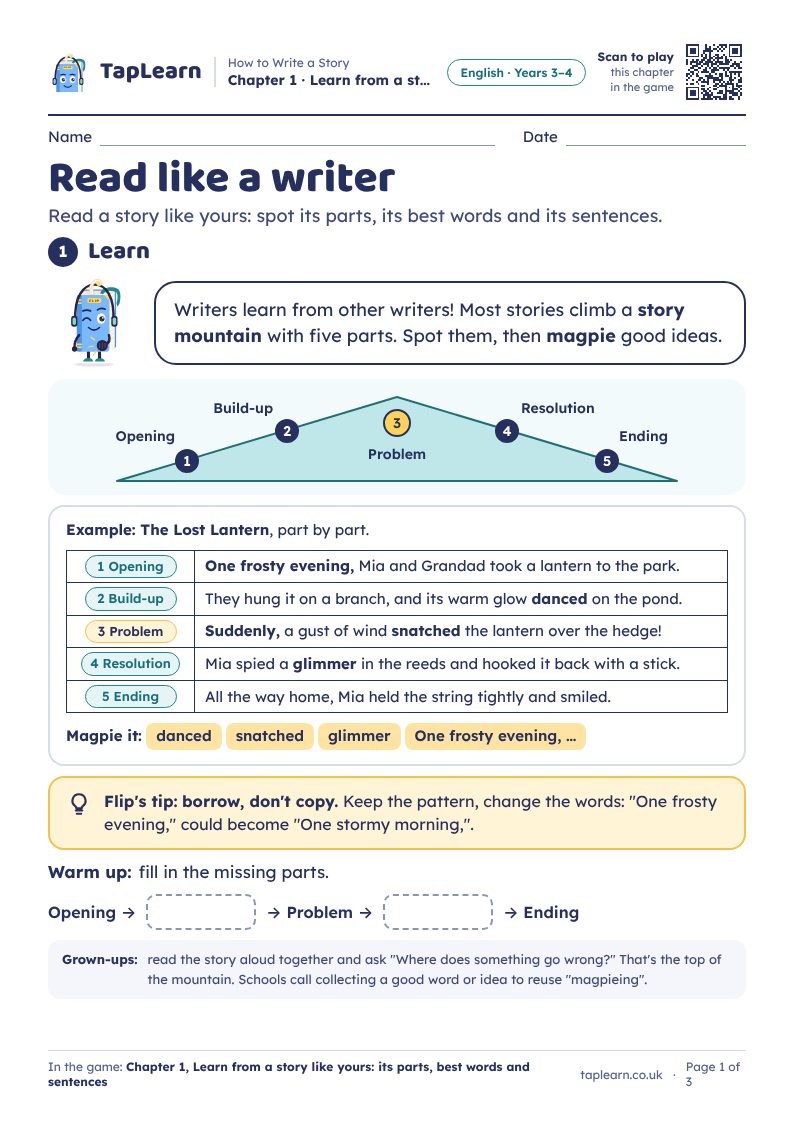
Read Like a Writer is a printable story mountain worksheet for Years 3 and 4 (ages 7 to 9) that teaches children to spot the opening, build-up, problem, resolution and ending, and to borrow a pattern without copying the words. It covers the Years 3–4 English statement on planning by discussing writing similar to what they will write, to learn from its structure, vocabulary and grammar.
Free to print, no account needed.
Print it on A4, in colour or black and white. Do it after the chapter, or before it to see what your child already knows.
What's on the worksheet
Your child spots the five parts of a story mountain, magpies great words and borrows sentence patterns without copying. Includes a story detectives activity with a book from home and an answers sheet.
- Page 1 · Learn
- The five parts of a story mountain shown with The Lost Lantern, words to magpie, Flip's tip to keep the pattern but change the words, and a fill-the-missing-parts warm-up.
- Page 2 · Try it together
- Story detectives: read a short storybook together, stop when each new part starts, note what happens on the story mountain, and hunt for great words and a sentence pattern to magpie.
- Page 3 · Practise
- Label the muddled parts of The Runaway Hat, ring the more vivid word, borrow sentence patterns, decide whether children borrowed or copied, and a challenge about the problem.
- Answers sheet
- Every answer, mix-ups like confusing the problem and the ending, and bedtime-mountain and word-of-the-day ideas.
3 A4 pages and an answers sheet · about 25 minutes
Using it at home
- Read the story aloud and ask "Where does something go wrong?" That's the top of the mountain.
- In story detectives, if a book has more than one problem, pick the biggest, and ask "How did the character fix it?"
- Collect one great word from a book and both try to use it before bedtime.
Watch out for
- Mixing up the problem and the ending.
- Ask "Where does something go wrong?", "How is it fixed?" and "How are things at the very end?"
- Copying sentences word for word.
- Magpieing keeps a good word or the shape of a sentence. Say: "Keep the pattern, change the words."
Questions from the worksheet
- Draw a ring round the word that helps you picture it more clearly: The fox went / crept through the grass. A big / towering wave crashed on the rocks.
- Borrow the pattern, not the words. Write your own sentence like this one: Suddenly, a gust of wind snatched the lantern over the hedge!
- Did each child borrow from The Lost Lantern, or copy it? Tick one.
- Leo says, "The problem in The Lost Lantern is when Mia walks home." Is he right? Which part is that, and where is the problem?
The answers are on the answers sheet, for grown-ups.
National curriculum in England
This worksheet practises this statement from the Years 3–4 english programme of study:
- Plan their writing by: discussing writing similar to that which they are planning to write in order to understand and learn from its structure, vocabulary and grammar
In the classroom
- Map a class reader onto a story mountain together, then do story detectives in pairs with picture books.
- Start a class magpie wall of great words and sentence openers.
Questions and answers
What is a story mountain?
A story mountain shows the five parts of a story: opening, build-up, problem, resolution and ending. The problem is at the top, where something goes wrong.
What does magpieing mean in writing?
Magpieing means collecting a good word or idea from another writer to reuse in your own writing.
What is the difference between borrowing and copying?
Borrowing keeps a sentence pattern but changes the people, place and things. Copying uses the same words.
More worksheets from How to Write a Story: A Story Workshop with Inky
- Chapter 2: Setting description worksheet: Super settings Members
- Chapter 3: Show not tell worksheet: Show, don't tell Members
- Chapter 4: Story planning worksheet: Plan a plot Members
- Chapter 5: Conjunctions and speech marks worksheet: Say it, join it Members
- Chapter 6: Story writing worksheet: My own story Members
 TapLearn