Conjunctions and speech marks worksheet for Years 3–4: Say it, join it
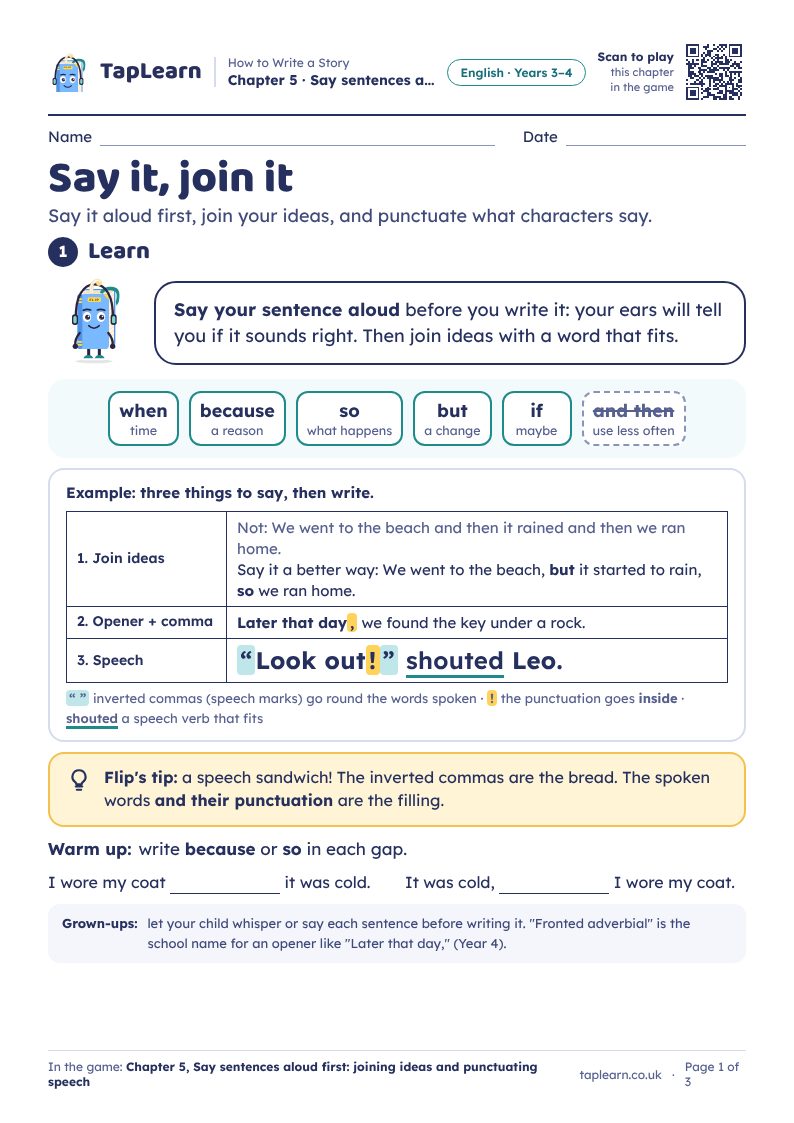
Say It, Join It is a printable conjunctions and speech marks worksheet for Years 3 and 4 (ages 7 to 9) that teaches children to say a sentence aloud, join ideas with a word that fits and put inverted commas round spoken words. It covers the Years 3–4 English statement on composing and rehearsing sentences orally, including dialogue, with a varied and rich vocabulary.
This worksheet is for members
Membership opens every chapter of every game and every worksheet, for all your children.
See the plansAlready a member? Log in to print it.
Start with the free one: Read like a writer (chapter 1).
Print it on A4, in colour or black and white. Do it after the chapter, or before it to see what your child already knows.
What's on the worksheet
Your child says sentences aloud first, joins ideas with when, because, so, but and if, adds commas after openers and punctuates speech. Includes a microphone game and an answers sheet.
- Page 1 · Learn
- Joining words and what they mean, a worked example fixing an "and then" chain, adding a comma after an opener and punctuating speech, Flip's speech sandwich tip, and a warm-up.
- Page 2 · Try it together
- The microphone game: the grown-up says two short ideas, the child joins them aloud into a pretend microphone, then you act out a short chat and write it with inverted commas.
- Page 3 · Practise
- Fill gaps with joining words, add commas after openers, add inverted commas round spoken words, choose a speech verb that fits, and a challenge about where the ! goes.
- Answers sheet
- Every answer, mix-ups like punctuation outside the speech marks, and do-the-voices and flip-it ideas.
3 A4 pages and an answers sheet · about 25 minutes
Using it at home
- Let your child whisper or say each sentence before writing it. "Fronted adverbial" is the school name for an opener like "Later that day,".
- For the microphone game, try ideas like "It was dark. I switched on the light."
- Read a story page together and do the voices: only the words inside the speech marks are said in character.
Watch out for
- Joining every idea with "and then".
- Say it aloud: does it sound like a list? Try when, because, so or but.
- Choosing a joining word that doesn't fit, or no comma after an opener.
- Saying it aloud helps with both.
- Putting speech marks round the wrong words, or punctuation outside them.
- Only the words the character says go inside, with their comma, question mark or exclamation mark.
Questions from the worksheet
- Say each sentence aloud, then fill the gap with because, so, when, but or if: Leo wanted to play outside, ___ it was pouring with rain.
- Each sentence starts with an opener. Add the missing comma: Without a sound the fox crept away.
- Add the inverted commas round the words each character says: Where is my hat? asked Leo.
- Sam writes: "Look at that rainbow"! said Mia. Is the ! in the right place? Write it correctly.
The answers are on the answers sheet, for grown-ups.
National curriculum in England
This worksheet practises this statement from the Years 3–4 english programme of study:
- Draft and write by: composing and rehearsing sentences orally (including dialogue), progressively building a varied and rich vocabulary and an increasing range of sentence structures (English appendix 2)
In the classroom
- Play the microphone game as a talk partners warm-up before writing.
- Use Practise C as a shared punctuation task on the board.
Questions and answers
Why should children say a sentence aloud before writing it?
Their ears tell them if it sounds right, so they catch missing words and joining words that don't fit.
Which joining words do Year 3 and 4 children use?
On this sheet: when for time, because for a reason, so for what happens, but for a change, and if for maybe.
Where does the punctuation go in speech?
Inside the inverted commas, with the spoken words: "Look out!" shouted Leo.
More worksheets from How to Write a Story: A Story Workshop with Inky
- Chapter 1: Story mountain worksheet: Read like a writer Free
- Chapter 2: Setting description worksheet: Super settings Members
- Chapter 3: Show not tell worksheet: Show, don't tell Members
- Chapter 4: Story planning worksheet: Plan a plot Members
- Chapter 6: Story writing worksheet: My own story Members
 TapLearn