Story planning worksheet for Years 3–4: Plan a plot
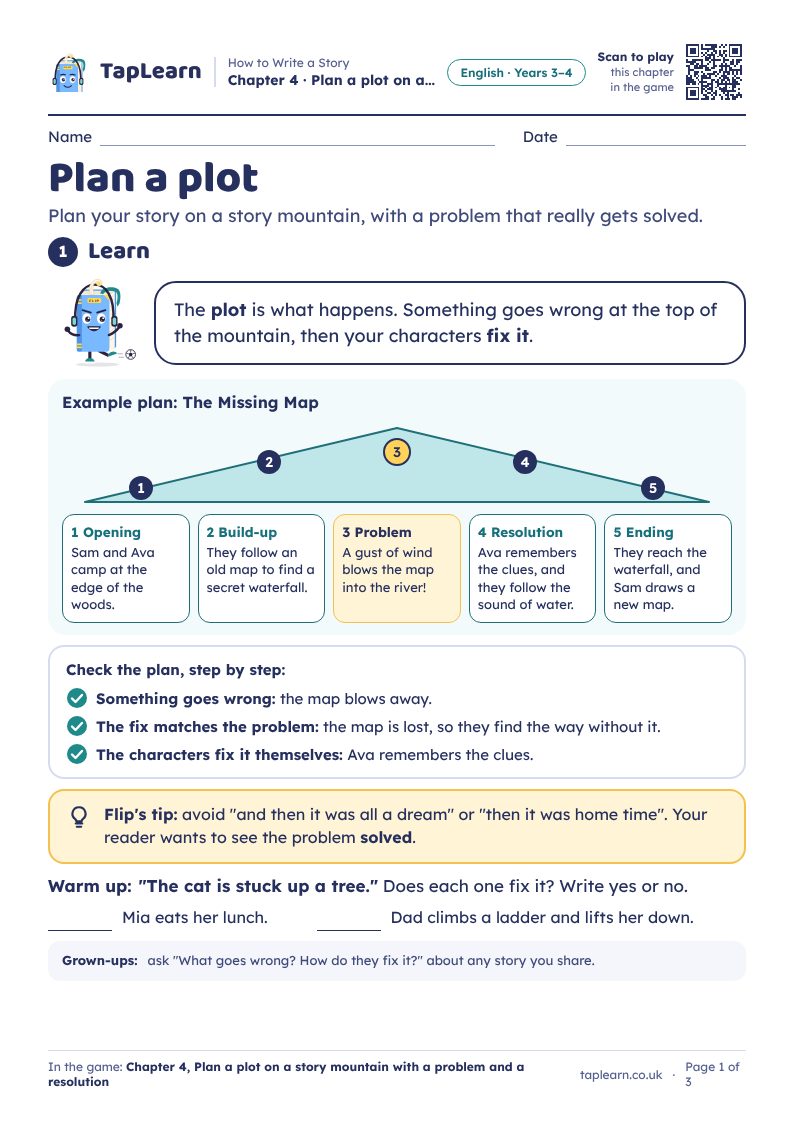
Plan a Plot is a printable story planning worksheet for Years 3 and 4 (ages 7 to 9) that teaches children to plan five parts on a story mountain and check the characters really fix the problem. It covers the Years 3–4 English statements on planning by discussing writing similar to what they will write, to learn from its structure, vocabulary and grammar and creating settings, characters and plot in narratives.
This worksheet is for members
Membership opens every chapter of every game and every worksheet, for all your children.
See the plansAlready a member? Log in to print it.
Start with the free one: Read like a writer (chapter 1).
Print it on A4, in colour or black and white. Do it after the chapter, or before it to see what your child already knows.
What's on the worksheet
Your child plans a story with an opening, build-up, problem, resolution and ending, and checks that the resolution really solves the problem. Includes a five-finger plot activity and an answers sheet.
- Page 1 · Learn
- An example plan for The Missing Map on a story mountain, three checks for a good plan, Flip's tip to avoid "it was all a dream" endings, and a does-it-fix-it warm-up.
- Page 2 · Try it together
- Five-finger plot: retell a story you both know on five fingers, then keep the characters but change the problem and plan a new resolution and ending.
- Page 3 · Practise
- Spot what's wrong with plans that have no problem, an unsolved problem or a dream ending, ring resolutions that really fix problems, plan your own story, and a challenge.
- Answers sheet
- Every answer, mix-ups like problems left unsolved, and film-fingers and problem-swap ideas.
3 A4 pages and an answers sheet · about 25 minutes
Using it at home
- Ask "What goes wrong? How do they fix it?" about any story you share.
- In five-finger plot, if the new problem is too big to fix, talk about it: "How could they solve that? Who could help?"
- After a film, retell it on five fingers together.
Watch out for
- Planning stories where nothing goes wrong.
- Ask "What's the problem? What could go wrong for your character?"
- Leaving the problem unsolved.
- Ask "How does the problem get fixed? Who fixes it?"
- Ending with "it was all a dream".
- It can feel like a cheat. Ask "How could your character solve it for real?"
Questions from the worksheet
- What is wrong with each plan? Write N (no problem), U (problem unsolved) or D (dream ending).
- Draw a ring round the resolution that really fixes the problem: the class hamster has escaped!
- Plan your own story. Write a few words for each part: opening, build-up, problem, resolution, ending.
- Ava says, "It was all a dream is a great ending: it's a surprise!" What would you tell her?
The answers are on the answers sheet, for grown-ups.
National curriculum in England
This worksheet practises these statements from the Years 3–4 english programme of study:
- Plan their writing by: discussing writing similar to that which they are planning to write in order to understand and learn from its structure, vocabulary and grammar
- Draft and write by: in narratives, creating settings, characters and plot
In the classroom
- Use five-finger plot with a familiar fairy tale, changing the problem in groups.
- Use Practise A as a discussion task on what makes a good plan.
Questions and answers
How do you plan a story?
Plan five parts on a story mountain: opening, build-up, problem, resolution and ending. Make sure something goes wrong and gets fixed.
What is a resolution in a story?
The resolution is where the characters fix the problem. It should match the problem and make sense.
Why avoid "it was all a dream" endings?
The reader cared about what happened, and a dream means none of it mattered. It's better to let the character solve the problem.
More worksheets from How to Write a Story: A Story Workshop with Inky
- Chapter 1: Story mountain worksheet: Read like a writer Free
- Chapter 2: Setting description worksheet: Super settings Members
- Chapter 3: Show not tell worksheet: Show, don't tell Members
- Chapter 5: Conjunctions and speech marks worksheet: Say it, join it Members
- Chapter 6: Story writing worksheet: My own story Members
 TapLearn