Show not tell worksheet for Years 3–4: Show, don't tell
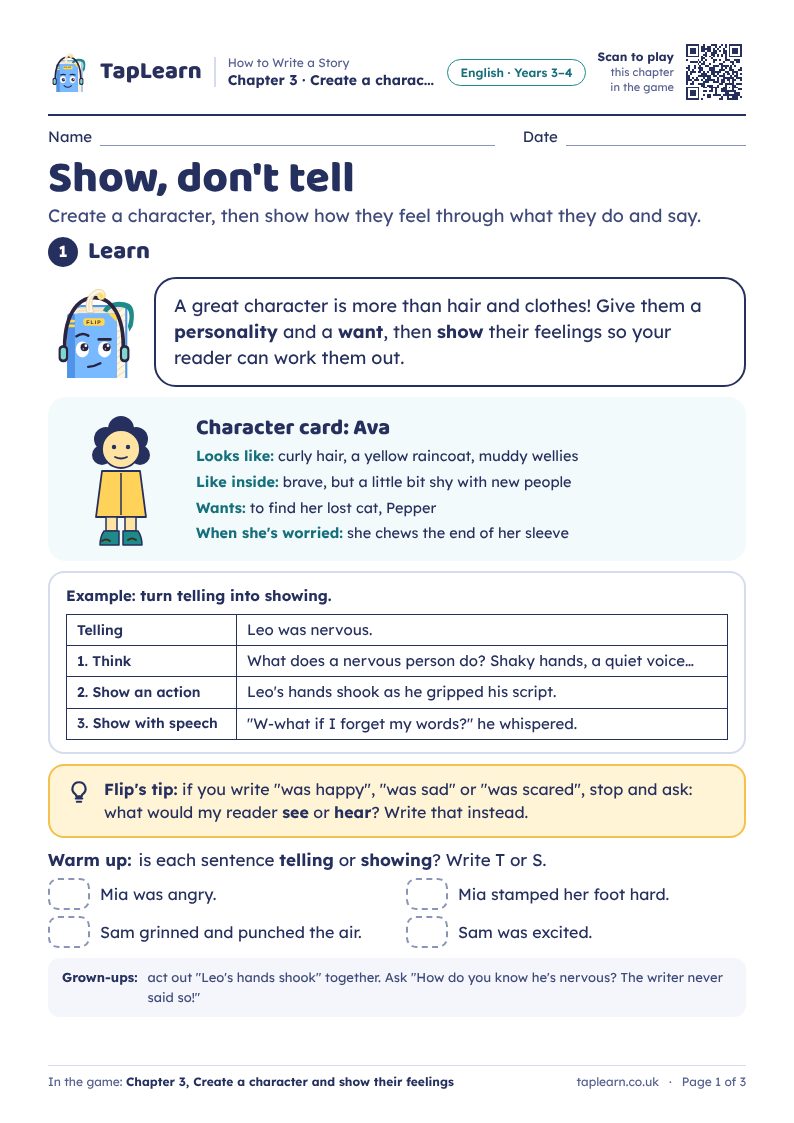
Show, Don't Tell is a printable show not tell worksheet for Years 3 and 4 (ages 7 to 9) that teaches children to give a character a personality and a want, then show feelings through what they do and say. It covers the Years 3–4 English statements on creating settings, characters and plot in narratives and composing and rehearsing sentences orally, including dialogue, with a varied and rich vocabulary.
This worksheet is for members
Membership opens every chapter of every game and every worksheet, for all your children.
See the plansAlready a member? Log in to print it.
Start with the free one: Read like a writer (chapter 1).
Print it on A4, in colour or black and white. Do it after the chapter, or before it to see what your child already knows.
What's on the worksheet
Your child creates a story character with a personality and a goal, and shows their feelings through actions and speech instead of telling. Includes a show-me acting game and an answers sheet.
- Page 1 · Learn
- A character card for Ava, a worked example turning "Leo was nervous" into an action and speech, Flip's tip to write what the reader would see or hear, and a telling-or-showing warm-up.
- Page 2 · Try it together
- Show me!: write six feelings on scraps, take turns acting one out without words while the other guesses and says what they saw, then turn one into a sentence that shows it.
- Page 3 · Practise
- Match actions to feelings, rewrite telling sentences to show feelings, create your own character card, and a challenge about only describing looks.
- Answers sheet
- Every answer, mix-ups like describing only looks, and show-me and story-spotting ideas.
3 A4 pages and an answers sheet · about 25 minutes
Using it at home
- Act out "Leo's hands shook" together and ask "How do you know he's nervous? The writer never said so!"
- In show me!, no acting skill is needed: big, simple actions work well.
- In a book, find a feeling that is shown, not told, and talk about how the writer did it.
Watch out for
- Telling feelings, like "she was sad".
- Ask "What would she do if she was sad? What might she say?" Show the big moments.
- Describing only looks.
- One detail is plenty. Ask "What is your character like inside? What do they want?"
Questions from the worksheet
- Draw a line from each action to the feeling it shows: His knees shook and he hid behind the door. Sam yawned and drummed his fingers.
- Rewrite each sentence to show the feeling. Use an action, and speech if you like: Ava was sad. Leo was surprised.
- Create your own character. Draw them, then fill in their card: name, looks like, like inside, wants.
- Sam writes: "Tom has brown hair, blue eyes and a green jumper." Mia says, "I know what Tom looks like, but nothing else about him!" Who is right? What could Sam add?
The answers are on the answers sheet, for grown-ups.
National curriculum in England
This worksheet practises these statements from the Years 3–4 english programme of study:
- Draft and write by: in narratives, creating settings, characters and plot
- Draft and write by: composing and rehearsing sentences orally (including dialogue), progressively building a varied and rich vocabulary and an increasing range of sentence structures (English appendix 2)
In the classroom
- Play show me! as a drama warm-up, with the class guessing feelings from actions.
- Use Practise B as paired writing, sharing the most effective showing sentences.
Questions and answers
What does show, don't tell mean in writing?
It means showing a character's feelings through what they do and say, like "Leo's hands shook", instead of telling the reader "Leo was nervous".
How do you create a good story character?
Give them one detail about their looks, a personality, something they want, and a way they act when they're worried.
Is it ever fine to tell a feeling?
Yes. Telling now and then is fine. Show the feelings at the big moments of the story.
More worksheets from How to Write a Story: A Story Workshop with Inky
- Chapter 1: Story mountain worksheet: Read like a writer Free
- Chapter 2: Setting description worksheet: Super settings Members
- Chapter 4: Story planning worksheet: Plan a plot Members
- Chapter 5: Conjunctions and speech marks worksheet: Say it, join it Members
- Chapter 6: Story writing worksheet: My own story Members
 TapLearn