What is the internet worksheet for Years 3–6: What is the internet?
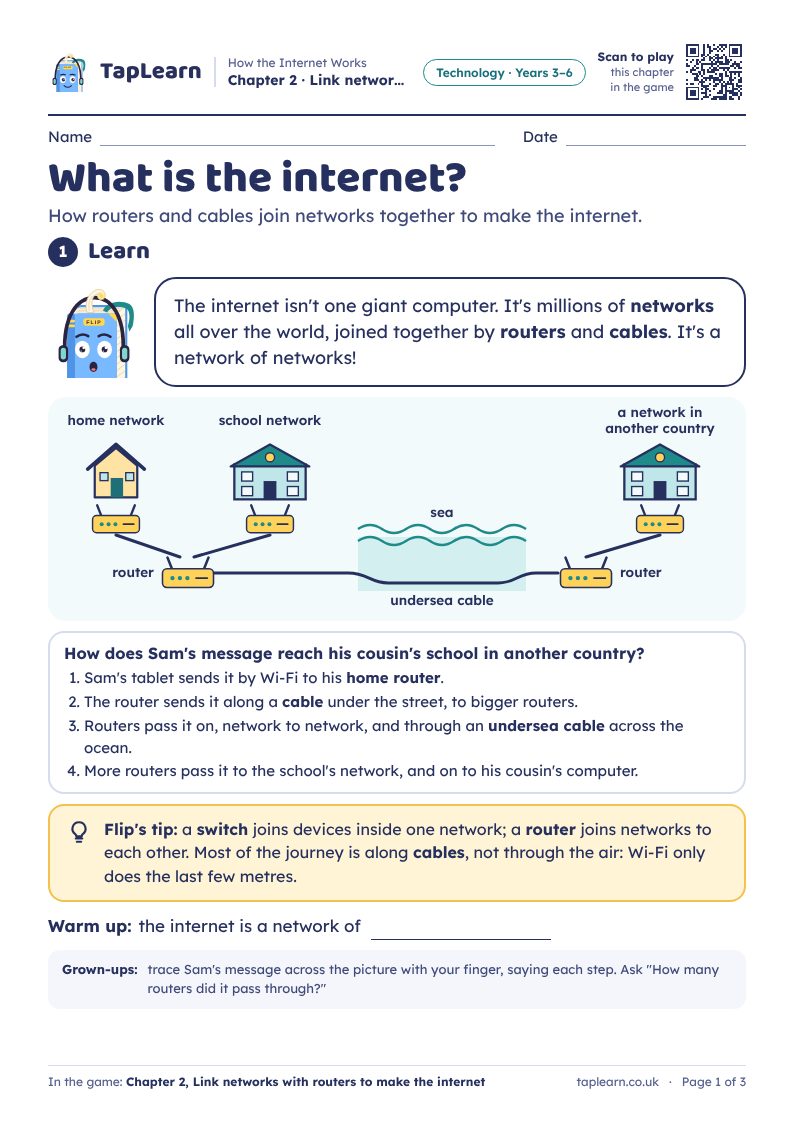
What Is the Internet? is a printable worksheet for Years 3 to 6 (ages 7 to 11) that teaches children that the internet is a network of networks, joined together by routers and cables, including cables under the sea. It follows the KS2 computing curriculum in England: understand computer networks including the internet, and the services they can provide, such as the World Wide Web.
This worksheet is for members
Membership opens every chapter of every game and every worksheet, for all your children.
See the plansAlready a member? Log in to print it.
Start with the free one: Computer networks (chapter 1).
Print it on A4, in colour or black and white. Do it after the chapter, or before it to see what your child already knows.
What's on the worksheet
Describe the internet as a network of networks, joined by routers and cables, including the cables under the sea. With a follow-the-cable activity and answers.
- Page 1 · Learn
- A picture of home and school networks joined by routers and an undersea cable, and a worked example following Sam's message to another country.
- Page 2 · Try it together
- Follow the cable: find your home router, follow its cable to the wall with your eyes, and draw where a message might travel next.
- Page 2–3 · Practise
- Sort switch from router, order a message's journey, decide true or false, fill the gaps, and explain "a network of networks". Then a challenge about Wi-Fi and cables.
- Answers sheet
- Every answer, what to watch out for (one giant computer, mostly wireless, router and switch mixed up) and a pass-it-on game.
3 A4 pages and an answers sheet · about 30 minutes
Using it at home
- When you look at your router together, just look: there's no need to touch or unplug anything.
- Trace Sam's message across the picture with your finger before starting the Practise sets.
Watch out for
- Thinking the internet is one giant computer.
- Explain that it's lots of separate networks, owned by different people, that agree to pass messages on.
- Thinking the internet mostly travels through the air.
- Wi-Fi is the part we notice, but the long journeys are along cables, even under the sea.
- Mixing up a router and a switch.
- A switch links devices inside a network; a router links networks to each other.
Questions from the worksheet
- Switch or router? It joins our home network to the rest of the internet.
- Number the steps to show a message's journey to another country.
- True or false: Wi-Fi carries messages all the way round the world.
- Why is the internet called "a network of networks"?
- Mia says, "The internet mostly travels through the air, like Wi-Fi." Is she right?
The answers are on the answers sheet, for grown-ups.
National curriculum in England
This worksheet practises this statement from the Years 3–6 computing programme of study:
- Understand computer networks including the internet; how they can provide multiple services, such as the world wide web; and the opportunities they offer for communication and collaboration
Source: National curriculum in England: computing programmes of study (DfE)
In the classroom
- Use the journey ordering set as a group activity with the four steps on cards.
- Play pass it on: line pupils up as routers and pass a folded note from one end to the other.
Questions and answers
What is the internet, in simple words?
The internet is millions of computer networks all over the world, joined together by routers and cables so they can pass messages to each other. That's why it is called a network of networks.
Does the internet go under the sea?
Yes. Almost all internet messages between continents travel through cables laid along the sea bed. Wi-Fi only carries them the last few metres to your device.
 TapLearn