Determiners and pronouns worksheet for Year 4: Word jobs
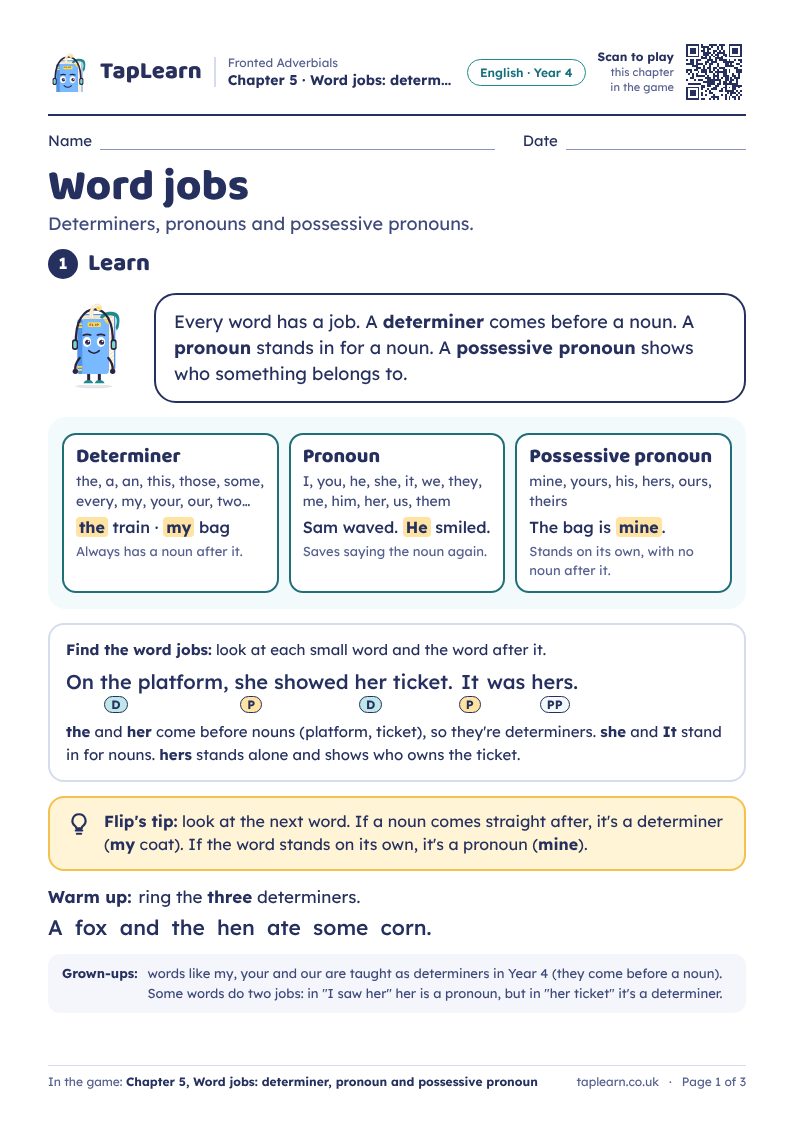
Word Jobs is a printable determiners and pronouns worksheet for Year 4 (ages 8 to 9) that teaches children that a determiner comes before a noun, a pronoun stands in for a noun and a possessive pronoun like mine shows who owns something. It covers the Year 4 statement on the terms determiner, pronoun and possessive pronoun.
Free to print, no account needed.
Print it on A4, in colour or black and white. Do it after the chapter, or before it to see what your child already knows.
What's on the worksheet
Your child spots determiners, pronouns and possessive pronouns using a next-word test, and chooses between words like my and mine. Includes a lost property game with everyday things and an answers sheet.
- Page 1 · Learn
- The three word jobs with examples, a worked example labelling a sentence about a ticket, Flip's next-word test, and a ring-the-determiners warm-up.
- Page 2 · Try it together
- Lost property: hold up everyday things and ask "Whose is this?", answer with a determiner (my sock) and then a possessive pronoun (mine), then hunt for the, a and this in a book.
- Page 3 · Practise
- Sort words into the three jobs, ring my or mine and similar pairs, replace repeated words with a pronoun, label words D, P or PP, and a challenge about "This bag is my".
- Answers sheet
- Every answer, mix-ups like my and mine, and a little-word-spotting idea.
3 A4 pages and an answers sheet · about 25 minutes
Using it at home
- Words like my, your and our are taught as determiners in Year 4, because they come before a noun.
- In lost property, include family things ("our cup", "ours") and someone else's ("their bike", "theirs").
- In a book, find "the", "a" and "this" and say the noun that follows each one.
Watch out for
- Mixing up pronouns and determiners.
- Use the next-word test: a determiner has a noun straight after it (this book); a pronoun replaces the noun (it).
- Mixing up my and mine, your and yours, our and ours.
- "My" needs a noun: my coat. "Mine" stands alone: the coat is mine.
- Being puzzled by words with two jobs, like his and her.
- "His hat" is a determiner, "the hat is his" a possessive pronoun, and "I saw her" a pronoun.
Questions from the worksheet
- Sort the words into determiner, pronoun or possessive pronoun: the, she, mine, those, they, ours, an, him, theirs, every, we, yours.
- Ring the right word in each sentence: This is ( my / mine ) coat. The coat is ( my / mine ). Those seats are ( our / ours ).
- Cross out the repeated words and write a pronoun above them: The dog barked. The dog wanted a walk.
- Write D (determiner), P (pronoun) or PP (possessive pronoun) under each underlined word: After school, we found a puppy. It was ours!
- Sam says my and mine do the same job, so "This bag is my." is fine. Is he right? Explain the difference.
The answers are on the answers sheet, for grown-ups.
National curriculum in England
This worksheet practises this statement from the Year 4 english programme of study:
- Terminology: determiner, pronoun, possessive pronoun, adverbial
In the classroom
- Play lost property with classroom objects as a starter.
- Use Practise A as a card sort in pairs.
Questions and answers
What is the difference between a determiner and a pronoun?
A determiner comes before a noun (the train, my bag). A pronoun stands in for a noun so you don't repeat it (he, it, they).
What is a possessive pronoun?
A possessive pronoun shows who something belongs to and stands on its own, with no noun after it: mine, yours, his, hers, ours, theirs.
Is my a determiner or a pronoun?
In Year 4, my is taught as a determiner because it comes before a noun (my coat). Mine is the possessive pronoun.
 TapLearn