Fronted adverbials worksheet for Year 4: Sentence openers
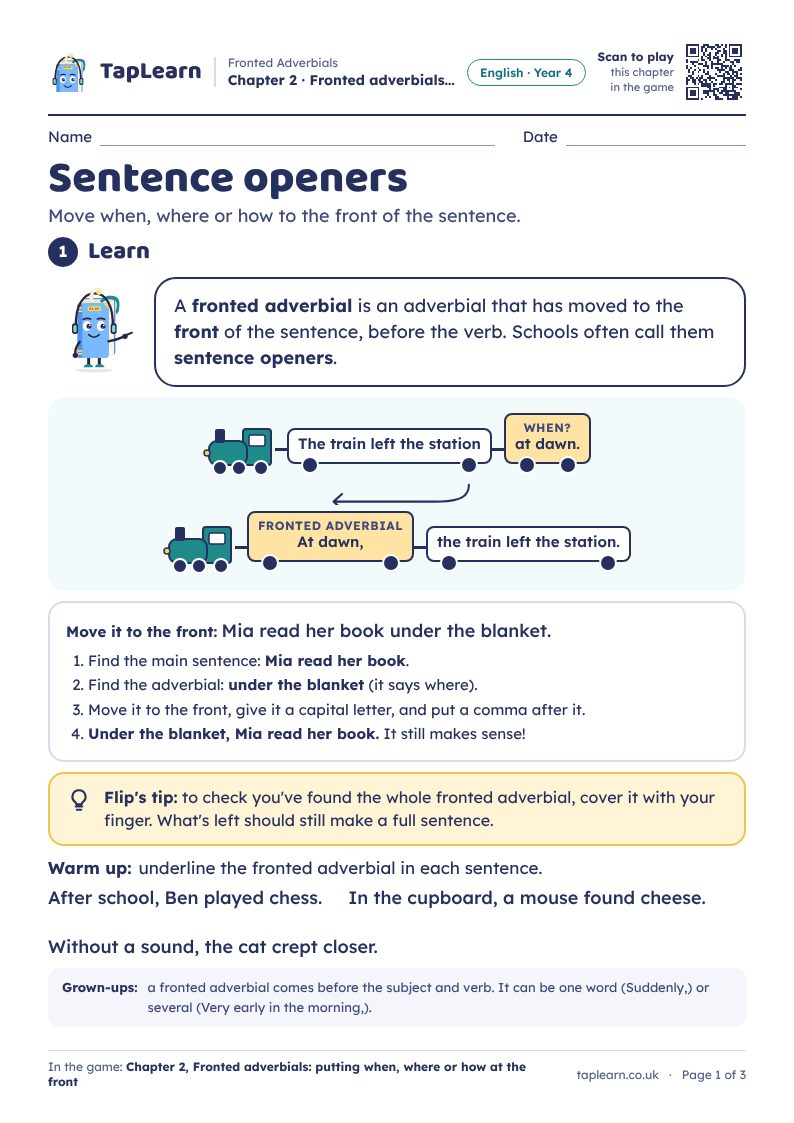
Sentence Openers is a printable fronted adverbials worksheet for Year 4 (ages 8 to 9) that teaches children to spot an adverbial at the start of a sentence and move one to the front, as in "At dawn, the train left the station." It covers the Year 4 statements on using fronted adverbials.
Free to print, no account needed.
▶ Play chapter 2 in the game · How the fronted adverbials works
Print it on A4, in colour or black and white. Do it after the chapter, or before it to see what your child already knows.
What's on the worksheet
Your child spots fronted adverbials (sentence openers) and moves when, where or how adverbials to the start of a sentence, using a finger test to find the whole opener. Includes a storybook opener hunt and an answers sheet.
- Page 1 · Learn
- What a fronted adverbial is, a sentence with its adverbial moved to the front, a worked example with "under the blanket", Flip's finger test, and an underline-the-opener warm-up.
- Page 2 · Try it together
- Opener hunt: look through storybooks for sentences that start by saying when, where or how, write five fronted adverbials in the table, then try one at the end of its sentence.
- Page 3 · Practise
- Ring the whole fronted adverbial, move adverbials to the front, tick sentences that start with one, rewrite a sentence with an opener, and a challenge about "Very early".
- Answers sheet
- Every answer, mix-ups like ringing only part of a long opener, and a story-starts idea.
3 A4 pages and an answers sheet · about 25 minutes
Using it at home
- A fronted adverbial comes before the subject and verb. It can be one word (Suddenly,) or several (Very early in the morning,).
- For the opener hunt, fairy tales are a good start ("Once upon a time,"), and adventure stories are full of "Suddenly," and "Without warning,".
- Take turns starting a made-up story with an opener: "Far away,", "Very quietly,".
Watch out for
- Picking part of the main sentence, like "the stars".
- The fronted adverbial comes before the subject and verb, and in Year 4 it's followed by a comma, which is a useful clue.
- Picking only some of the words in a long opener, like "Deep" for "Deep in the forest".
- Use the finger test: the rest must be a complete sentence on its own.
- Forgetting to move the capital letter.
- The opener now starts the sentence, so it gets the capital. Names and I keep their capitals.
Questions from the worksheet
- Draw a ring round the whole fronted adverbial. Then write when, where or how: Once upon a time, a dragon lived in a cave. Deep in the forest, an owl was hooting.
- Move the adverbial to the front. Write the new sentence with a capital letter and a comma: The bell rang at half past three.
- Tick the sentences that start with a fronted adverbial: The dog barked loudly. Suddenly, the lights went out. Every morning, I brush my teeth.
- Sam says the fronted adverbial in "Very early in the morning, the birds began to sing." is just "Very early". Is he right? Use Flip's finger test to explain.
The answers are on the answers sheet, for grown-ups.
National curriculum in England
This worksheet practises these statements from the Years 3–4 english programme of study:
- Develop their understanding of the concepts set out in English appendix 2 by: using fronted adverbials
- Sentence: fronted adverbials (Year 4 english)
In the classroom
- Use the warm-up as a starter on mini whiteboards.
- Give pairs sentences on strips to cut and rearrange with the adverbial at the front.
Questions and answers
What is a fronted adverbial?
A fronted adverbial is an adverbial moved to the front of a sentence, before the verb, like "At dawn," in "At dawn, the train left the station."
Are fronted adverbials the same as sentence openers?
Yes. Schools often call fronted adverbials sentence openers, because they open the sentence.
How do you check you've found the whole fronted adverbial?
Cover it with your finger. What's left should still make a full sentence.
 TapLearn