Commas after fronted adverbials worksheet for Year 4: Comma catch
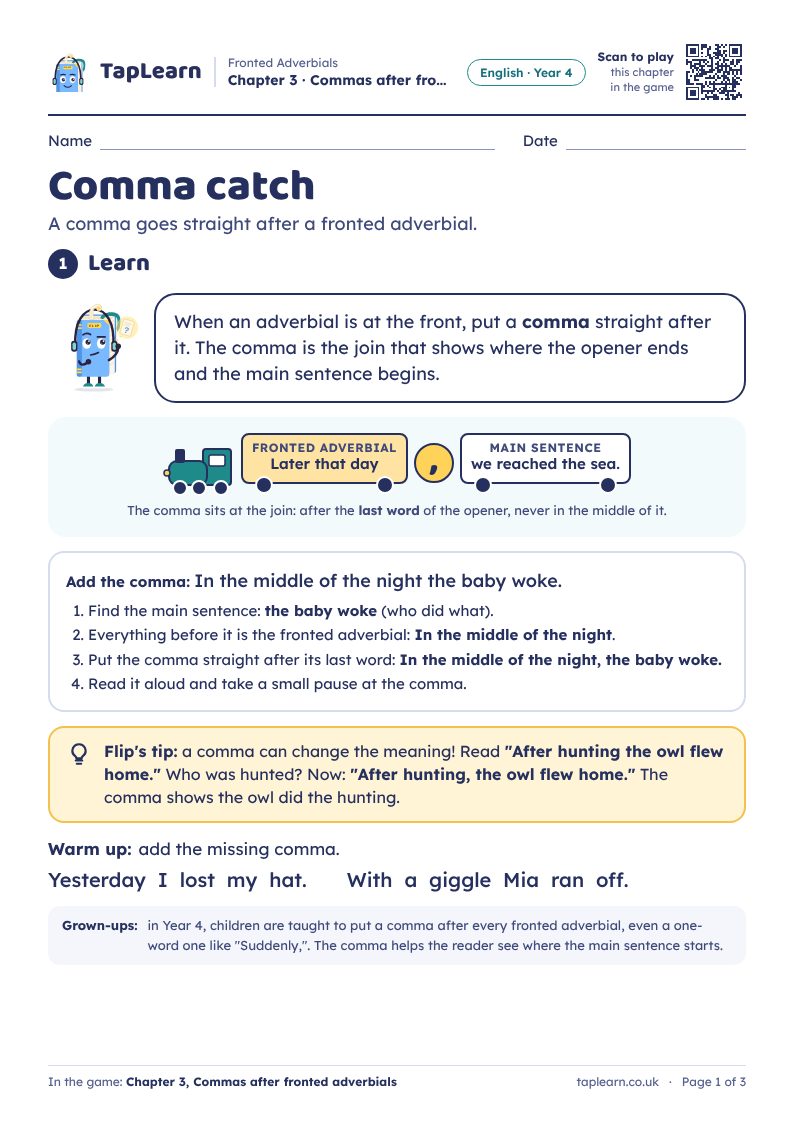
Comma Catch is a printable commas after fronted adverbials worksheet for Year 4 (ages 8 to 9) that teaches children to put the comma straight after the last word of the opener, never in the middle. It covers the Year 4 statement on using commas after fronted adverbials.
Free to print, no account needed.
Print it on A4, in colour or black and white. Do it after the chapter, or before it to see what your child already knows.
What's on the worksheet
Your child puts a comma straight after a fronted adverbial, fixes commas in the wrong place, and sees how a missing comma can change the meaning. Includes a bright-pen sticky-note comma activity and an answers sheet.
- Page 1 · Learn
- Where the comma goes, a worked example adding the comma to "In the middle of the night the baby woke", Flip's tip on how a comma changes meaning, and an add-the-comma warm-up.
- Page 2 · Try it together
- Bright-pen commas: the grown-up writes three sentences with openers and no commas on sticky notes, the child adds each comma in bright pen, then writes one for the grown-up to check.
- Page 3 · Practise
- Add commas, write your own opener with its comma, tick or fix comma positions, add a comma to sentences that could trick the reader, and a challenge about one-word openers.
- Answers sheet
- Every answer with example openers, mix-ups like "Later, that day", and comma-clap and silly-sentence ideas.
3 A4 pages and an answers sheet · about 25 minutes
Using it at home
- In Year 4, every fronted adverbial gets a comma, even a one-word one like "Suddenly,".
- For bright-pen commas, try "After tea we baked a cake" and "Under the stairs the cat was sleeping", then stick the notes up.
- Say sentences with openers and your child claps where the comma goes.
Watch out for
- Leaving out the comma.
- Read the sentence aloud together and listen for the little pause after the opener.
- Putting the comma in the middle of the opener, like "Later, that day".
- Find the main sentence first: the comma goes just before it.
- Putting the comma after the first word of the main sentence, like "After lunch we,".
- The comma marks the join: after the opener, before who did what.
Questions from the worksheet
- Add the comma after each fronted adverbial: At the end of the road the bus stopped. Quietly the spy opened the safe. Without looking back Leo ran home.
- Is the comma in the right place? Tick or cross. Then write the wrong ones correctly: Later, that day the rain stopped. After lunch we, played outside.
- A missing comma can trick the reader. Add the comma, then say what the sentence could wrongly seem to mean: While the children ate the dog sat under the table.
- Mia says you only need a comma after long openers, not one-word ones like Suddenly. What would you tell her?
The answers are on the answers sheet, for grown-ups.
National curriculum in England
This worksheet practises these statements from the Year 4 english programme of study:
- Sentence: fronted adverbials
- Indicate grammatical and other features by: using commas after fronted adverbials (Years 3–4 english)
In the classroom
- Use comma clap as a starter: read sentences aloud and pupils clap at the comma.
- Discuss Practise D as a class: draw both meanings of each sentence.
Questions and answers
Do you always need a comma after a fronted adverbial?
In Year 4, yes. Children are taught to put a comma after every fronted adverbial, even a one-word one like "Suddenly,".
Where does the comma go after a fronted adverbial?
Straight after the last word of the opener, where the main sentence begins: "Later that day, we reached the sea."
Why does the comma matter?
It shows where the opener ends. Without it, "After hunting the owl flew home" seems to say the owl was hunted.
 TapLearn