Adverbials worksheet for Year 4: When, where or how?
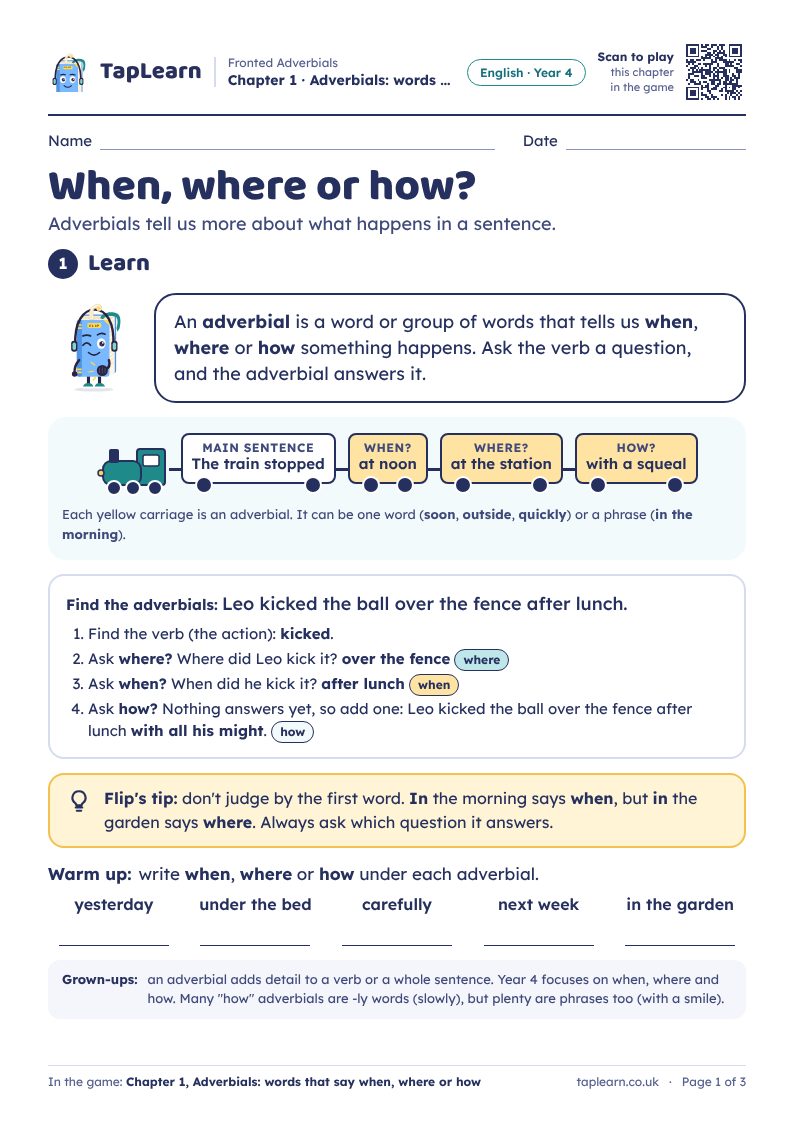
When, Where or How? is a printable adverbials worksheet for Year 4 (ages 8 to 9) that teaches children that an adverbial tells us when, where or how something happens, and to find it by asking the verb a question. It covers the Year 4 statements on using fronted adverbials and knowing the term adverbial.
Free to print, no account needed.
Print it on A4, in colour or black and white. Do it after the chapter, or before it to see what your child already knows.
What's on the worksheet
Your child finds adverbials by asking the verb a question, and sorts them into when, where and how. Includes a three-cup sorting game and an answers sheet.
- Page 1 · Learn
- What an adverbial is, a sentence train with when, where and how carriages, a worked example finding the adverbials in a sentence about Leo, Flip's tip not to judge by the first word, and a warm-up.
- Page 2 · Try it together
- Three-cup sort: label cups WHEN, WHERE and HOW, each write five adverbials on scraps, then take turns to read one and drop it in a cup, checking it in a sentence.
- Page 3 · Practise
- Sort nine adverbials, underline the adverbial and say what it tells, finish sentences with an adverbial, find the odd one out, and a challenge about "in the morning".
- Answers sheet
- Every answer, mix-ups like when and where both starting with in, and teatime call-out and add-a-carriage ideas.
3 A4 pages and an answers sheet · about 25 minutes
Using it at home
- Year 4 focuses on when, where and how. Many how adverbials are -ly words (slowly), but plenty are phrases too (with a smile).
- In the three-cup sort, sneak in a tricky one like "in the night" so your child has to ask the question, not look at the first word.
- At teatime, take turns saying a phrase like "under the table" or "very slowly"; the other calls out when, where or how.
Watch out for
- Mixing up when and where, as both can start with in, at or on (at noon, at the station).
- Ask, "Could you point to it on a map, or on a clock?"
- Mixing up how with when or where.
- How adverbials describe the way something is done. Act the sentence out: if it changes how you move, it's a how.
- Underlining too little, like "dark" instead of "in the dark wood".
- The adverbial is the whole group of words that answers the question.
Questions from the worksheet
- Sort these adverbials into when, where and how: at midnight, behind the shed, slowly, last summer, on the roof, with a big smile, soon, across the field, gently.
- Underline the adverbial. Write when, where or how at the end: The owl hooted in the dark wood. We packed our bags before breakfast.
- Finish each sentence with an adverbial that answers the question: The children sang (how?). Ava found a shell (where?).
- Odd one out! Ring the adverbial that answers a different question. Say why: after tea, at dawn, in the attic, next Monday.
- Leo says "in the morning" must be a where adverbial, because it starts with in. Is he right? Explain.
The answers are on the answers sheet, for grown-ups.
National curriculum in England
This worksheet practises these statements from the Years 3–4 english programme of study:
- Develop their understanding of the concepts set out in English appendix 2 by: using fronted adverbials
- Terminology: determiner, pronoun, possessive pronoun, adverbial (Year 4 english)
In the classroom
- Play add a carriage as a starter: build a sentence round the class by adding when, where and how adverbials.
- Run the three-cup sort in groups with sorting hoops.
Questions and answers
What is an adverbial in Year 4?
An adverbial is a word or group of words that tells us when, where or how something happens, like "after lunch", "over the fence" or "slowly".
How do you find the adverbial in a sentence?
Find the verb, then ask when?, where? and how? The words that answer are the adverbial.
Can an adverbial be more than one word?
Yes. It can be one word (soon, outside) or a phrase (in the morning, with a big smile).
 TapLearn