Fronted adverbial sentences worksheet for Year 4: Write with openers
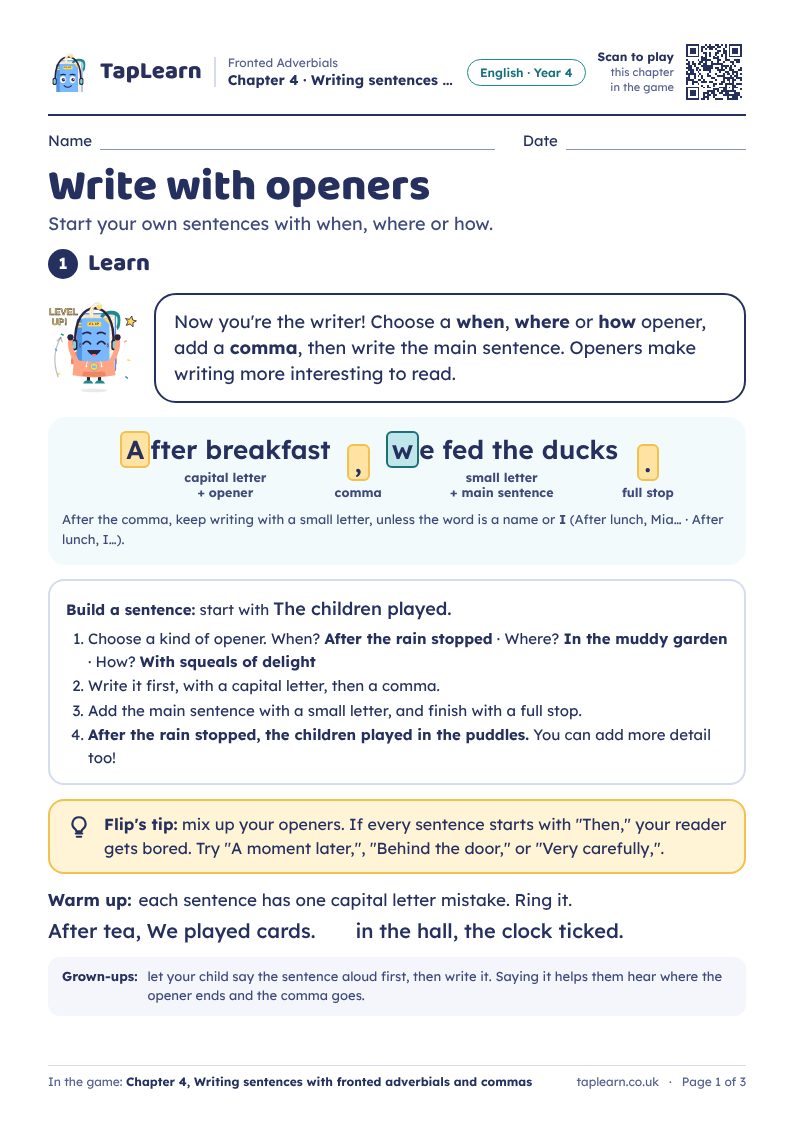
Write With Openers is a printable fronted adverbial sentences worksheet for Year 4 (ages 8 to 9) that teaches children to write their own sentences that open with a when, where or how adverbial, a comma and a small letter after it. It covers the Year 4 statements on using fronted adverbials and using commas after them.
Free to print, no account needed.
Print it on A4, in colour or black and white. Do it after the chapter, or before it to see what your child already knows.
What's on the worksheet
Your child writes their own sentences that start with a when, where or how fronted adverbial, with a comma and a small letter after it. Includes a retell-your-day opener game and an answers sheet.
- Page 1 · Learn
- The parts of a sentence with an opener labelled, a worked example building "After the rain stopped, the children played", Flip's tip to mix up openers, and a capital-letter warm-up.
- Page 2 · Try it together
- Retell your day: write six when, where and how openers on scraps, take turns to pull one out and say a true sentence about your day, then the child writes four.
- Page 3 · Practise
- Match openers to endings, write an opener of the right kind for each sentence, rewrite sentences to start with the adverbial, write three sentences about a picture, and a challenge.
- Answers sheet
- Every answer with example openers, mix-ups like a capital after the comma, and car-journey-story and opener-swap ideas.
3 A4 pages and an answers sheet · about 25 minutes
Using it at home
- Let your child say the sentence aloud first, then write it. Saying it helps them hear where the opener ends and the comma goes.
- In retell your day, tell your part of the day too, so your child hears plenty of examples, and check each sentence for capital, comma and full stop.
- On a car journey, build a story together, one sentence each, every sentence starting with a different opener.
Watch out for
- Forgetting the comma in their own writing.
- Ask them to read it aloud and point to where they paused.
- Writing a capital letter straight after the comma, like "Last night, The…".
- The sentence carries on, so it's a small letter unless it's a name or I.
- Leaving out the capital at the start.
- The opener now begins the sentence, so its first word needs the capital.
Questions from the worksheet
- Write an opener of the right kind for each sentence. Remember the comma: ___ the class went on a trip (when?). ___ Ava opened the present (how?).
- Rewrite each sentence so it starts with its adverbial: We ate ice cream on the pier. The fox crept through the garden at midnight.
- Each sentence has one capital letter mistake. Ring it: After tea, We played cards. in the hall, the clock ticked.
- Leo wrote: Last night, The wind howled. He says it's fine because it's a new part of the sentence. Is he right? Fix it if not.
The answers are on the answers sheet, for grown-ups.
National curriculum in England
This worksheet practises these statements from the Years 3–4 english programme of study:
- Develop their understanding of the concepts set out in English appendix 2 by: using fronted adverbials
- Sentence: fronted adverbials (Year 4 english)
- Indicate grammatical and other features by: using commas after fronted adverbials
In the classroom
- Play opener swap: say a sentence and pupils say it again with a when, then a where, then a how opener.
- Use Practise D as a short writing task, then share openers in pairs.
Questions and answers
How do you write a sentence with a fronted adverbial?
Write the opener first with a capital letter, add a comma, then write the main sentence with a small letter and end with a full stop.
Do you need a capital letter after the comma?
No. The sentence carries on after the comma, so the next word has a small letter unless it's a name or I.
Why should children use different openers?
Starting every sentence the same way, like "Then,", is dull to read. Mixing when, where and how openers makes writing more interesting.
 TapLearn