Fronted adverbials worksheet for Year 4: When, where, how?
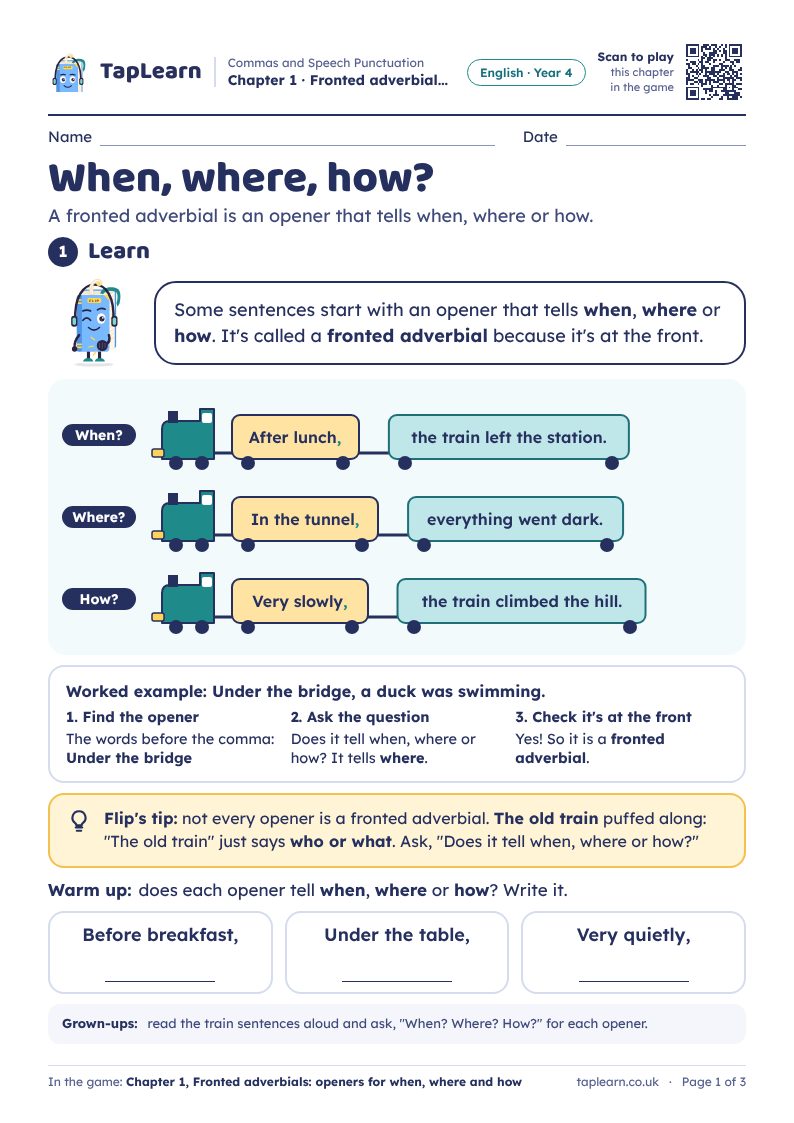
When, Where, How? is a printable fronted adverbials worksheet for Year 4 (ages 8 to 9) that teaches children to spot a sentence opener that tells when, where or how, like After lunch, and to tell it apart from one that just says who. It covers the Years 3 to 4 and Year 4 English statements on using commas after fronted adverbials.
Free to print, no account needed.
▶ Play chapter 1 in the game · How the fronted adverbials works
Print it on A4, in colour or black and white. Do it after the chapter, or before it to see what your child already knows.
What's on the worksheet
Your child spots fronted adverbials, sentence openers that tell when, where or how, and tells them apart from openers that just say who. Includes an opener hunt in a story book and an answers sheet.
- Page 1 · Learn
- Train sentences with when, where and how openers, a worked example checking Under the bridge in three steps, Flip's tip on openers that just say who, and a when-where-how warm-up.
- Page 2 · Try it together
- Opener hunt: read a page of a favourite story book together, hunt for sentences that begin by telling when, where or how, and write each opener in the table with its question.
- Page 3 · Practise
- Underline fronted adverbials or write none, sort openers into when, where and how, write openers to fit each question, write your own journey sentence, and a challenge.
- Answers sheet
- Every answer, mix-ups like openers that name someone, and opener ping-pong and front-it ideas.
3 A4 pages and an answers sheet · about 25 minutes
Using it at home
- Read the train sentences aloud and ask "When? Where? How?" for each opener.
- In the opener hunt, if your child picks "The big dog" or a name, ask whether it tells when, where or how, or just who.
- Play front it: say "We had pizza after the film" and your child moves the adverbial to the front.
Watch out for
- Thinking an opener that names someone, like The old train or Mia, is a fronted adverbial.
- Ask, "Does it tell when, where or how?"
- Picking adverbials at the end of the sentence.
- It's only fronted if it comes first, as in "In the field, we waved."
- Mixing up when, where and how.
- Turn it into a question: "When did it happen? Where? How?"
Questions from the worksheet
- Underline the fronted adverbial. If the sentence doesn't start with one, write none: At the station, we met Grandma. The old train puffed up the hill.
- Sort the openers into when, where and how: Later that day, Behind the seats, Carefully, On Saturday, Across the bridge, With a big smile.
- Write a fronted adverbial to start each sentence. When? ___, the train arrived. Where? ___, we found a lost umbrella.
- Leo says, "The sleepy guard is a fronted adverbial, because it's at the front." Is Leo right? Why?
The answers are on the answers sheet, for grown-ups.
National curriculum in England
This worksheet practises these statements from the Years 3–4 english programme of study:
- Indicate grammatical and other features by: using commas after fronted adverbials
- Punctuation: use of commas after fronted adverbials (Year 4 english)
In the classroom
- Play opener ping-pong as a starter: call out when, where or how and pupils give an opener of that kind.
- Use Practise B as a sorting task in pairs, with openers on cards.
Questions and answers
What is a fronted adverbial?
A fronted adverbial is an opener at the start of a sentence that tells when, where or how something happens, like After lunch, or In the tunnel. It is followed by a comma.
Is The old train a fronted adverbial?
No. It tells you who or what the sentence is about, not when, where or how. Being at the front isn't enough.
What are sentence openers in Year 4?
Sentence openers are the words that start a sentence. Fronted adverbials are one kind: they tell when, where or how.
 TapLearn