Punctuating speech worksheet for Year 4
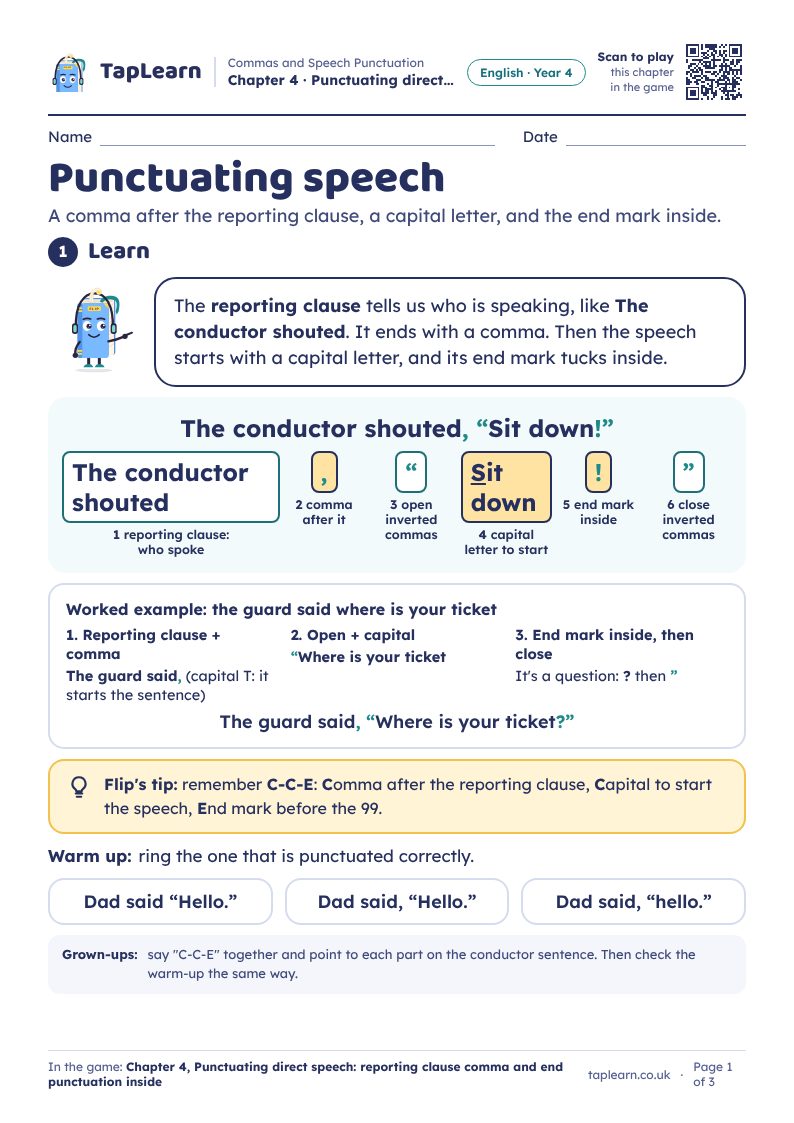
Punctuating Speech is a printable punctuating speech worksheet for Year 4 (ages 8 to 9) that teaches children the C-C-E check: a comma after the reporting clause, a capital letter to start the speech and the end mark inside, as in The conductor shouted, "Sit down!" It covers the Years 3 to 4 and Year 4 English statements on using and punctuating direct speech, with inverted commas and other punctuation.
This worksheet is for members
Membership opens every chapter of every game and every worksheet, for all your children.
See the plansAlready a member? Log in to print it.
Start with the free one: When, where, how? (chapter 1).
Print it on A4, in colour or black and white. Do it after the chapter, or before it to see what your child already knows.
What's on the worksheet
Your child punctuates direct speech fully: a comma after the reporting clause, a capital letter to start the speech and the end mark inside the inverted commas. Includes a family quotes activity and an answers sheet.
- Page 1 · Learn
- The six parts of The conductor shouted, "Sit down!", a worked example punctuating the guard said where is your ticket, Flip's C-C-E tip, and a ring-the-correct-one warm-up.
- Page 2 · Try it together
- Family quotes: write three things people at home said today as direct speech, check comma, capital and end mark inside, tick each box, then read them aloud in each person's voice.
- Page 3 · Practise
- Add the reporting clause comma, move escaped end marks inside, ring letters that should be capitals, punctuate two sentences fully, and a challenge about Stop!
- Answers sheet
- Every answer, mix-ups like the end mark outside, and say-the-punctuation and story-check ideas.
3 A4 pages and an answers sheet · about 25 minutes
Using it at home
- Say "C-C-E" together and point to each part of the conductor sentence before your child starts.
- If your child writes the end mark after the 99, ask, "Does the ! belong to the speech or to the whole sentence?"
- Read a sentence aloud saying the punctuation, like "comma, 66, capital, exclamation mark, 99".
Watch out for
- Leaving out the comma after the reporting clause.
- Ask, "What comes before the 66?"
- Putting the end mark outside the inverted commas, like "Stop"!
- The ! or ? belongs to the spoken words, so it goes before the 99.
- Forgetting the capital letter at the start of the speech.
- The spoken words start their own sentence, so they need a capital.
Questions from the worksheet
- Add the missing comma after each reporting clause: Ava asked "Can I sit by the window?"
- The end marks have escaped! Write each sentence with the end mark inside: Sam asked, "Is this our stop"? Gran cried, "What a view"!
- Ring the letter that should be a capital: Mia said, "my bag is heavy."
- Punctuate fully: comma, inverted commas, capital letters and end mark. the guard shouted stand back
- Leo writes: The guard shouted "Stop"! What two things need fixing? Write it correctly.
The answers are on the answers sheet, for grown-ups.
National curriculum in England
This worksheet practises these statements from the Years 3–4 english programme of study:
- Indicate grammatical and other features by: using and punctuating direct speech
- Punctuation: use of inverted commas and other punctuation to indicate direct speech (Year 4 english)
In the classroom
- Use Practise D as a mini-whiteboard task, checking C-C-E together after each sentence.
- Pupils find speech in a class reader and check it with C-C-E in pairs.
Questions and answers
What is a reporting clause?
A reporting clause tells you who is speaking, like The conductor shouted. When it comes before the speech, it ends with a comma.
Does the full stop go inside or outside the speech marks?
Inside. The end mark belongs to the spoken words, so it goes before the closing inverted commas: Mum said, "Hold my hand."
Why does speech start with a capital letter?
The spoken words start their own sentence, so the first word needs a capital, even after a reporting clause.
 TapLearn