Fronted adverbials and speech worksheet for Year 4: Openers and speech
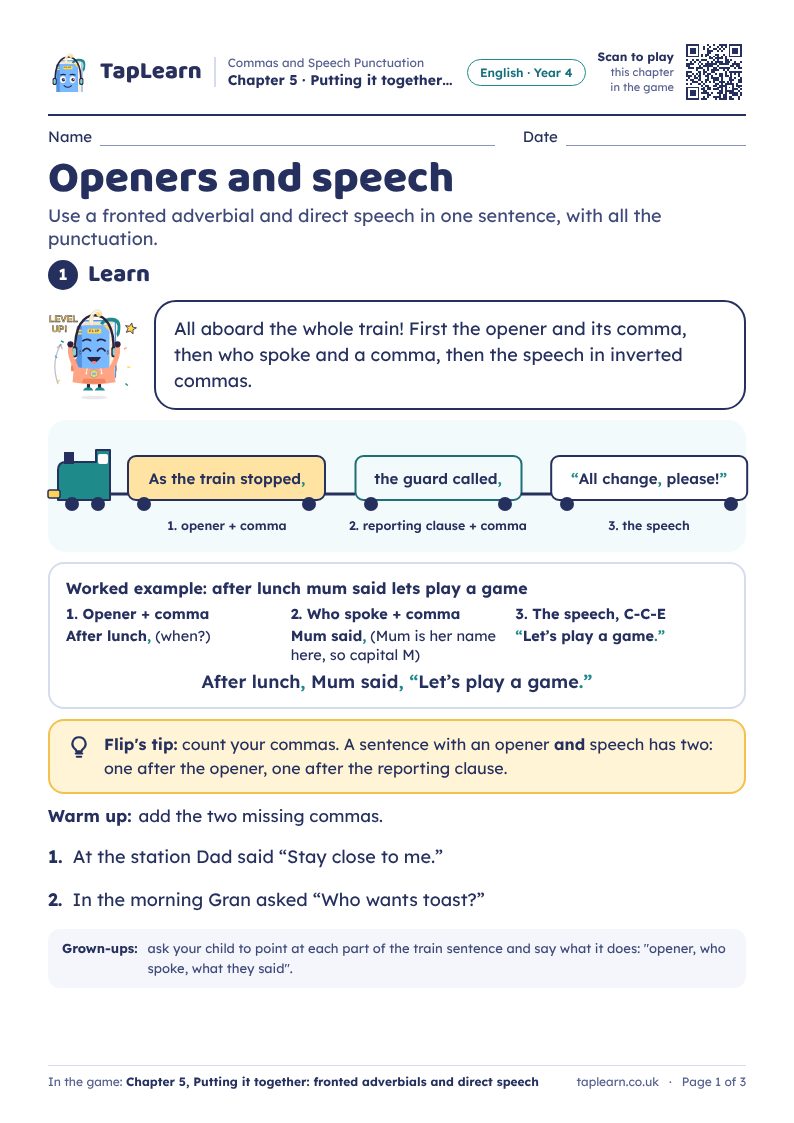
Openers and Speech is a printable fronted adverbials and speech worksheet for Year 4 (ages 8 to 9) that teaches children to write a sentence with an opener and speech, like As the train stopped, the guard called, "All change, please!" It covers the Year 4 English statements on commas after fronted adverbials and on punctuating direct speech.
This worksheet is for members
Membership opens every chapter of every game and every worksheet, for all your children.
See the plansAlready a member? Log in to print it.
Start with the free one: When, where, how? (chapter 1).
Print it on A4, in colour or black and white. Do it after the chapter, or before it to see what your child already knows.
What's on the worksheet
Your child writes sentences with a fronted adverbial and direct speech, with both commas, the inverted commas, a capital and the end mark inside. Includes an opener lucky dip and an answers sheet.
- Page 1 · Learn
- The three parts of a whole-train sentence, a worked example punctuating after lunch mum said lets play a game, Flip's count-your-commas tip, and an add-two-commas warm-up.
- Page 2 · Try it together
- Opener lucky dip: write six openers on scraps of paper, pick one from a bowl, the child makes up who spoke and what they said, then write it and tick off the five checks.
- Page 3 · Practise
- Add the two commas and the inverted commas, fix one mistake in each sentence, finish sentences with who spoke and what they said, write your own, and a challenge.
- Answers sheet
- Every answer, mix-ups like only one comma, and story-starter and count-the-commas ideas.
3 A4 pages and an answers sheet · about 25 minutes
Using it at home
- Ask your child to point at each part of the train sentence and say what it does: opener, who spoke, what they said.
- In the lucky dip, tick the five checks together for each sentence. Single inverted commas are fine if that's what your child's school uses.
- Say an opener out loud and your child adds who spoke and what they said, with no writing.
Watch out for
- Using only one comma when there should be two.
- Count them: one after the opener, one after the reporting clause.
- Putting the end mark outside or missing the capital in the speech.
- Use the C-C-E check.
- Putting the comma too early in the opener, like Before, bedtime.
- Wait until the opener has finished.
Questions from the worksheet
- Add the two commas and the inverted commas: After the long journey Gran said I need a cup of tea.
- Each sentence has one mistake. Write it correctly: At the café, Mum asked "What would you like?" Before, bedtime Dad said, "Brush your teeth."
- Finish each sentence with who spoke and what they said: As the train pulled away,
- Mia writes: Suddenly the driver shouted "Hold on"! How many mistakes can you find? Write it correctly.
The answers are on the answers sheet, for grown-ups.
National curriculum in England
This worksheet practises these statements from the Years 3–4 english programme of study:
- Indicate grammatical and other features by: using commas after fronted adverbials
- Punctuation: use of commas after fronted adverbials (Year 4 english)
- Indicate grammatical and other features by: using and punctuating direct speech
- Punctuation: use of inverted commas and other punctuation to indicate direct speech (Year 4 english)
In the classroom
- Run the opener lucky dip as a group activity, with groups swapping sentences to check.
- Pupils find a sentence with an opener and speech in a class book and count the commas.
Questions and answers
How many commas are in a sentence with a fronted adverbial and speech?
Two: one after the fronted adverbial and one after the reporting clause, as in After lunch, Mum said, "Let's play a game."
What order do the parts go in?
First the opener and its comma, then who spoke and a comma, then the spoken words in inverted commas with the end mark inside.
What is the C-C-E check?
It's a way to check speech: a Comma after the reporting clause, a Capital to start the speech, and the End mark inside the closing inverted commas.
 TapLearn