Inverted commas worksheet for Year 4
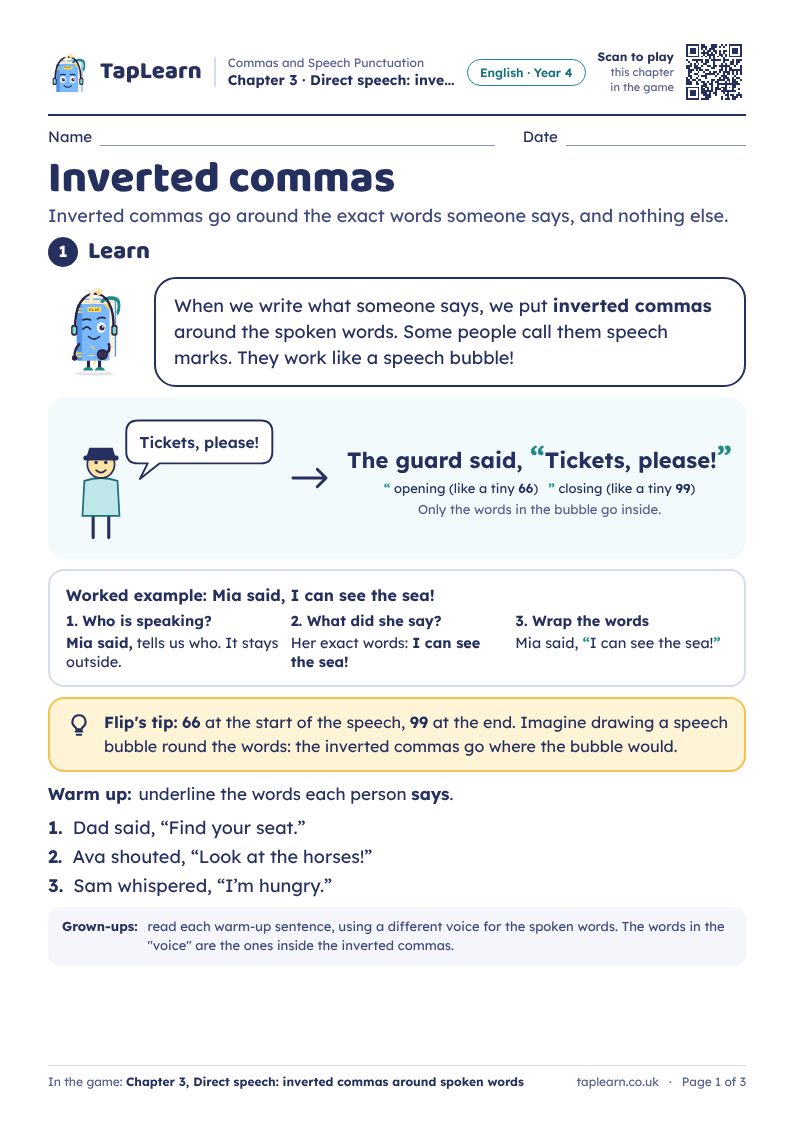
Inverted Commas is a printable inverted commas worksheet for Year 4 (ages 8 to 9) that teaches children to put 66 and 99 marks around only the exact words someone says, like a speech bubble, with who spoke kept outside. It covers the Years 3 to 4 and Year 4 English statements on using and punctuating direct speech, with inverted commas and other punctuation.
This worksheet is for members
Membership opens every chapter of every game and every worksheet, for all your children.
See the plansAlready a member? Log in to print it.
Start with the free one: When, where, how? (chapter 1).
Print it on A4, in colour or black and white. Do it after the chapter, or before it to see what your child already knows.
What's on the worksheet
Your child puts inverted commas around only the exact words someone says, keeping who said it outside. Includes a comic strip that turns speech bubbles into sentences and an answers sheet.
- Page 1 · Learn
- Inverted commas shown as a speech bubble around The guard said, "Tickets, please!", a worked example in three steps, Flip's 66-and-99 tip, and an underline-the-spoken-words warm-up.
- Page 2 · Try it together
- Comic strip: draw a short train trip story in three boxes with speech bubbles, then write each bubble as a sentence and check the inverted commas go round the bubble words only.
- Page 3 · Practise
- Add inverted commas, write what people say as sentences, tick the one correct sentence, write what a friend might say on a train, and a challenge about Mum said.
- Answers sheet
- Every answer, mix-ups like wrapping the whole sentence, and air-quotes and book-spotting ideas.
3 A4 pages and an answers sheet · about 25 minutes
Using it at home
- Read each warm-up sentence aloud, using a different voice for the spoken words: those are the words inside the inverted commas.
- In the comic strip, point to a bubble and ask, "Which words are inside the bubble?"
- Try air quotes: say "Gran said, Sit down" and your child does air quotes round the spoken part.
Watch out for
- Putting inverted commas around the whole sentence.
- Ask, "Which words did they actually say out loud?"
- Closing too early when the speech has a comma in it, like Next stop, Oakwood!
- Close at the very end of the speech.
- Mixing up who spoke and what was said.
- "Ava said" is the reporting part, so it stays outside.
Questions from the worksheet
- Add the inverted commas: 66 before the spoken words, 99 after. Leo said, Our train is late. The driver called, Next stop, Oakwood!
- Only one is right. Tick it, and cross the others: "Ava said, I love trains." Ava said, "I love trains." Ava said, "I love" trains.
- Write something a friend might say on a train. Start with My friend said,
- Leo writes: "Mum said, it's time to go." Has he put the inverted commas in the right place? What should he change?
The answers are on the answers sheet, for grown-ups.
National curriculum in England
This worksheet practises these statements from the Years 3–4 english programme of study:
- Indicate grammatical and other features by: using and punctuating direct speech
- Punctuation: use of inverted commas and other punctuation to indicate direct speech (Year 4 english)
In the classroom
- Turn the comic strip into a group task: each group writes three bubbles as sentences for another group to check.
- Use Practise C on mini-whiteboards: pupils hold up the number of the correct sentence.
Questions and answers
What are inverted commas?
Inverted commas, also called speech marks, go around the exact words someone says. The opening one looks like a tiny 66 and the closing one like a tiny 99.
Do inverted commas go around the whole sentence?
No. They go around the spoken words only. Words like Ava said tell us who spoke, so they stay outside.
Should children use single or double inverted commas?
Both are fine. Some schools use single inverted commas and some use double: follow what your child's school uses.
 TapLearn