Commas after fronted adverbials worksheet for Year 4: Opener commas
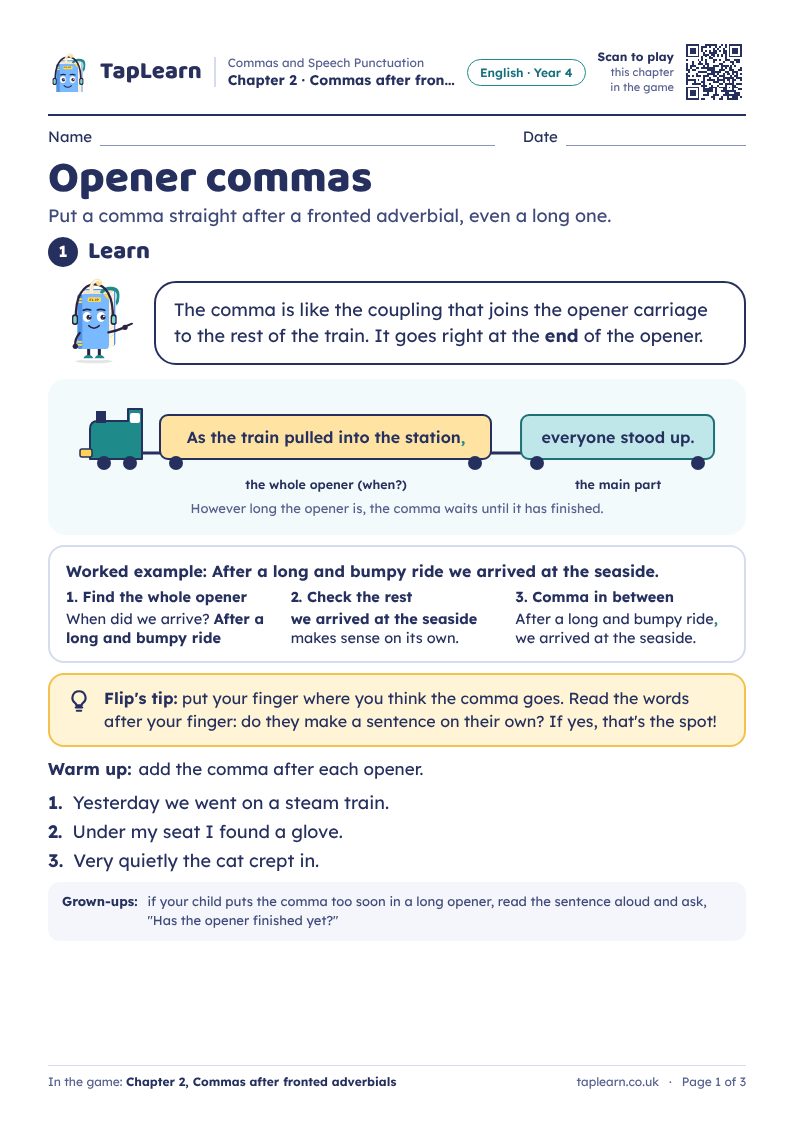
Opener Commas is a printable commas after fronted adverbials worksheet for Year 4 (ages 8 to 9) that teaches children to put one comma right at the end of the opener, even a long one like As the train pulled into the station. It covers the Years 3 to 4 and Year 4 English statements on using commas after fronted adverbials.
This worksheet is for members
Membership opens every chapter of every game and every worksheet, for all your children.
See the plansAlready a member? Log in to print it.
Start with the free one: When, where, how? (chapter 1).
Print it on A4, in colour or black and white. Do it after the chapter, or before it to see what your child already knows.
What's on the worksheet
Your child puts a comma straight after a fronted adverbial, waiting until a long opener has finished, and moves adverbials to the front. Includes a finish-my-sentence game and an answers sheet.
- Page 1 · Learn
- The comma as the coupling between the opener and the rest of the train, a worked example with a long opener, Flip's finger test, and an add-the-comma warm-up.
- Page 2 · Try it together
- Finish my sentence: the grown-up says an opener like At the park, the child finishes it out loud, then you write it with the comma and swap. Try In the middle of the night.
- Page 3 · Practise
- Add commas after openers, tick or cross comma positions, move adverbials to the front, write a sentence with a long opener, and a challenge about two commas.
- Answers sheet
- Every answer, mix-ups like a comma too early, and comma-clap and stretch-it ideas.
3 A4 pages and an answers sheet · about 25 minutes
Using it at home
- If your child puts the comma too soon in a long opener, read the sentence aloud and ask, "Has the opener finished yet?"
- In finish my sentence, let your child say some openers too, so you finish their sentences.
- Play comma clap: say a sentence with an opener and your child claps where the comma goes.
Watch out for
- Putting the comma too early inside a long opener, like In the middle, of the night.
- Ask, "Has the opener finished?"
- Putting the comma too late, after the main part has started.
- Use the finger test: do the words after your finger make a sentence on their own?
- Leaving out the comma.
- Read it aloud: there's usually a small pause where the opener ends.
Questions from the worksheet
- Add the comma after each fronted adverbial: In the back of the train a baby was crying. As soon as the whistle blew the train moved off.
- Is the comma in the right place? Tick or cross: In the middle, of the night the train stopped. Before we got off the train we, checked our bags.
- Move the adverbial to the front. Write the new sentence with a comma: We had a picnic after the journey.
- Write a sentence that starts with a long fronted adverbial (four words or more).
- Sam says, "Long openers need two commas." He writes: In the corner, of the carriage, a dog was asleep. Is Sam right? Write it correctly.
The answers are on the answers sheet, for grown-ups.
National curriculum in England
This worksheet practises these statements from the Years 3–4 english programme of study:
- Indicate grammatical and other features by: using commas after fronted adverbials
- Punctuation: use of commas after fronted adverbials (Year 4 english)
In the classroom
- Use Practise B as a mini-whiteboard true or false check.
- Stretch an opener as a class: At the park, then At the park near Gran's house. Where does the comma go now?
Questions and answers
Where does the comma go after a fronted adverbial?
The comma goes straight after the whole opener, before the main part of the sentence starts: After a long and bumpy ride, we arrived.
Does a long fronted adverbial need two commas?
No. The opener is one chunk, so it needs one comma, at the end: In the corner of the carriage, a dog was asleep.
How can children check where the comma goes?
Put a finger where the comma might go and read the words after it. If they make a sentence on their own, that's the spot.
 TapLearn