Subtracting across zeros worksheet for Year 4: Exchanging across zeros
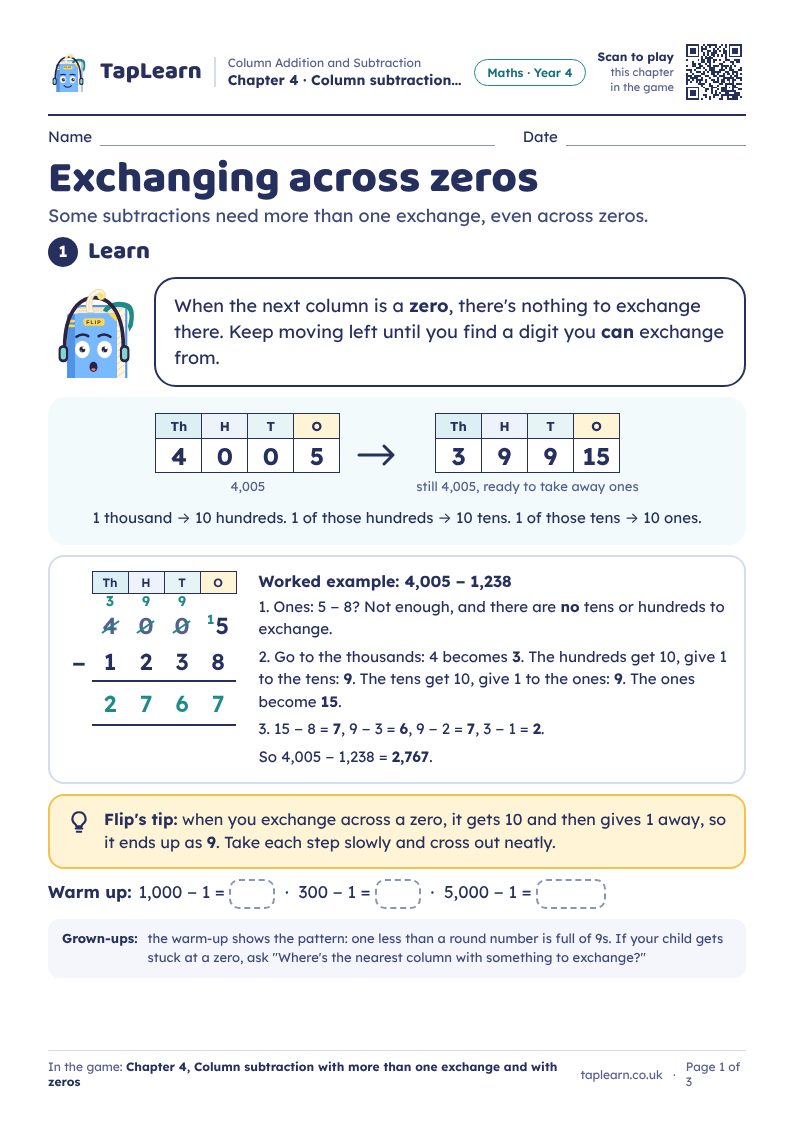
Exchanging Across Zeros is a printable subtracting across zeros worksheet for Year 4 (ages 8 to 9) that teaches children to subtract when they need more than one exchange, including across zeros. It covers the Year 4 maths statement to add and subtract numbers with up to 4 digits using the formal written methods of columnar addition and subtraction.
This worksheet is for members
Membership opens every chapter of every game and every worksheet, for all your children.
See the plansAlready a member? Log in to print it.
Start with the free one: Lining up columns (chapter 1).
▶ Play chapter 4 in the game · How the column subtraction works
Print it on A4, in colour or black and white. Do it after the chapter, or before it to see what your child already knows.
What's on the worksheet
Your child subtracts 4-digit numbers that need more than one exchange, including across zeros such as 4,005 − 1,238. Includes a paper place value cards activity and an answers sheet.
- Page 1 · Learn
- 4,005 is rearranged step by step so the ones have 15, a worked example of 4,005 − 1,238, Flip's tip that a zero ends up as 9, and a round-number warm-up.
- Page 2 · Try it together
- Paper place value cards: make 3,000 from paper thousands, then swap down through hundreds, tens and ones to take away 1,456. Then show what numbers become after exchanging.
- Page 3 · Practise
- Subtract from numbers like 5,000 and 7,203, find Ava's mistake in 3,002 − 1,456, a fuel tank word problem, and a challenge about 5,000 − 1.
- Answers sheet
- Every answer, mix-ups like leaving a zero as 10, and counting back over a thousand and odometer talk.
3 A4 pages and an answers sheet · about 25 minutes
In the classroom
- Demonstrate 4,005 − 1,238 with place value counters, letting children call out each swap.
- Use Practise C as a pair task: find Ava's mistake and write a tip to help her.
Questions from the worksheet
- Subtract. Some of these need more than one exchange: 5,000 − 2,347
- Subtract: 8,100 − 3,456
- Ava worked out 3,002 − 1,456 and got 2,454. Find her mistake and the right answer.
- Ava says, "To work out 5,000 − 1 in columns, I have to exchange three times." Is she right? What is 5,000 − 1?
The answers are on the answers sheet, for grown-ups.
National curriculum in England
This worksheet practises this statement from the Year 4 maths programme of study:
- Add and subtract numbers with up to 4 digits using the formal written methods of columnar addition and subtraction where appropriate
Source: National curriculum in England: mathematics programmes of study (DfE)
Using it at home
- The warm-up shows a pattern: one less than a round number is full of 9s. Talk about it before starting.
- If your child gets stuck at a zero, ask "Where's the nearest column with something to exchange?"
- Take each exchange slowly and cross out neatly: rushing is where most slips happen.
Watch out for
- Getting stuck at a zero, as in 4,005 − 1,238.
- Go left to the first digit that isn't 0, exchange there, then work back to the right.
- Leaving a zero as 10 after exchanging.
- After getting 10 and giving 1 away, a zero becomes 9.
- Taking smaller from larger, like 5 − 0, instead of exchanging.
- Remind: always top take away bottom.
Questions and answers
How do you subtract across zeros?
Move left to the first column that isn't zero and exchange there. Each zero you pass gets 10 and gives 1 away, so it becomes 9.
What is 4,005 − 1,238?
4,005 − 1,238 = 2,767. Exchange 1 thousand into hundreds, tens and ones so the ones have 15 and the zeros become 9s.
Why is 5,000 − 1 equal to 4,999?
5,000 has no hundreds, tens or ones, so you exchange three times. Each zero becomes 9 and the thousands become 4.
More worksheets from Column Addition and Subtraction for Year 4: A Sky Harbour Adventure
- Chapter 1: Column addition worksheet: Lining up columns Free
- Chapter 2: Column addition with carrying worksheet: Exchanging when adding Members
- Chapter 3: Column subtraction worksheet: Exchanging to subtract Members
- Chapter 5: Estimating by rounding worksheet: Estimate first Members
- Chapter 6: Inverse operations worksheet: Undo it to check Members
- Chapter 7: Two-step word problems worksheet: Two-step problems Members
 TapLearn