Column subtraction worksheet for Year 4: Exchanging to subtract
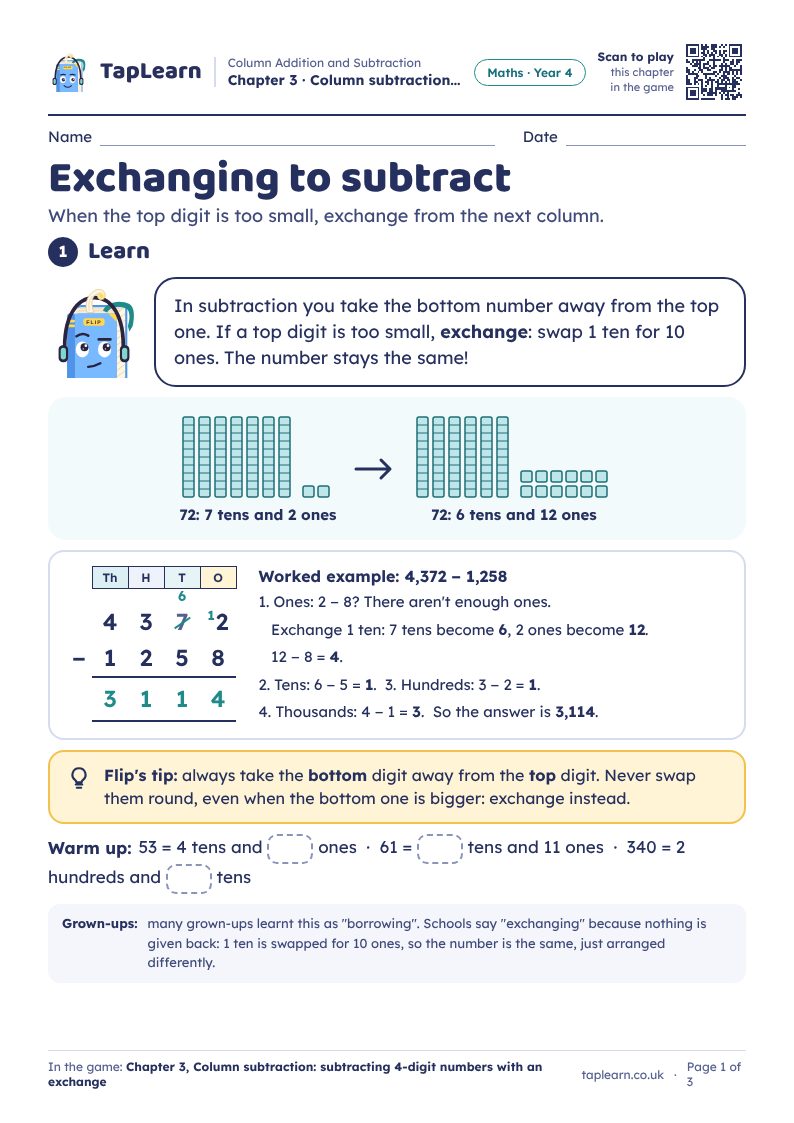
Exchanging to Subtract is a printable column subtraction worksheet for Year 4 (ages 8 to 9) that teaches children to subtract 4-digit numbers in columns, exchanging from the next column when a top digit is too small. It covers the Year 4 maths statement to add and subtract numbers with up to 4 digits using the formal written methods of columnar addition and subtraction.
This worksheet is for members
Membership opens every chapter of every game and every worksheet, for all your children.
See the plansAlready a member? Log in to print it.
Start with the free one: Lining up columns (chapter 1).
▶ Play chapter 3 in the game · How the column subtraction works
Print it on A4, in colour or black and white. Do it after the chapter, or before it to see what your child already knows.
What's on the worksheet
Your child subtracts 4-digit numbers in columns, exchanging one ten for ten ones when a top digit is too small. Includes a coin swap shop activity, spot-the-mistake questions and an answers sheet.
- Page 1 · Learn
- 72 shown as 7 tens and 2 ones and as 6 tens and 12 ones, a worked example of 4,372 − 1,258, Flip's top-take-away-bottom tip, and an exchange warm-up.
- Page 2 · Try it together
- Coin swap shop: set out 342p in pound, 10p and 1p coins, take away 127p and swap a 10p for ten 1p coins when needed. Then decide which ones columns need an exchange.
- Page 3 · Practise
- Subtract 4-digit numbers, crossing out to exchange, find Ben's mistake, an airship unloading problem, and a challenge about a forgotten exchange in 6,352 − 2,127.
- Answers sheet
- Every answer, mix-ups like taking the smaller digit from the bigger, and exchange chat and change-at-the-till ideas.
3 A4 pages and an answers sheet · about 25 minutes
Using it at home
- Many grown-ups learnt this as borrowing. Schools say exchanging because nothing is given back: 1 ten is swapped for 10 ones.
- Let your child do the swapping with real coins in the swap shop: it shows an exchange doesn't change how much money there is.
- Make up the third swap shop sum together and write it in columns.
Watch out for
- Taking the smaller digit from the bigger one, like 8 − 2 instead of 2 − 8.
- Ask: "Which number are we starting with?" The top one, always.
- Forgetting to make the next column one less after exchanging.
- Cross out the digit and write the new one above it.
- Not checking the answer.
- Add the answer to the number taken away: it should give the top number.
Questions from the worksheet
- Does the ones column need an exchange? Ring yes or no: 5,382 −, 6,459 −, 7,620 −
- Subtract. Cross out and exchange when you need to: 3,925 − 1,608
- Airship Puffin was carrying 3,650 kg. The crew unloaded 1,425 kg. How much is it carrying now?
- Sam worked out 6,352 − 2,127 and got 4,235. He did exchange in the ones. What did he forget? What is the right answer?
The answers are on the answers sheet, for grown-ups.
National curriculum in England
This worksheet practises this statement from the Year 4 maths programme of study:
- Add and subtract numbers with up to 4 digits using the formal written methods of columnar addition and subtraction where appropriate
Source: National curriculum in England: mathematics programmes of study (DfE)
In the classroom
- Model the swap shop with place value counters, then let pairs run it with their own numbers.
- Use Sam's challenge as a whole-class discussion about what crossing out shows.
Questions and answers
What is column subtraction?
Column subtraction is a written method where numbers are lined up by place value and the bottom number is taken from the top, one column at a time, starting with the ones.
What is exchanging in subtraction?
When a top digit is too small, swap 1 from the next column for 10 in this one. The number stays the same, just arranged differently.
Is exchanging the same as borrowing?
Yes, they mean the same step. Schools now say exchanging because nothing is given back.
More worksheets from Column Addition and Subtraction for Year 4: A Sky Harbour Adventure
- Chapter 1: Column addition worksheet: Lining up columns Free
- Chapter 2: Column addition with carrying worksheet: Exchanging when adding Members
- Chapter 4: Subtracting across zeros worksheet: Exchanging across zeros Members
- Chapter 5: Estimating by rounding worksheet: Estimate first Members
- Chapter 6: Inverse operations worksheet: Undo it to check Members
- Chapter 7: Two-step word problems worksheet: Two-step problems Members
 TapLearn