Column addition with carrying worksheet for Year 4: Exchanging when adding
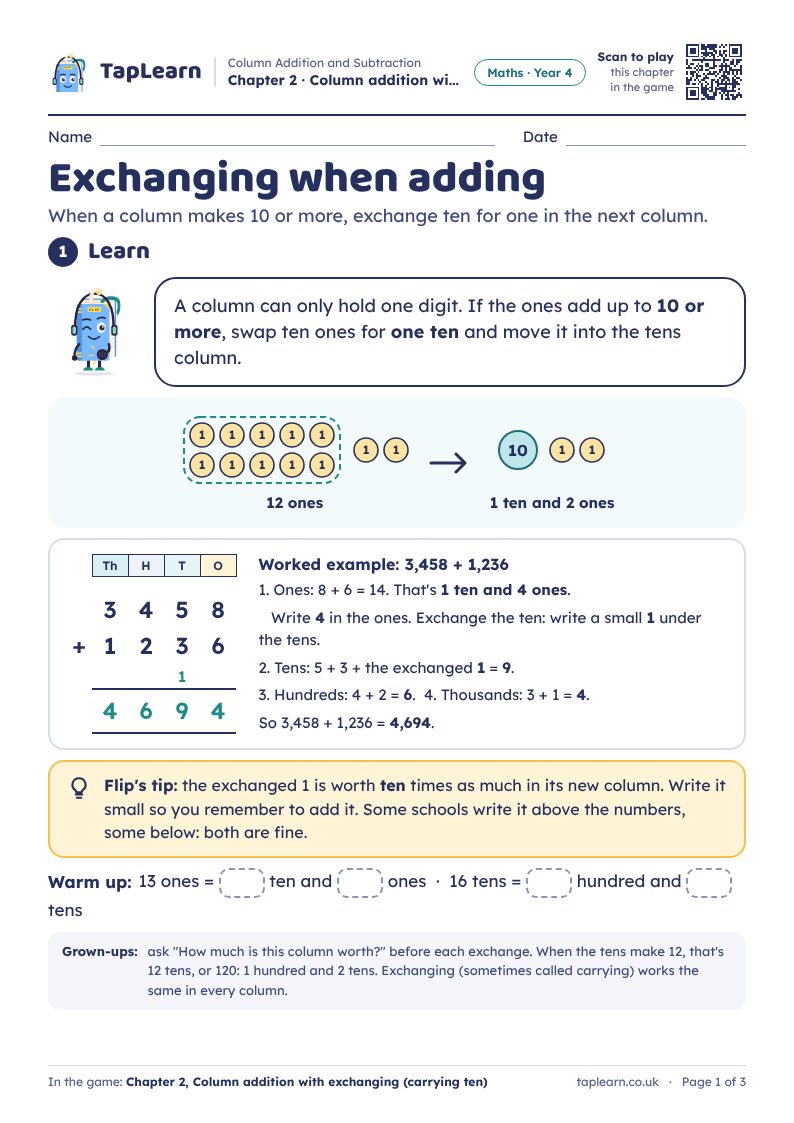
Exchanging When Adding is a printable column addition with carrying worksheet for Year 4 (ages 8 to 9) that teaches children to exchange ten for one in the next column when a column adds up to 10 or more. It covers the Year 4 maths statement to add and subtract numbers with up to 4 digits using the formal written methods of columnar addition and subtraction.
This worksheet is for members
Membership opens every chapter of every game and every worksheet, for all your children.
See the plansAlready a member? Log in to print it.
Start with the free one: Lining up columns (chapter 1).
▶ Play chapter 2 in the game · How the column addition works
Print it on A4, in colour or black and white. Do it after the chapter, or before it to see what your child already knows.
What's on the worksheet
Your child adds 4-digit numbers in columns, exchanging ten ones for one ten (carrying) whenever a column makes 10 or more. Includes a coin year sums activity, a spot-the-mistake question and an answers sheet.
- Page 1 · Learn
- Twelve ones become 1 ten and 2 ones, with a worked example of 3,458 + 1,236, Flip's tip on writing the exchanged 1 small, and a warm-up on 13 ones and 16 tens.
- Page 2 · Try it together
- Coin year sums: find the years stamped on two coins, add them in columns and count the exchanges, then check another way. Then decide which columns need an exchange.
- Page 3 · Practise
- Add 4-digit numbers writing each exchange, find what went wrong in Mia's sum, an airship load word problem, and a challenge about whether the answer always has 4 digits.
- Answers sheet
- Every answer, mix-ups like writing two digits in one column, and ten-or-not and coin swap games.
3 A4 pages and an answers sheet · about 25 minutes
In the classroom
- Use ten or not as a quick starter: say two digits and children show whether the column needs an exchange.
- Give pairs Mia's mistake from Practise C to diagnose and explain before solving the rest.
Questions from the worksheet
- Does this column need an exchange? Ring yes or no: 6 + 7, 4 + 5, 8 + 2
- Add. Write each exchange in the small boxes: 1,999 + 2,001
- Airship Swift carries 1,465 kg of post and 2,378 kg of fruit. What is its total load?
- Mia says, "When I add two 4-digit numbers, the answer always has 4 digits." Is she right? Give an example to show what you think.
The answers are on the answers sheet, for grown-ups.
National curriculum in England
This worksheet practises this statement from the Year 4 maths programme of study:
- Add and subtract numbers with up to 4 digits using the formal written methods of columnar addition and subtraction where appropriate
Source: National curriculum in England: mathematics programmes of study (DfE)
Using it at home
- Ask "How much is this column worth?" before each exchange: 12 tens is 120, so 1 hundred and 2 tens.
- If coin years are hard to read, use two years you both know instead, like the years you were born.
- Some schools write the exchanged 1 above the numbers and some below: follow your child's school.
Watch out for
- Forgetting the exchanged 1.
- Ask your child to write it small every time and tick it off once it's added in.
- Writing two digits in one column, like 14 in the ones.
- One column holds one digit: the ten moves next door.
- Not exchanging when a column makes exactly 10.
- It still needs an exchange: write 0 and move 1 ten.
Questions and answers
What is carrying in column addition?
Carrying, also called exchanging, means swapping ten in one column for one in the next column when a column adds up to 10 or more.
Is carrying the same as exchanging?
Yes. Schools in England often say exchanging, because ten ones are swapped for one ten. Many grown-ups learnt it as carrying.
Can adding two 4-digit numbers make a 5-digit answer?
Yes. If the thousands add up to 10 or more, the answer has 5 digits, such as 6,000 + 5,000 = 11,000.
More worksheets from Column Addition and Subtraction for Year 4: A Sky Harbour Adventure
- Chapter 1: Column addition worksheet: Lining up columns Free
- Chapter 3: Column subtraction worksheet: Exchanging to subtract Members
- Chapter 4: Subtracting across zeros worksheet: Exchanging across zeros Members
- Chapter 5: Estimating by rounding worksheet: Estimate first Members
- Chapter 6: Inverse operations worksheet: Undo it to check Members
- Chapter 7: Two-step word problems worksheet: Two-step problems Members
 TapLearn