Two-step word problems worksheet for Year 4: Two-step problems
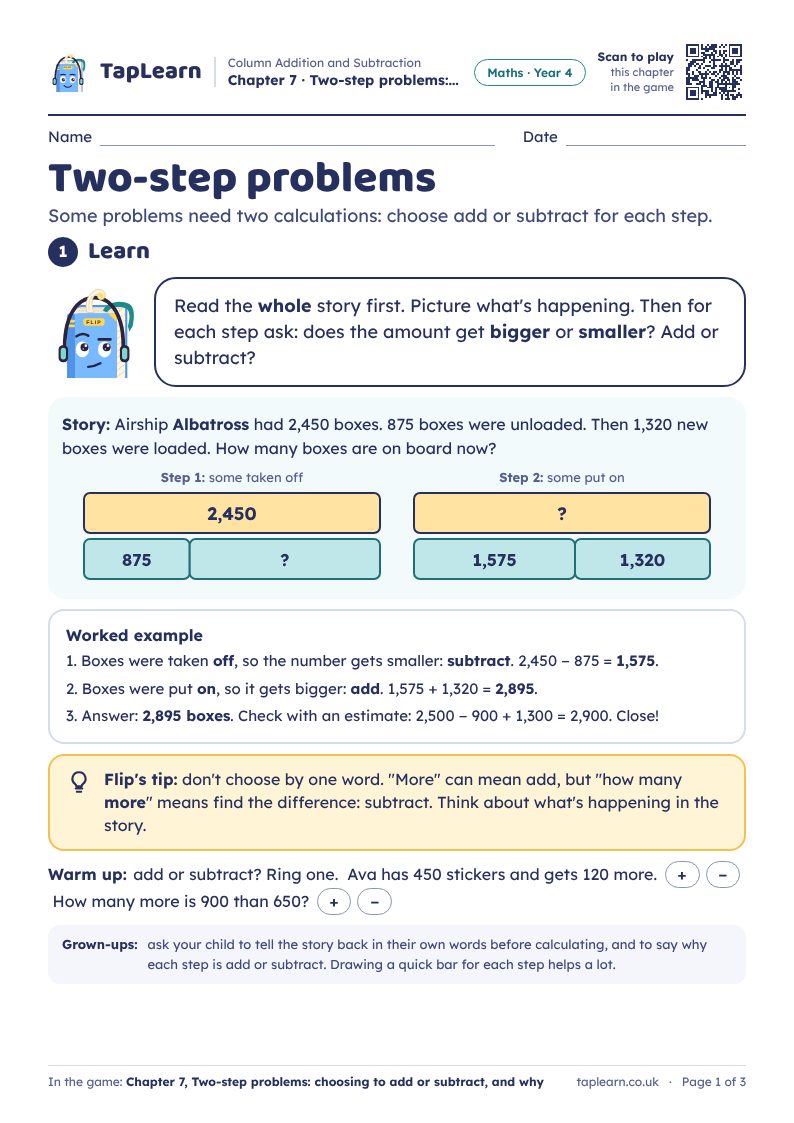
Two-Step Problems is a printable two-step word problems worksheet for Year 4 (ages 8 to 9) that teaches children to decide whether to add or subtract at each step of a problem and explain why. It covers the Year 4 maths statement to solve addition and subtraction two-step problems in contexts, deciding which operations and methods to use and why.
This worksheet is for members
Membership opens every chapter of every game and every worksheet, for all your children.
See the plansAlready a member? Log in to print it.
Start with the free one: Lining up columns (chapter 1).
Print it on A4, in colour or black and white. Do it after the chapter, or before it to see what your child already knows.
What's on the worksheet
Your child solves two-step word problems by deciding whether to add or subtract at each step and explaining why, with bar models to help. Includes a story swap activity using numbers from around the home and an answers sheet.
- Page 1 · Learn
- An airship story solved in two steps with bar models, an estimate check, Flip's tip about the word 'more', and an add-or-subtract warm-up.
- Page 2 · Try it together
- Story swap: pick numbers from things at home, make up a two-step story for each other, and say whether each step adds or subtracts and why. Then ring + or − for each step.
- Page 3 · Practise
- Solve four two-step problems about buns, points, a crane and stickers, explaining one choice, and a challenge about a train's empty seats.
- Answers sheet
- Every answer, the keyword trap and stopping after one step, and car journey and explain-it ideas.
3 A4 pages and an answers sheet · about 30 minutes
Using it at home
- Ask your child to tell the story back in their own words before calculating, and say why each step adds or subtracts.
- Stories where one step adds and one subtracts give the most useful practice in story swap.
- On car journeys, make up two-step stories with numbers on road signs.
Watch out for
- Choosing by one word, like adding because of "more".
- Ask: "Who has more? So is this number bigger or smaller?" Think about the story.
- Stopping after one step.
- Ask your child to reread the question at the end: "Have I answered what it asks?"
- Adding when the story takes away, or the other way round.
- Act the story out or draw a bar for each step.
Questions from the worksheet
- The harbour café baked 1,250 buns. It sold 780 in the morning and 345 in the afternoon. How many buns are left?
- Ava has 2,365 points. She wins 1,480 more, then spends 875 points on a new kite. How many points does she have now?
- Leo has 1,200 stickers. He has 350 more than Mia. Mia then gives 125 stickers to Sam. How many does Mia have now?
- A train has 1,500 seats. 640 people get on at the first stop and 520 at the second. How many seats are empty? Sam says 860. Is he right?
The answers are on the answers sheet, for grown-ups.
National curriculum in England
This worksheet practises this statement from the Year 4 maths programme of study:
- Solve addition and subtraction two-step problems in contexts, deciding which operations and methods to use and why
Source: National curriculum in England: mathematics programmes of study (DfE)
In the classroom
- Use Practise A as a discussion task: pairs decide + or − for each step without calculating, then justify.
- Run story swap in pairs, with each child writing a two-step problem for their partner.
Questions and answers
What is a two-step word problem?
A two-step problem needs two calculations to answer it, such as subtracting what was unloaded and then adding what was loaded.
How do children decide whether to add or subtract?
Picture the story and ask whether the amount gets bigger or smaller at each step. Don't choose by one word alone.
Does 'more' always mean add?
No. "How many more" asks for the difference, which means subtract.
More worksheets from Column Addition and Subtraction for Year 4: A Sky Harbour Adventure
- Chapter 1: Column addition worksheet: Lining up columns Free
- Chapter 2: Column addition with carrying worksheet: Exchanging when adding Members
- Chapter 3: Column subtraction worksheet: Exchanging to subtract Members
- Chapter 4: Subtracting across zeros worksheet: Exchanging across zeros Members
- Chapter 5: Estimating by rounding worksheet: Estimate first Members
- Chapter 6: Inverse operations worksheet: Undo it to check Members
 TapLearn