Inverse operations worksheet for Year 4: Undo it to check
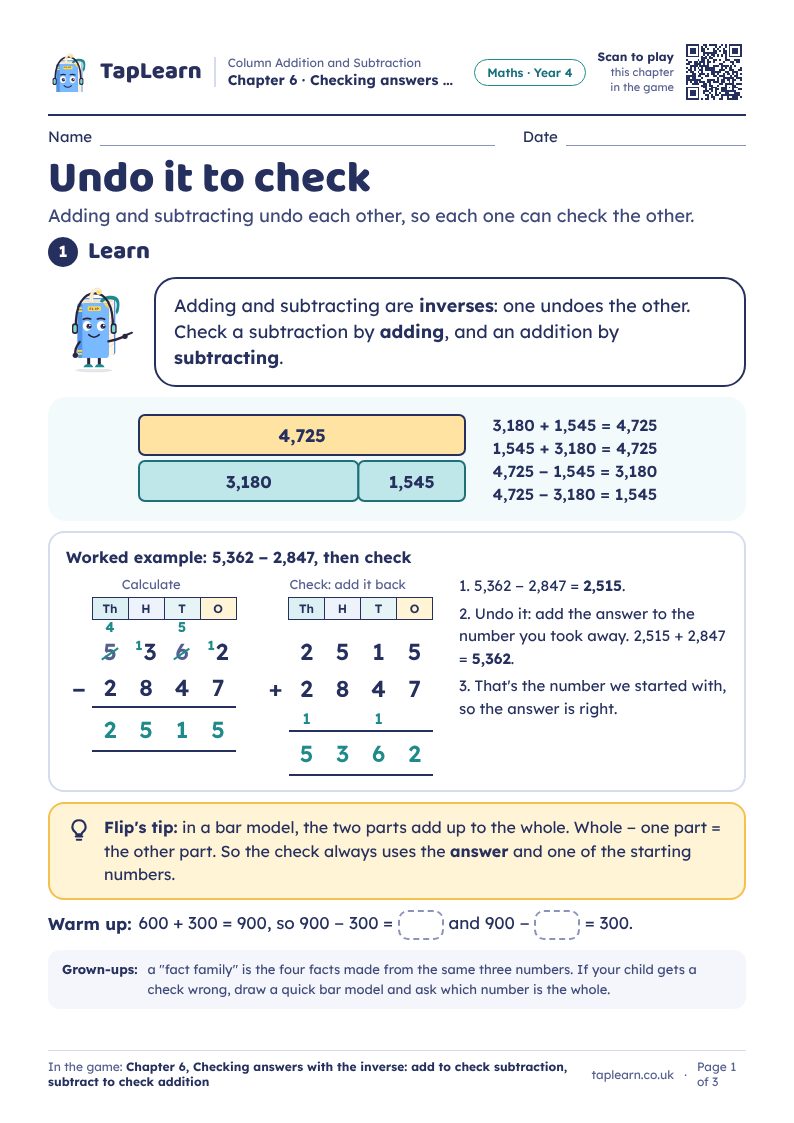
Undo It to Check is a printable inverse operations worksheet for Year 4 (ages 8 to 9) that teaches children to check an addition by subtracting and a subtraction by adding, using bar models. It covers the Year 4 maths statement to estimate and use inverse operations to check answers to a calculation.
This worksheet is for members
Membership opens every chapter of every game and every worksheet, for all your children.
See the plansAlready a member? Log in to print it.
Start with the free one: Lining up columns (chapter 1).
▶ Play chapter 6 in the game · How the inverse operations works
Print it on A4, in colour or black and white. Do it after the chapter, or before it to see what your child already knows.
What's on the worksheet
Your child checks additions by subtracting and subtractions by adding, using bar models to see which numbers go together. Includes a secret number game to play together and an answers sheet.
- Page 1 · Learn
- A bar model shows the four facts for 3,180, 1,545 and 4,725, a worked example checking 5,362 − 2,847, Flip's bar model tip, and a warm-up.
- Page 2 · Try it together
- Secret number: the grown-up hides a number, adds to it and gives only the answer, and the child undoes it with a subtraction to find the secret. Then match calculations to their checks.
- Page 3 · Practise
- Calculate and check two sums with the inverse, check Sam's homework and correct the wrong one, find missing numbers, and a challenge about checking 6,000 − 2,450.
- Answers sheet
- Every answer, mix-ups like checking with the same operation, and undo machine and fact family games.
3 A4 pages and an answers sheet · about 25 minutes
In the classroom
- Play the undo machine as a starter: "I added 300 and got 1,000. What did I start with?"
- Give pairs three numbers and ask them to write the full fact family as a bar model.
Questions from the worksheet
- Calculate. Then check with the inverse: 6,203 − 3,785
- Check each one with the inverse. Tick the right ones and correct the wrong one: 8,004 − 5,629 = 3,475
- Use the inverse to find the missing number: 1,488 + ___ = 4,000
- Mia worked out 6,000 − 2,450 = 3,550. To check, she did 3,550 + 6,000. Is that the right check? What should she add?
The answers are on the answers sheet, for grown-ups.
National curriculum in England
This worksheet practises this statement from the Year 4 maths programme of study:
- Estimate and use inverse operations to check answers to a calculation
Source: National curriculum in England: mathematics programmes of study (DfE)
Using it at home
- If a check goes wrong, draw a quick bar model and ask which number is the whole.
- Keep secret numbers below 5,000 so answers stay at 4 digits, and ask "Why did you subtract to undo it?"
- When your child solves a subtraction, ask them to undo it with an addition.
Watch out for
- Checking by doing the same calculation again.
- That can repeat the same slip. The inverse is a different route.
- Using the wrong numbers in the check.
- A bar model shows which numbers are the parts and which is the whole.
- Getting stuck on missing numbers like ___ − 1,250 = 2,375.
- The missing number is the whole, so add the parts.
Questions and answers
What does inverse mean in maths?
Inverse operations undo each other. Adding and subtracting are inverses, so one can be used to check the other.
How do you check a subtraction with the inverse?
Add your answer to the number you took away. If you get the number you started with, the answer is right.
What is a fact family?
A fact family is the four addition and subtraction facts made from the same three numbers, such as 3,180 + 1,545 = 4,725 and 4,725 − 1,545 = 3,180.
More worksheets from Column Addition and Subtraction for Year 4: A Sky Harbour Adventure
- Chapter 1: Column addition worksheet: Lining up columns Free
- Chapter 2: Column addition with carrying worksheet: Exchanging when adding Members
- Chapter 3: Column subtraction worksheet: Exchanging to subtract Members
- Chapter 4: Subtracting across zeros worksheet: Exchanging across zeros Members
- Chapter 5: Estimating by rounding worksheet: Estimate first Members
- Chapter 7: Two-step word problems worksheet: Two-step problems Members
 TapLearn