Punctuation terminology worksheet for Year 6: Punctuation names
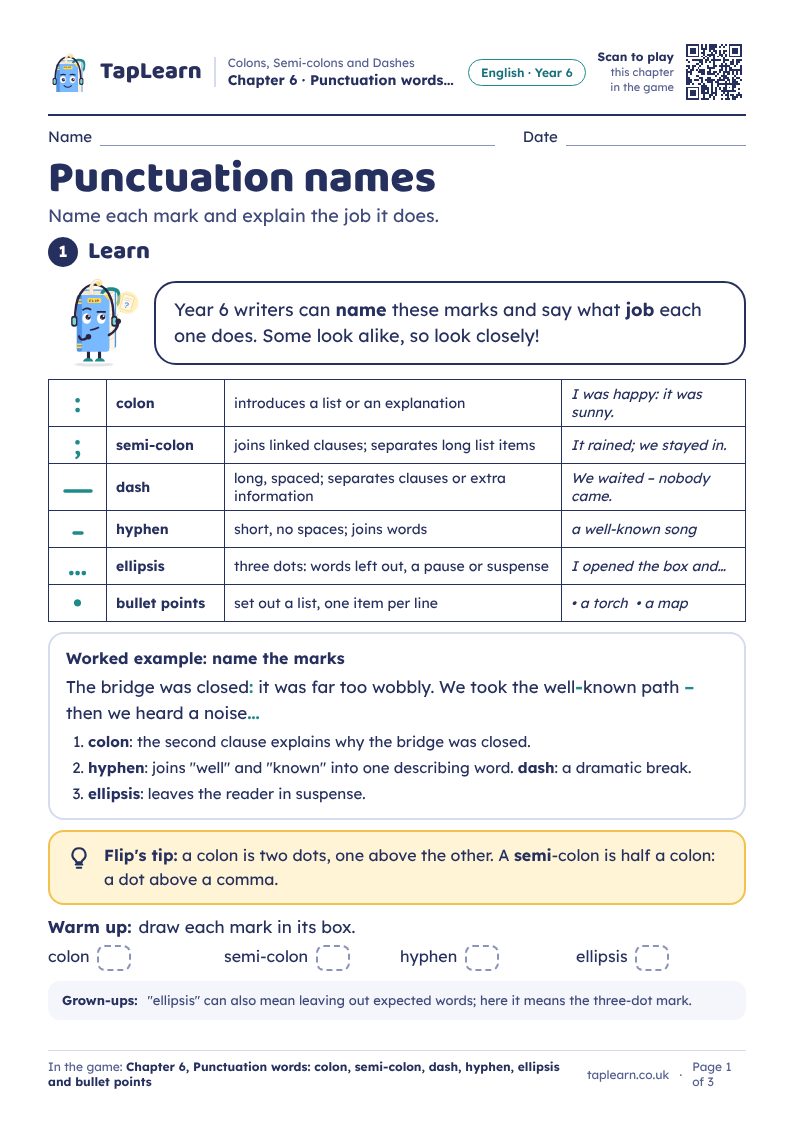
Punctuation Names is a printable punctuation terminology worksheet for Year 6 (ages 10 to 11) that teaches children to name a colon, semi-colon, dash, hyphen, ellipsis and bullet points, and to explain the job each one does. It covers the Year 6 English terminology: ellipsis, hyphen, colon, semi-colon and bullet points.
This worksheet is for members
Membership opens every chapter of every game and every worksheet, for all your children.
See the plansAlready a member? Log in to print it.
Start with the free one: Clause islands (chapter 1).
Print it on A4, in colour or black and white. Do it after the chapter, or before it to see what your child already knows.
What's on the worksheet
Your child names and explains a colon, semi-colon, dash, hyphen, ellipsis and bullet points, and tells a hyphen from a dash. Includes a punctuation hunt in a recipe or comic and an answers sheet.
- Page 1 · Learn
- A table of each mark, its name, its job and an example, a worked example naming the marks in a short passage, Flip's semi-colon-is-half-a-colon tip, and a draw-each-mark warm-up.
- Page 2 · Try it together
- Punctuation hunt: look through a recipe, comic, newspaper or magazine together, tally each mark you spot, say what job one example is doing, and see which mark was most common.
- Page 3 · Practise
- Match names to marks, write a hyphen or dash in each gap, name and explain the mark in four sentences, write a sentence with an ellipsis, and a challenge about the semi-colon.
- Answers sheet
- Every answer, mix-ups like colon and semi-colon swapped, and an air-marks idea.
3 A4 pages and an answers sheet · about 25 minutes
Using it at home
- Recipes are good for finding colons and bullet points; comics are full of dashes and ellipses.
- Remind your child that "semi" means half: a semi-colon has one full dot with a comma under it.
- Play air marks: one person names a mark and the other draws it in the air with a finger.
Watch out for
- Swapping the colon and the semi-colon.
- Semi means half: a semi-colon has only one full dot, with a comma under it.
- Mixing up a hyphen and a dash.
- A hyphen joins words with no spaces; a dash is longer, with a space each side, and separates.
- Getting the ellipsis wrong.
- It's always three dots, never two or five. Its job is to show missing words, a pause or suspense.
Questions from the worksheet
- Hyphen or dash? Write - or – in each box: a well known story. I waited nobody came. a man eating shark. It was late we had to go.
- Name the mark and explain its job: I crept towards the cupboard… and opened it. Leo felt proud: he had finished the marathon.
- Write a sentence that uses an ellipsis to build suspense.
- Sam says, "A semi-colon is just two dots, one on top of the other." Is he right? Explain, and draw both marks.
The answers are on the answers sheet, for grown-ups.
National curriculum in England
This worksheet practises this statement from the Year 6 english programme of study:
- Terminology: subject, object, active, passive, synonym, antonym, ellipsis, hyphen, colon, semi-colon, bullet points
In the classroom
- Use Practise A as a quick starter on mini-whiteboards: call out a name and pupils draw the mark.
- Run the punctuation hunt in groups with class readers, then compare which marks each group found.
Questions and answers
What punctuation terms do Year 6 children need to know?
Year 6 children learn the terms colon, semi-colon, hyphen, ellipsis and bullet points, alongside the dash. They should name each mark and explain its job.
What is an ellipsis?
An ellipsis is three dots (…) that show words left out, a pause or suspense, as in I opened the box and…
What is the difference between a colon and a semi-colon?
A colon is two dots, one above the other, and introduces a list or an explanation. A semi-colon is a dot above a comma, and joins linked clauses or separates long list items.
 TapLearn